April 15-16
We packed up Easy Rider in the 65-degree sunshine at Sanchez St. in the Castro, and savored a final cup of tea, overlooking the hidden garden of our neighbor. We bid goodbye to this fragrant bower with two resident turtle doves, a little green humming bird, a lemon tree and a giant vine of pink and yellow roses, which bloomed as large as grapefruits. These California treasures had been just out of reach to us, untended and unharvested below.

It was hard to leave our local loved ones. We will miss them and Land’s End with its 300 shipwrecks under the surf, the Point Lobos surfers, the Sutro bath ruins, dinner at the Cliff House, Twin Peaks, Golden Gate Park, the Marin Headlands, St. Gregory’s of Nyssa church, the Sanchez St wiggle, brunch at the Presidio, the DeYoung, hiking up Bernal Hill, the giant rainbow flag at the top of Market and Castro, the Berkeley campus, Chez Panisse, and so much more. We will never forget the gauntlet of sad homeless folks, some of them stoned out of their minds, who set up camp on virtually every street corner and sidewalk.
At 11:15 a.m. Sunday we headed across the Bay Bridge, through Sacramento, climbing up into the Sierra Nevada mountains to Lake Tahoe. Just before the sign to Sutter’s Mill, where the 1949 gold rush began, we stopped at a gas station to buy tire chains. There was an ominous weather report.
As we drove through ill-fated Donner Pass, the temperature dropped. As the story goes, the infamous Donner party of westward pioneers survived the winter of 1846-7 here only by eating some of its own people. Luckier settlers moved quickly to tame this savage wilderness: just 50 years later, elegant Victorian hotels were welcoming tourists at nearby Lake Tahoe.

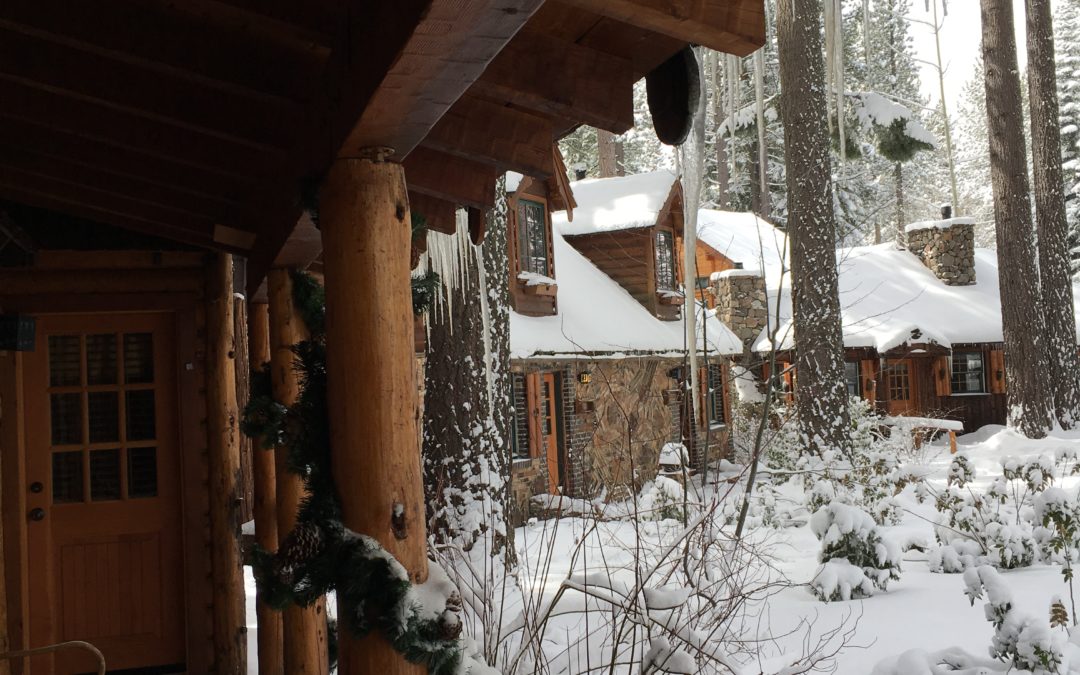
The snow showers began as we pulled into Tahoe City, where our log cabin at The Cottages Inn offered a cosy respite. Red plaid wool blankets warmed the bed, and hunter’s caps and jackets decorated the walls. Thunder cracked to tell us the weather was taking a turn for the worse. Hot cider and Scrabble kept us out of trouble until supper time, which was next door at a lakefront lodge with a giant stone fireplace decorated with a magnificent buffalo head. We had come a long way from San Francisco’s vegetarian sensibilities.
The locals told us that bears might break into our car overnight if we left anything for them to eat. Even a scented chapstick might draw them in, after the long winter’s privations.
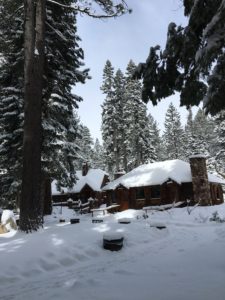
It started to snow in earnest.
The bears left us alone, but by morning, we had to sweep about 9 inches of perfect powder off Easy Rider. John looked longingly at the cross-country skiing possibilities. Instead, we headed south on 395 through Bridgeport—with a 1950s-style lunch at a hotel where Mark Twain once stayed.
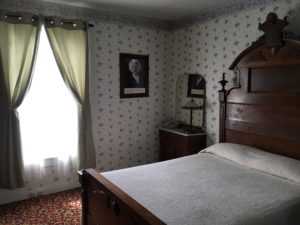
Mark Twain slept here
The snow disappeared, and there were no other tourists. We drove past lakes and mountains shrouded in a cold fog, stopping only at saline Mono Lake, where alas the ranger station was closed for plumbing repairs.
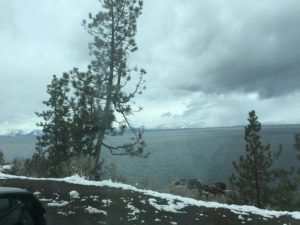
Lake Tahoe
The dwindling lake, which was requisitioned by Los Angeles for drinking water, was saved by a lawsuit, John discovered. Los Angeles had to pump some water back into Mono, and now its levels are rising.
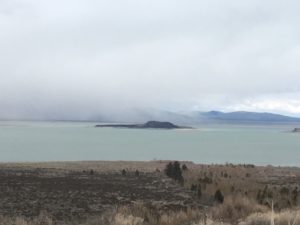
Mono Lake
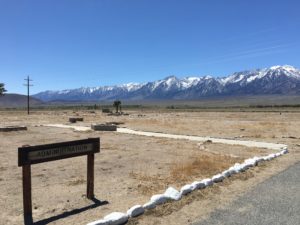
We passed Manzanar, and remembered how Norman Mineta and others in Congress worked to win reparations for the Japanese interned during WWII . The Manzanar ghost village reminded us of the layout of the Nazi concentration camps. Of course there were huge differences; here there was food and medical care; there were no gas chambers, no death marches, no final solution.
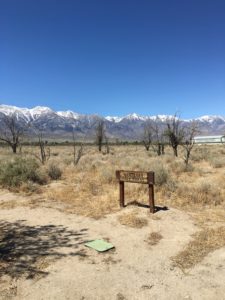
Manzanar
We arrived at nightfall in Bishop, a classic all-American town in the Paiute Shoshone territory. The locals said the best dinner in town was at The Back Alley bowling alley. After unusually good T-bone steaks and baked potatoes, we strolled over to the lanes. They were swarming with a local league of bowlers, many of them from the local Native American Paiute tribe. An older man teased his preteen grandson, who earlier in the day had his first sex education class. “Which did you like better, the birds, or the bees?” he asked the boy.
A friendly Paiute woman was putting away her bowling ball, and invited us to sniff its surprising pineapple scent. “My boyfriend has a red ball that smells like cinnamon,” she said. The Dude and his bowling companions would have been as amazed as we were that Storm bowling balls now feature such exotic options.
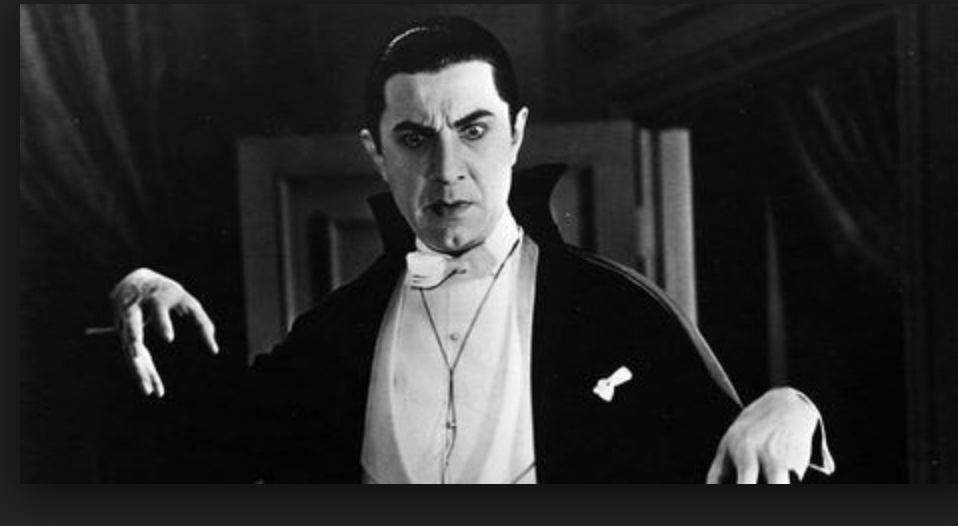
Living in the heart of darkness (Silicon Valley) for the past three months has taught me that we cannot pin our hopes for American democracy on the great media platforms: Facebook, Google, Twitter, YouTube, et. al. Their leaders seem to know only how to make money from us, and the tools they have invented are out of control. The companies are proving incapable of dealing with the information dystopia they have created. Digital innocents think they are accessing an agnostic information universe when they click onto these platforms. Instead, we are getting the content most likely to confirm our prejudices, based on all the private information we have shared through our online search, posting, shopping and “like” histories.
Mark Zuckerberg is the man in the hot seat, forced to defend the tech platforms’ vampire business model to Congress. People are just beginning to wake up to the problems generated by these data-sucking companies. Facebook now has 2 billion members around the world, whose private preferences are the “product” Facebook has given to any “advertiser” that comes along. Because they know so much about us, Facebook’s clients–malicious Russian robots and conspiracy theorists included–can figure out exactly how to win our trust. Analysts who know Facebook intimately, including Kara Swisher of RECODE and Farhad Manooj of the New York Times, confirm that Zuckerberg and his peers have no idea how to deal with, or even measure, the profound social and political impacts they have unleashed.
Google, which has the most data of all, has done a marginally better job of weaning its search engine off robotic conspiracy theories. But it has failed to care much about the fake news and hate speech its subsidiary, YouTube, turns up as preferred content.
Belatedly, as the techlash gains force, some folks in Silicon Valley are thinking about software solutions. Below is one look at whether the algorithms that got us into so much trouble can reverse course, and nurture our better natures. This depends entirely on the values and priorities of the people writing the code for it. Given the track record so far, this is not reassuring. We need laws that companies must follow. This requires government policies, demanded by media literate citizens using their real intelligence.
https://motherboard.vice.com/en_us/article/zmgza5/knowhere-ai-news-site-profile?utm_campaign=be41b4895a-EMAIL_CAMPAIGN_2018_04_06&utm_medium=email&utm_source=API+Need+to+Know+newsletter&utm_term=0_e3bf78af04-be41b4895a-45842181
I don’t think that ceding more power to algorithms is the best solution. It may be part of the response, but it can’t be the whole story. I like the idea floated by Markos Kounalakis: create a Mayor of Facebook. Create accountability through human, democratic systems, so that people can help other people when they are doxxed, their identities are stolen, and their safety is compromised by viral hate videos. Here is Markos’s brilliant idea:
http://www.markoskounalakis.com/blog/2018/4/6/facebook-and-its-global-village-need-a-mayor-to-represent-us

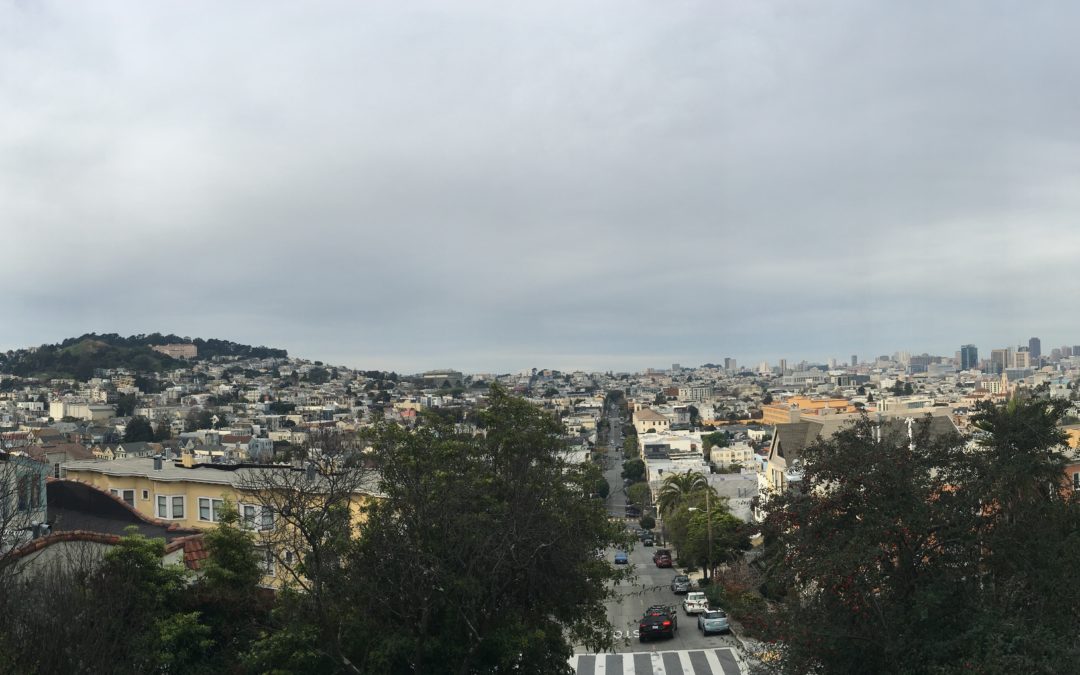
We’ve had an amazing three months in San Francisco and Berkeley, but now that the snows are melting back East, and the boys are swinging their bats, it’s time to head home. Easy Rider is tanned, rested and ready. We the drivers, not so much, thanks to a wonderful round of farewells that continue for several more days. We depart April 15 and will find our way through many national parks and heartland cities. On the horizon: Lake Tahoe, Death Valley, Zion, Bryce, Denver, St. Louis, Louisville, Gettysburg and other iconic spots. Stay tuned for reports and photos! Wish us smooth roads, generous truck drivers, and colorful encounters. As we say goodbye, here are a few snapshots to remember our adventure out West.
Jan. 15 Salinas to San Francisco
We surprised ourselves by skipping our beloved Monterey aquarium, and setting off instead to see something new: the John Steinbeck center in Salinas. Here on display was Rocinante–his Travels With Charley camper–and other mementos of the America he brought to life.
Steinbeck chose to represent the underdog, as a great journalist must do. He worked in the lettuce fields, instead of taking his place in Salinas’s middle class. His father was a California businessman, a middle manager at a flour company that went bust, and then, at Spreckels, the largest sugar company in the world. John Steinbeck was a contemporary of Hemingway, but he was more interested in social justice than proving his manhood. Steinbeck’s novels told the world about the invisible victims of the Great Depression, like the Dustbowl Okies, who fled from their forfeited farms to California, only to starve or be exploited there.
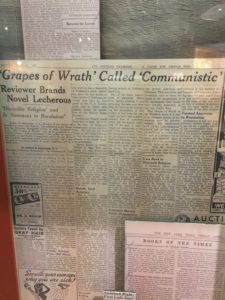
Banned and Burned
The city fathers in Salinas were not comfortable with the ugly truths he exposed, calling his work “Communist propaganda.” In Kern County, they banned his books and burned Grapes of Wrath in a town square! But Steinbeck prevailed, winning the Pulitzer Prize, the National Book Award, the Nobel Prize for Literature, and the Presidential Medal of Freedom in 1964. Today there is fancy building in the middle of town, called the National Steinbeck Center. It is one of Salinas’ main touristic claims to fame.
As we headed up to San Francisco at last, John decided that we should also name our car, in honor of our own journey across America. It would be Easy Rider, after the iconic 1969 hippie road trip movie featuring Peter Fonda. Peter’s father Henry Fonda starred in the 1940 film of Steinbeck’s Grapes of Wrath, which launched his film career.
When we finally arrived at Sanchez St., we were ready for this journey to end. Now we could settle in to the Wild West of San Francisco’s Castro neighborhood, with its rainbow flags, composting rules and counterculture history. Here, every fetish was a noble rebellion. The punky skunky smell was artisanal marijuana, sold legally at the nearby Apothecarium. When two young, white homeless men in a bedraggled tent set up on the sidewalk across from the laundromat, the police came to move them along. But instead of snarling and arresting them, the way they do in Budapest or New York, the officer asked, “Do you need services?”
Ah, we’ve come a long way, from Boston, and even Salinas. It’s time to cultivate our garden–and think about all that we’ve seen.
THE END.
Jan. 13-14: Pioneertown and Hearst’s Enchanted Castle
As we left the desert, we couldn’t resist a side trip to Pioneertown, a Wild West film set still popular with tourists. All sorts of Hollywood B movies were made here. Pappy and Harriet’s, the funky café at the edge of town, has hosted famous country and rock performers on stage for 35 years.
After patting a few goats, taking snapshots and fortifying ourselves with iced tea at Pappy and Harriet’s, our desert idyll was over. We headed north, skirting the LA basin past Barstow and Bakersfield, toward Paso Robles.
Unstable Ground
We could have veered west into the dense labyrinth of LA, enjoying some of its Hollywood splendor before heading up the coastal Highway 1. I lived here twice, when I was in my early 20s– first on a Carpinteria mesa where I was a housemother at a boys’ prep school, and then in Malibu, when I had my favorite job as a general assignment reporter for the Los Angeles Times. John and I had planned to stay in Santa Barbara on Jan. 12 to visit my old friend Roxie, who lives on her grandparents’ avocado ranch. But she had to flee in the middle of the night on Jan. 9, as flash floods and mudslides roared by her house. The river of mud killed 21 people in Santa Barbara County, injuring 120 more, and destroying 100 homes.
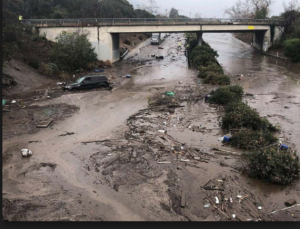
As we detoured north on Jan. 13, a victim was still missing in the mud, which was blocking all north-south traffic on Santa Barbara’s main highway 101.
http://https://www.cnn.com/2018/01/14/us/southern-california-mudslides/index.html
California is notoriously unstable, which is both its downfall and its genius. The abrupt tectonic movement of the earth, the wild fires and floods, also permeate its culture. In California, the expectation of the new allows people to migrate here and start again, defining themselves as they wish, without the historic constraints of ancestry or neighbors who know who you really are. Change is normal. It’s a place where you have to be young, no matter how old you are.
We drove inland, up the spine of the state, past solar and wind farms, and irrigated fields of citrus and grapes. This was, and always will be, Steinbeck country. A few figures huddled in the fields, picking winter crops. Darkness had already fallen when we finally turned toward the coast at Cambria. We could hear and smell the ocean, but we would have to wait until sunrise, to actually see it.
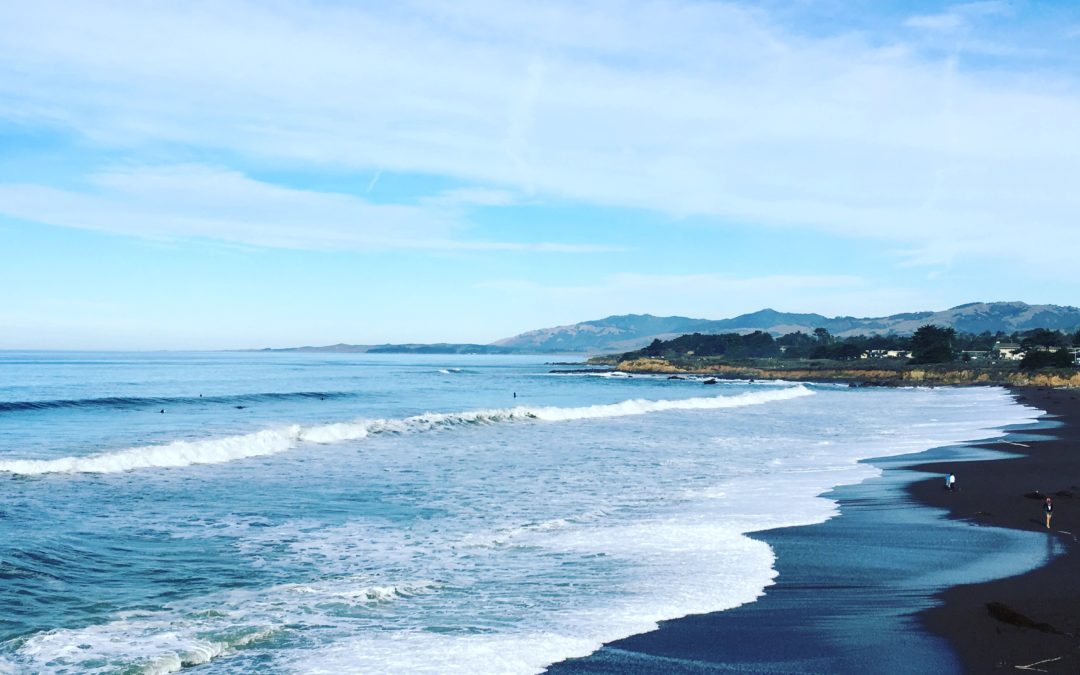
The next morning we headed down to the musky-smelling sea, walking on wet sand littered with driftwood and long ropes of kelp. We were surprised to see so many old surfers, still mounting the waves in their winter wetsuits.
Hearst’s Hilltop Folly
At Hearst Castle, we boarded a bus for the 5-mile, cliff-clinging ride up Hearst’s mountain. From here, William Randoph Hearst ran one of America’s greatest 20th century media empires, which he used without apology, to his own personal advantage. He took his father’s mining fortune, bought newspapers, and from 1919 to 1947, built this extraordinary set of buildings and gardens in the middle of nowhere. It ultimately encompassed 250,000 acres of prime coastal and grazing land. Aside from a term in Congress, Hearst never had the political career he lusted after. His extraordinary lifestyle on this mountaintop, complete with wild animals and frolicking Hollywood stars, was unsustainable. Now, as a California state park, his castle remains an unparalleled masterpiece, attracting 750,000 paying visitors each year.
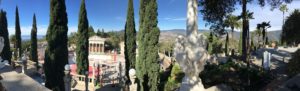
Even in today’s era of obscene billionaire mega-mansions, Hearst’s project is the most ambitious private residence ever built in America. Donald Trump couldn’t begin to compete with its excess. The White House is a shack in comparison; Elvis’s Graceland is a broom closet. According to Wikipedia, Hearst’s great mountain top estate “featured 56 bedrooms, 61 bathrooms, 19 sitting rooms, 127 acres of gardens, indoor and outdoor swimming pools, tennis courts, a movie theater, an airfield, and the world’s largest private zoo.” Although he had to sell off his exotic animals after the 1929 stock market crash, a few zebras still mingle today with the cattle herd grazing on the grounds.
Today Hearst Castle is like an aging but still glamorous movie star, dependent on expensive reconstructions, illusions, and memories. For all its hubris, this place is magical. The credit goes to architect Julia Morgan, but apparently Hearst also had a hand in its design. He kept buying bigger tapestries and art works, forcing the exasperated Morgan to redo her carefully proportioned stone walls and ceilings. The estate combines genuine 3,000 year old treasures, including Egyptian, Roman, Greek and Renaissance artworks, mixed with homey touches, like the bottles of ketchup Hearst insisted on serving at his baronial table. Hollywood royalty were his ultimate decorative flourish; they flew in for house parties throughout the 1930s and 40s.
NEXT: AND SO IT ENDS