When we had picked this town out on the map, it was mostly because I knew we didn’t want to be in Palm Springs or its neighboring fancy resort towns. This would be an entirely different kind of place, a counterculture oasis. It was where Gram Parsons’ friends tried to fulfill his cremation request when he died of a drug overdose in 1973. A decade later, Joshua Tree National Monument (now Park) inspired the title of U2’s best and most famous album. Bono said, as he was creating the music, “I started to see two Americas, the mythic America and the real America.” [From Wikipedia: King, Philip, and Nuala O’Connor (directors) (1999). Classic Albums: U2 – The Joshua Tree (Television documentary). Isis Productions.]
We also saw more than one America, as we were driving across the continent to get here. There were rich Americans living in porticoed estates, next to poor Americans, in unpainted wooden shacks. There were Black American slave descendants, still waiting table for the white heirs to antebellum privilege, in unsustainable plantation houses that rented out rooms for the night. The original Native Americans were both everywhere and nowhere, thanks to relentless efforts by European, Hispanic and other interlopers to take over their territory. We met white Christians and black Christians, intimately close on the radio airwaves, but far apart in the physical world. There were East Asian immigrants working at gas stations, and fourth-generation Appalachian truckers who paid them for a cup of coffee. Underneath it all was the hot magma of politics, ready to spew forth at the slightest provocation: volcanic Trump fans and anti-Trump fanatics, who couldn’t stand to think about each other’s worthy existence. They were all Americans, engaging somehow in the same national destiny, without the common bonds of blood, history, or plans for tomorrow.
John booked us a romantic retreat at Campbell House in Twentynine Palms, which, appropriately, was deserted. We loved the story of the stone house’s construction in the mid- 1920s, by disreputable newlyweds. Elizabeth Crozer, a Philadelphia debutante, was disinherited when she ran off to marry Bill Campbell, an orphan who’d been injured by mustard gas in WW1. They were advised by Dr. James Luckie of Pasadena that the desert might heal his damaged lungs. The advice was brilliant. Bill survived another 20 years, long enough to live through the next world war, from their desert redoubt.
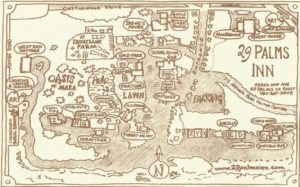
The healing qualities of the desert air were especially good news for us, since John and I were still coughing like crazy from the colds we picked up in the South. We got a little lost on our first night, driving under faint stars in the desert’s famously dark sky, to the Twentynine Palms Inn for dinner. It was great to finally be in Southern California, at the edge of the legendary Joshua Tree National Park! We felt better already. Was it the desert air, the live bluegrass music, or the margaritas? We waited for two seats at the bar, crowding in among the locals. This place had a special vibe, a kind of desert version of Rick’s legendary Casablanca café.
When the young Campbells camped out in the winter of 1924-5, in an isolated tent near the Mara Oasis, having a named Twentynine Palms was still a mirage, There were just seven or eight other shacks. The Campbells mingled with the Native American nomads who watered seasonally at the oasis, and became avid archeologists, documenting the earliest human life in the area. http://campbellhouse29palms.com/history.php
Elizabeth’s father relented and she received her inheritance, so they built their 1929 estate on 25 acres of high desert. After Elizabeth died in 1971, the children sold the property to the composer who wrote “Zip-a-de-Doo-Dah.” He turned it into a Hollywood party house. An English aristocrat then bought the place, installing her china teapot collection and renaming it Roughly Manor. Today it is the quirky Campbell House B&B, honoring the young couple who started their runaway marriage here.
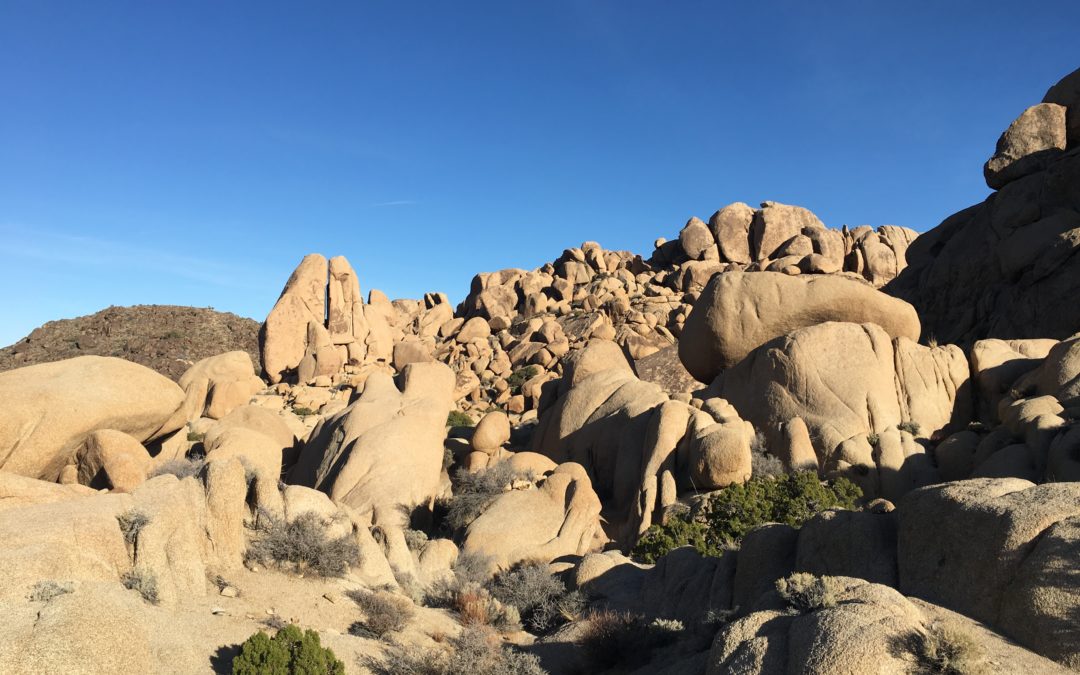
We stopped at the Joshua Tree National Park headquarters the next day, full of rookie questions. What are Joshua trees, anyway? They looked like frenzied cactuses, arms all akimbo. They are actually short-spiked agave plants, the ranger explained. The smaller chocotillo cactuses, other denizens of this desert, grew huddled together like a tribe of chattering monkeys. And then there were the enormous sand-colored rocks, balancing against each other in random formations. What mighty force could have pushed them into such improbable dependancies?
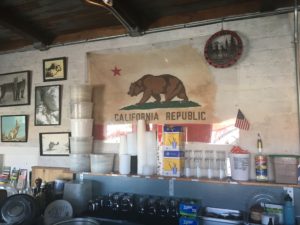
We drove half and hour to lunch in the nearby hippie town of Joshua Tree, but took a wrong turn. We found ourselves dead-ending into a very large, official sign that said “Live Combat Zone. 100% I.D. required.” U.S. Marines came out of a formidable guard post to confront us. We turned the car around very, very quickly. It was a relief to find the right road, and stumble into the Crossroads Café. Its dreadlocked and tattooed waiters were escapees from places like East Harlem and Boston, and they occupied a completely different world from the Marine base close by.
The Crossroads Cafe
We learned that like everywhere else, the Native Americans had a terrible time in this area, as the newer Americans took over in the 20th century. There was the tragic death of a gifted Indian runner named Willie Boy, who fell in love with a non-Indian girl and committed suicide in 1909, after being framed for her murder. Folks are sorry about it now. What was done, is done, but that doesn’t mean it’s over with.
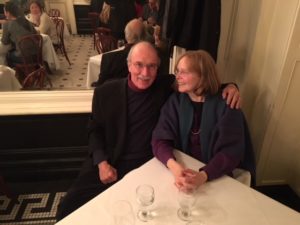
On our second night, as we took up our favorite perch at the Twentynine Palms Inn bar, we struck up a conversation with the folks sitting next to us. Some were from the local community college, and some from the Marine base. They were all friends. After hearing them talk about military things, I asked “What do you think about North Korea?” Their reaction was swift and unanimous: if Trump hit the nuclear button, General Mattis, the Secretary of Defense, would save us. He was sane, even if the Presidents of the United States and North Korea were not. One speaker said he grew up on various military bases, with a father who served in Vietnam. “I’m grateful for being exposed to the wider world,” he said, “so I know what Trump is.” How can we talk to Trump voters now? I asked innocently, holding my breath. “You don’t,” he said firmly. “You talk to them with your votes.”
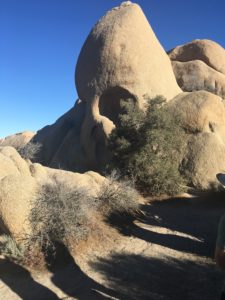
Skull Rock
The next day was our last at Joshua Tree, so we took an especially long hike, on a path through the giant desert rocks. We watched for rattlesnakes that never appeared, stopping at Skull Rock, the Keys View lookout, and Barker Dam. I imagined the Campbells, carefully labeling Indian artifacts there, and the cattle rustlers and gold prospectors who died seeking their fortunes. To John, some rocks looked like sleeping elephant seals, and I saw others that were petrified whales or ghosts.
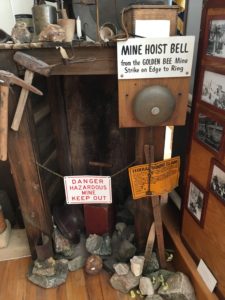
In the afternoon we stopped by the former one-room Twentynine Palms schoolhouse, now a museum. Normal glassware, left in the sun, would turn purple in the old days. The tiny museum was crowded with gray-haired visitors, one carrying an oxygen tank, another leaning on her walker. They were listening intently to an aged volunteer, who was glorifying the pioneers.They were oohing and ahing at a gold mine shaft.
The past: mining gold
Old people are building the past, I realized, looking around me. Young people are building the future.
We were going to be back on the road the next morning, driving north through Barstow, toward our San Francisco goal. In two days, we would be living in yet another America, the unstable epicenter of its high tech industries, where twentysomethings are mining artificial intelligence and virtual realities to invent another brave new world.
On our last night in Twentynine Palms, we watched a wobbly old videotape of John Huston’s “Grapes of Wrath,” which even in its original black and white, is a magnificent movie. It prepared us for the final push of our journey, through Monterey to Salinas, where John Steinbeck worked the lettuce fields and learned everything he needed to know, in order to write one of America’s greatest, and most devastating sagas.
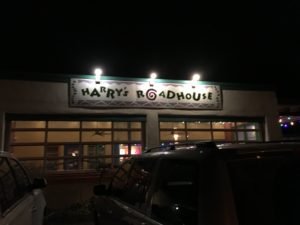
Many of our friends seem to be in various stages of moving to Santa Fe, NM. The brother of one of our close Boston friends is running for Mayor here. Others, who have established themselves already in Santa Fe, participate in the Grumpy Grandpas lunch group and the Raging Grannies singing society. Our friends took us to Harry’s Roadhouse, where the owner perked up when he learned we were from Boston. He told us his Boston story: When he was hitchhiking once he got a ride with a Boston driver. As they were going down the highway, an ambulance suddenly screamed by, and the Boston driver abruptly switched lanes to follow the vehicle, careening dangerously closely behind him, at full speed. A policeman tried to pull him over for tailgating the ambulance. But the Boston driver kept driving, yelling back at the cop: “It’s my brother in there!”
That sounded more like Tennessee or Texas drivers, to us, but never mind. New Mexico has always been full of dreamers and artists, those who make history and those who make it up because it’s a good story. They enjoy myriad transcendental and intellectual approaches to the unknown, including sunset rituals, healing massages, Yoga, crystals, secret alien encounters and nuclear experiments, paranormal phenomena, and the devil’s own hot sauce. Other states have politicians who do corrupt and bad things, our friend observed, but New Mexico suffers from a different problem: politicians who do nothing.
Snowy portholes for the solstice dagger of light
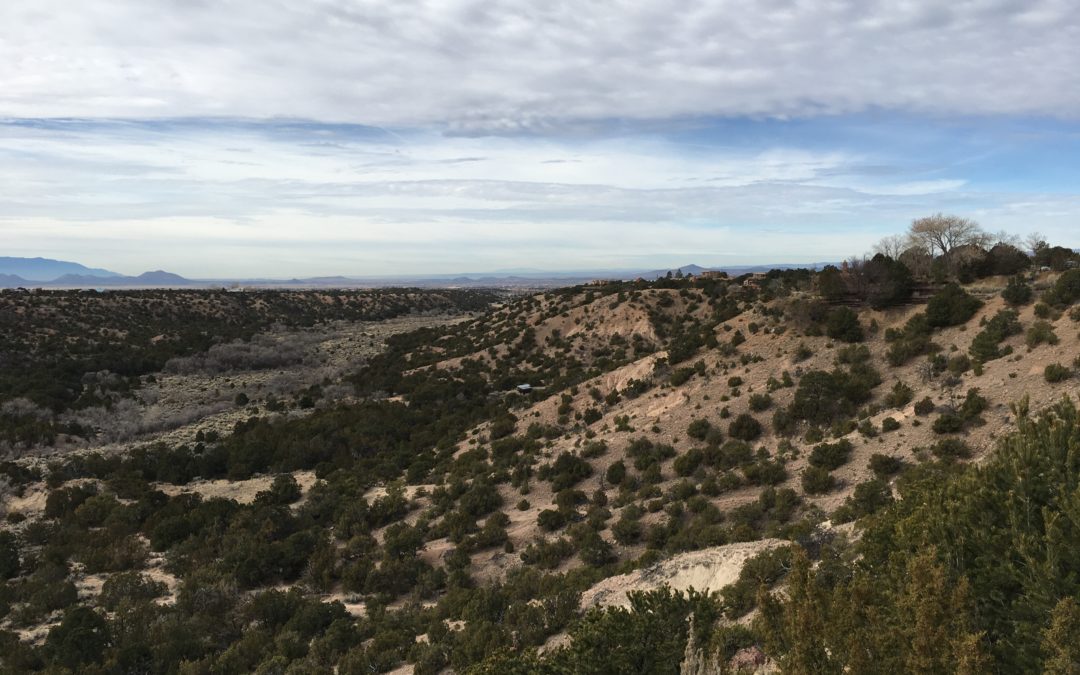
I have always loved New Mexico. This time we visited not only our hosts’ graceful hacienda, but also the work-in-progress artist’s house being taken over by other friends, who are in the process of abandoning New York City to move here. Their adopted home needs a lot of repairs. But it has a magic secret. Through a series of strategic portholes in the thick adobe walls, the sun, at the time of solstice, shines through as a solid shaft of light, piercing the entire house.
Alas, my timing was wrong for this miraculous display. Our visit was hampered by my head and chest cold, which was getting worse by the hour. I felt as if I were spreading plague. John, who had gotten sick first in Mississippi, was feeling better now in New Mexico. So he carried on sociably while I fled to our bedroom to sneeze. There would be no visits to Ten Thousand Waves this time, for massages and lunch. Instead we bought several boxes of Kleenex and hit the road on Jan. 9 for Gallup and Flagstaff.
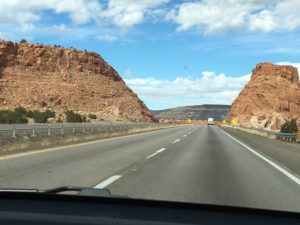
The Texas panhandle had been a series of small rancheros. In New Mexico, we found a few scattered cows and sheep grazing in deep canyons and along flat-topped mesas, sun-washed in ochre and yellow. We were amused by a billboard on I-40 outside Albuquerque, consisting only of the famous bushy black eyebrows, eyeglasses, and mustache of Groucho Marx. “Laugh More,” it said. We did.
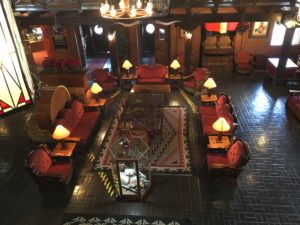
Driving parallel to Route 66, we wondered what it actually looked like. At lunchtime we finally turned onto the historic road, where we found the El Rancho Hotel, a once-famous wild west film location. Guest rooms were named for all the top movie stars who stayed here. Forty years later, it seemed pretty quiet, with just a few locals in the café.
El Rancho Grande
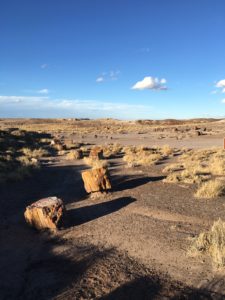
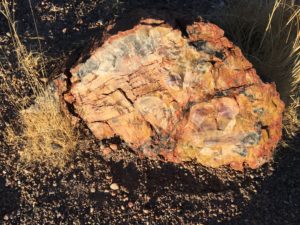
Heading toward Flagstaff, AZ, we took a side trip to the Petrified Forest, near Holbrooke. Trees that grew over 200 million years ago washed down here into a massive volcanic sea, and petrified into gorgeous giant stones.
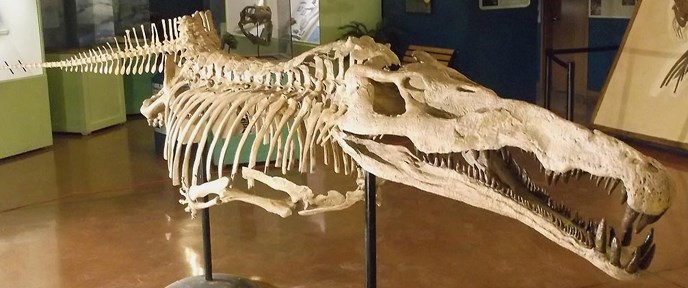
Randy the park ranger told us that the fierce crocodile skeleton displayed at the Visitor Center was a Smilosuchus, dating from the dawn of the dinosaurs, in the Triassic period. https://www.nps.gov/pefo/learn/management/images/smilosuchus-cast.jpg?maxwidth=1200&autorotate=false He said some relatives of this dinosaur grew to be 80 feet long! With this frame of reference, Homo Sapiens seem ridiculously small and arriviste.
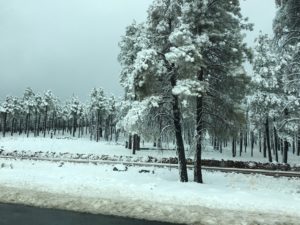
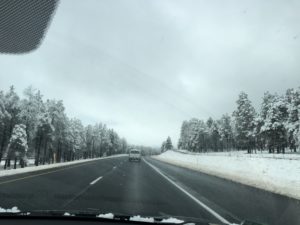
With a new sense of our own insignificance, we retired to our Courtyard hotel in Flagstaff, AZ. The next morning, the car was covered with snow!
We had to watch for icy patches on the highway as we headed toward Kingman, where the cozy Siren’s Café had already run out of lunch specials by 12:30 p.m. A postman breezed in, singing to the crowd, “Here’s your mailman!” He hand-delivered packages to each staffer behind the counter, and then turned to the entire room, saying “Thank you for employing me!” Everyone laughed and applauded. Even though it was snowy outside, he was wearing shorts!
Fortified by warm food and good humor, we crossed through a long, lonely stretch of the Mohave Desert into California. All we could see was a mirage on the horizon, as the gas gauge warned us of pending doom. In the nick of time a real oasis appeared out of nowhere, on Route 66 in Fenner. The gas station was owned by a Seventh Day Adventist who strategically placed religious pamphlets on giant display racks that had to be navigated by anyone trying to visit the restroom.
Our own salvation lay many miles ahead, in the Joshua Tree National Park. We didn’t know it yet, but miraculous margaritas and live music were waiting for us, at the Twentynine Palms Inn.
All the sinners from the Bible Belt must have migrated to Texas. As we arrived at our Gainesville B&B at dinner time, John discovered that this town was the site of the largest mass hanging in US history. Forty-two citizens were hanged or shot after a kangaroo court in 1862, for being sympathizers to the Union side. Today Gainesville is adjacent to the largest gambling casino in the US, which is just over the Oklahoma border.
Our earnest young hosts at the empty Denton Historical House confessed that they were new to the B&B business, having just bought and restored the place a year ago, hoping to capture the gamblers. They steered us to dinner down the street at a former whorehouse, where our waitress wondered why we weren’t staying there. Its history was more delicious than its food.
The next day we had another big drive, aiming for Tucumcari, NM, a town I picked off the map because I loved Lowell George’s lyrics to the Linda Ronstadt song “Willin’.”***
Because our B&B hosts didn’t offer the fancy hot breakfast we expected, we stopped early for lunch off Rte 287 in Childress, and stumbled into the Top Notch Texas BBQ. Here we enjoyed fabulous slabs of BBQ meats, pecan pie and peach cobbler! I casually asked the young waitress, “What happens in Childress?” She shrugged, “Nothing.” But then she added: “The state prison is nearby. It’s the big business here.” She gestured at the booth behind us, where two prison deputies, with guns in their holsters, were eating lunch.
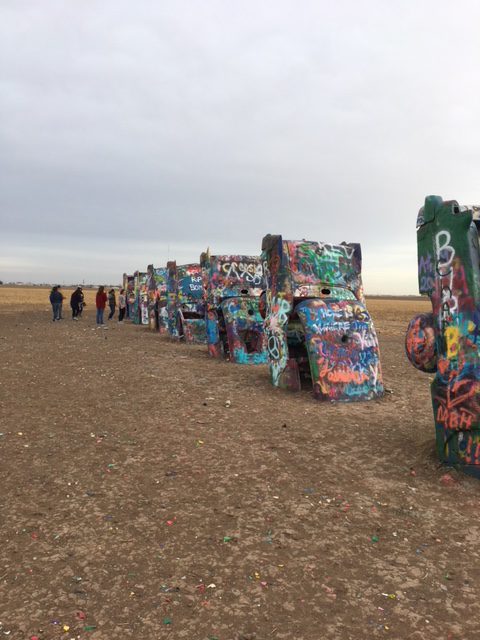
We escaped without further incident to Amarillo, where we discovered Cadillac Ranch on a side road. This was once just a muddy field, but some hippie artist in the mid-1970s decided to plant a bunch of real full-sized Cadillacs, face down, into the ground. For forty years, folks have been decorating them will all kinds of colorful graffiti. The gift shop nearby was overshadowed by a huge cowboy statue honoring the Second Amendment. An RV park out back apparently offered permanent housing to folks down on their luck. Amarillo once flourished as the helium capitol of the world. We found it a friendly-enough place, but we couldn’t linger, because we wanted to get to Tucumcari by dinnertime.
Well after dark, we pulled into our Tucumcari truck stop, the Garden Court hotel. We walked across the parking lot to discover the joys of KB Steak House, where the menu offered—yes—“Chicken-Fried Chicken” as well as all the permutations of beef that are native to this region.
John was valiantly working through a head cold that first found him in Natchez, and I was chugging Airborne and zinc tablets to avoid catching it too. Alas, as we set out the next morning to join our waiting friends in Santa Fe, the virus exploded in my head and chest. What a bedraggled set of travelers we were, as we presented ourselves, sneezing and coughing, at the front door of our friends’ Spanish hacienda!
**** And I’ve been from Tucson to Tucumcari Tehachapi to Tonopah Driven every kind of rig that’s ever been made Driven the backroads so I wouldn’t get weighed And if you give me weed, whites and wine And you show me a sign And I’ll be willin’ to be movin’
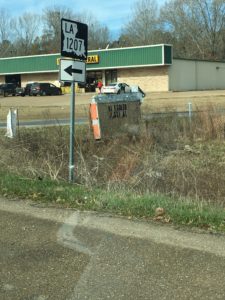
Driving through Mississippi and northern Louisiana, we were struck by the economic hardship and lack of public services in Scotlandville, Sugartown and other small rural communities. They seemed to have only God to get them through. Every half mile, next to collapsing wooden shacks and trailer homes, there was another Baptist church with a tiny cemetery. “Seventh Day Sabbath OBEY GOD’S LAW” warned a billboard. Boo Paul’s Assembly Building stood tall as an impressive outpost of the Calvary Missionary Ministry in the middle of Louisiana’s rural oil and gas fields.
“Bluegrass Festival”
On the radio, everyone was talking about Jesus. White church elders debated different ways to avoid sin if you had unnatural (homosexual) feelings. “He rose spiritually and gendered!” insisted one man. On a black Gospel radio show in Jena, Louisiana, the preacher said “I’m going to keep trusting God despite contradictory circumstances.” He invited everyone to meet down at the church this Saturday, to participate in a NAACP voter registration drive. “The only way you can make changes is at the ballot box,” he said.
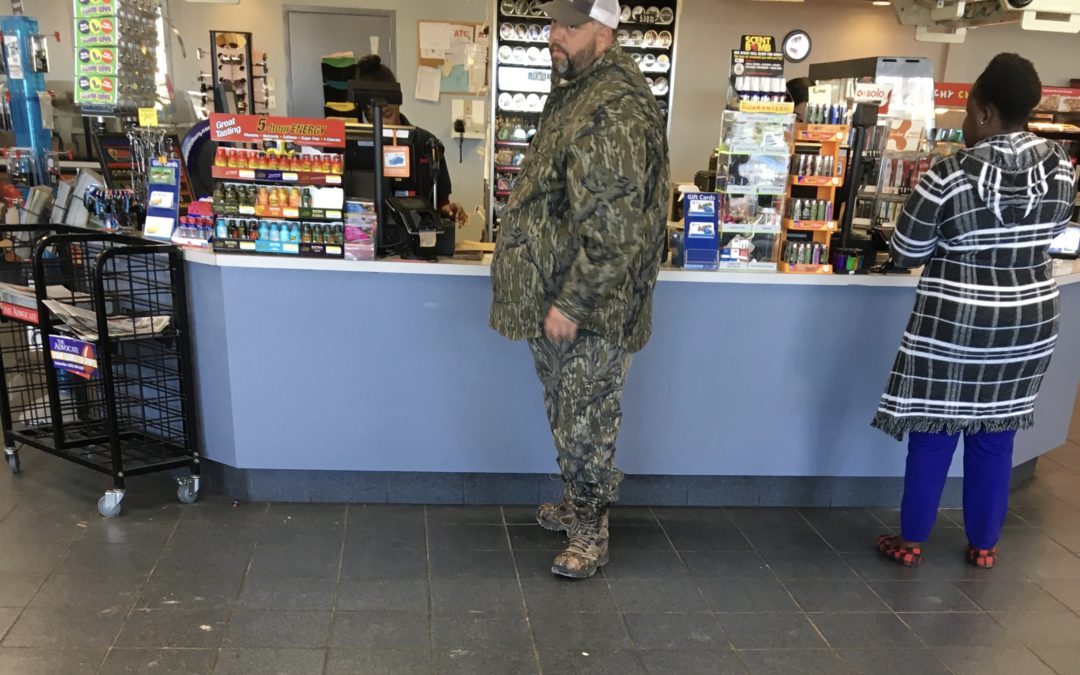
It was hunting season, and we met burly men in full camouflage gear, driving their muddy all-terrain vehicles and trucks into roadside gas stations with next-door cafes. “Deer and duck processing” shacks offer their services with hand-lettered signs. The Butt Hot BBQ looked like a popular spot, featuring a giant homemade billboard of a pig with flames coming out of his rear end. We passed the Concordia Pawn and Gun shop and the Sunflower Baptist Church. Acres of of cotton fields were barren for winter, but there were posted notices offering “We Buy Pecans,” and “Crawfish” with a phone number to call. Catahoula, LA showed a certain pride, or was it stubbornness? with two barbershops along its short main street.
Sleek megachurches lined the road as we crossed over into Texas at 1:40 p.m. We found lunch at Jim’s BBQ and Catfish place, with fabulous pulled pork sandwiches, peach cobbler, triple-sized ice teas, and hunting trophies on the walls. The temperature was finally thawing out, climbing to 57 and then 62 degrees!
As we continued north toward our B&B in Gainesville, the car wreck billboards were getting more insistent. “When Everyone Forgets How to Drive, We Won’t Let You Down,” promised State Farm Insurance. ““In a Jam? Call Sam,” said another huge sign. Our favorite simply stated in gigantic letters, “Blessed are Those who Mourn,” with a Bible verse citation and an attorney’s phone number.
We finally understood what all this was about, at around 5:30 p.m., driving through the gigantic ring road outside Dallas. I was minding my own business, driving in the far right lane of a congested eight-lane divided highway, where everyone else was zipping around, changing lanes with a gotta-get-home-NOW–for-dinner intensity. Our northbound side of the highway was moving pretty fast, but the southbound lanes were crawling at a near standstill. All of a sudden, in the breakdown lane to our immediate right, a big black car came whizzing right toward us, at a high rate of speed. He was using our northbound breakdown lane as his route south! We stayed on course and managed to avoid a head-on collision, but it was a bit of a nerve-tingler that we weren’t going to forget anytime soon. It was actually the second time on this trip that we were nearly erased by another driver. In Tennessee on Dec. 30, huge trucks were racing to Nashville meet their end-of-the year deadline. We were passing a huge semi-trailer at about 75 miles an hour, when he decided to move into our lane. I was able to keep driving on the shoulder, hitting the brakes hard to pull behind him.
Driving calmly in the Wild West
This cross-country trip was not for the faint of heart. The long haul driving days like this one from Natchez to Gainesville required a 100% cold-blooded focus on what was directly in front of us, without regard to the past, the future, or the charms along the countryside.
To sweeten our long days in the car, we listened to an audiobook of John Steinbeck’s Travels with Charley. Steinbeck found a way, on his 1960 journey across the country, to ask people about what was going on in America. The issues they worried about then seemed easy and old-fashioned, compared to the political Armageddon we are facing 58 years later. Steinbeck’s technique was to invite people into his camper, offering a drink of coffee laced with whiskey. Charley, the poodle, provided a natural entry point for conversation.
But I didn’t have a dog, a camper, or whiskey to offer, and engaging people informally was proving to be more difficult in these hostile times. My profession of journalism, with all of its 2018 offshoots and permutations, has lost its most important function, which is providing the country with a common set of facts. “Where do you get your news?” would have been a good starting point to learn about political views, but it seemed like a hostile question, thanks to President Trump’s attack on the media as “the enemies of the people.”
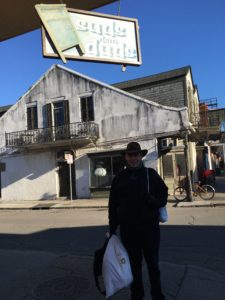
John with our laundry at Suds dem Duds
So I was looking forward, for multiple reasons, to the laundromat in New Orleans. I figured we were all stuck there, and I could start a conversation with my fellow captives. After beignets at Café Du Monde, we found ourselves at the Suds Dem Duds! down the street from our Bourbon Orleans Hotel. Dinah, the proprieter, said she used to sell Volkswagens, and having this laundromat business was a dream come true. I asked her how she felt about 2018, and she was optimistic. Before I could pop my questions about the news and Trump, she turned to help an Australian family, who were emptying their suitcase contents in a jumbo washer. What was it with these Australians? They were everywhere.
From my perch near the door, I snuck glances at a middle-aged nondescript man, a regular named Tom, who was sitting impassively in a folding chair. A quick guess: a veteran with PTSD? Certainly a loner. He never smiled or joined the chitchat of the other customers. Dinah told me, after he left, that he works as a bartender! Maybe he needed some peace and quiet before putting on his smile for work.
I realized I was violating Dinah’s and Tom’s world by lurking around, trying to pry out their political wisdom. The folks I was meeting seemed generally okay, and they deserved to be left in peace to go about their daily business. Nobody wants a Joe Bftsplk https://en.wikipedia.org/wiki/Joe_Btfsplk hanging around, reminding them that their President is a maniac, bringing us to the brink of nuclear war, race war and gender war, as well as the End Times, climate-wise.
So I decided to suspend my search for truth and justice in the random views of Americans. I would just listen
and enjoy the life around me, and New Orleans was the perfect place to start. We visited the Mardi Gras costume exhibit at the Presbytere, and the Battle of New Orleans Civil War display next to the St. Louis Cathedral.
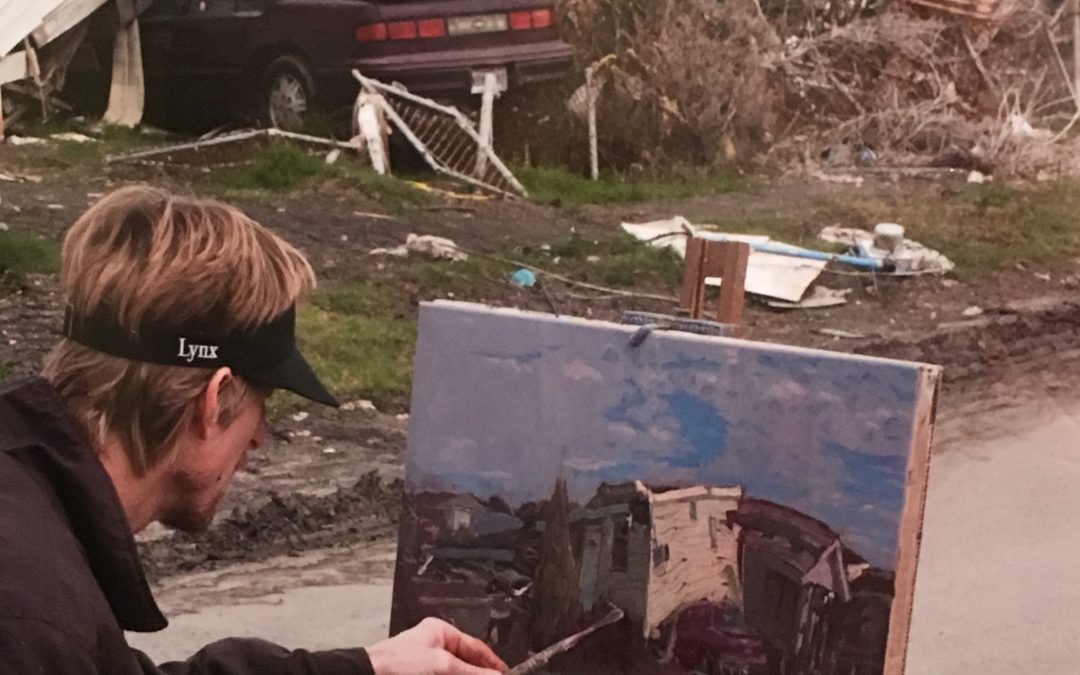
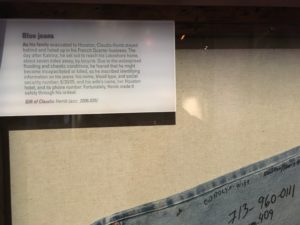
A Katrina photo exhibit offered shocking evidence of both the destruction and heroism of neighbors helping neighbors.
Blue jeans worn by a Katrina survivor, with his Social Security number and other identifying info in case he was found dead
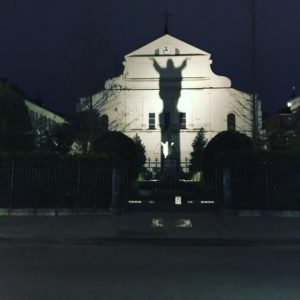
The statue in front of the St. Louis Cathedral, which casts quite a shadow at night, is known locally as “the touchdown Jesus.” Next door, our Hotel Bourbon concierge regaled us with his building’s colorful history: once a convent and then a theater, this was the place where Andrew Jackson declared his run for the presidency. It was also the site of a celebrated Creole duel, leaving bloodstains that are still visible under the carpet on the stairs, according to the concierge, who gives official Haunted Hotels tours. He said that the Charbonnet twins, Stephan and Louis, having had a bit too much to drink, decided to turn to the gentleman’s way of gaining “satisfaction” as they both attempted to court the same beautiful debutante. They engaged in a sword fight, ending up in a tangle as they fell down the stairs, stabbing each other to death. I couldn’t help thinking about their mother, receiving the news.
Tennessee Williams’ table at Gallatoire’s
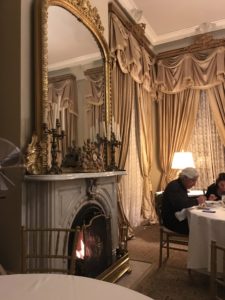
To add to all that drama, we booked Tennessee Williams’ table in the corner at Gallatoire’s. After a festive dinner, with multiple guests celebrating birthdays, we grabbed a taxi out to Mulate’s to hear live Cajun music.
There is a noir underside to the frivolity of The Big Easy. We found the streets a bit sinister and deserted at 9:30 as we left Mulate’s, so we walked very quickly to the nearest lit-up hotel. The concierge told us to wait inside while he called a taxi, confirming that crime is a factor here.
The next day we had breakfast with a friend who works with the families of incarcerated youth. We were inspired again by her work, supporting young people as they leave prison. Some people just try to hold on to what they have. Others, like our friend, go to where the trouble is and try to make things better. How can we do this in a divided world? I was beginning to understand. Start local, with what is in front of you. Find some sort of common ground. Allow people their dignity and a chance to excel.
Driving northwest from cheerful New Orleans, the South was not only frozen, but marked by the legacy of exploitation. On the road to Natchez, MS we stopped by two remarkable places: one was Rosedown, a cotton plantation built in 1835 by the Turnbull family, who had 450 slaves working a total of four estates. The slaves worked 18 hours a day, six days a week. The former Turnbull slaves became sharecroppers for them after the Civil War, and the last descendent of the Turnbull family lived there until 1955. It is a state historic site now, popular with visitors for its gardens in the spring. The whole place, shrouded in Spanish Moss, seemed a little creepy.
No matter where we drove on this journey, there was evidence of Native American life before the Europeans took over. The continent certainly wasn’t “empty” territory waiting to be colonized. In Natchez, the hereditary chief was called the Great Sun, and apparently when he died in 1728 his wives and retainers “were strangled with due ceremony to accompany him into the next life.” His house was burned and the burial mound was raised to a new height, upon which the house of his successor was erected. This was the official description from the Mississippi Department of Archives. Despite this, ethnographer Antoine-Simon Le Page du Pratz, who lived for eight years in France’s Natchez colony with the Indians until relations soured in 1728, found them to be “more civilized, their manner of thinking more just and full of sentiment, their customs more reasonable, and their ceremonies more natural and serious—distinguishing this nation from all others. It was easy to recognize them as more refined and polite.”
It was still bitter cold as we drove north. When we were halfway to Natchez, my cell phone rang. It was our B&B hostess calling to tell us her pipes had frozen, there was no water and we couldn’t stay with her. She generously had booked us a room at a more ostentatious antebellum mansion called Dunleith Castle. The estate was built in the late 18th century by a couple whose daughter was widowed at the age of 15. Her second husband lived longer than she did, and rebuilt the house after it was struck by lightning and burned to the ground. This did not seem like a lucky place to spend the night.
The dining room at Dunleith Castle, Natchez
We were looking for a little warmth and rest, as we retreated to our small room behind the Dunleith kitchen. A big challenge loomed the next day: we needed to drive halfway across Texas, if we were going to meet our friends in Santa Fe by Jan 7. We dreaded this leg of the trip. A fully armed population of Good Old Boys in pickup trucks, speeding around in their Trump Virtual Reality world, did not bode well for a Massachusetts car. I expected trouble, but not in my wildest nightmares, did I anticipate what came next.

 When we had picked this town out on the map, it was mostly because I knew we didn’t want to be in Palm Springs or its neighboring fancy resort towns. This would be an entirely different kind of place, a counterculture oasis. It was where Gram Parsons’ friends tried to fulfill his cremation request when he died of a drug overdose in 1973. A decade later, Joshua Tree National Monument (now Park) inspired the title of U2’s best and most famous album. Bono said, as he was creating the music, “I started to see two Americas, the mythic America and the real America.” [From Wikipedia: King, Philip, and Nuala O’Connor (directors) (1999). Classic Albums: U2 – The Joshua Tree (Television documentary). Isis Productions.]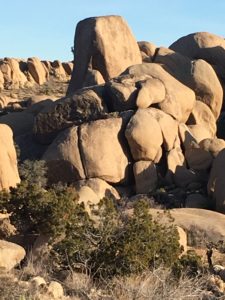
 That sounded more like Tennessee or Texas drivers, to us, but never mind. New Mexico has always been full of dreamers and artists, those who make history and those who make it up because it’s a good story. They enjoy myriad transcendental and intellectual approaches to the unknown, including sunset rituals, healing massages, Yoga, crystals, secret alien encounters and nuclear experiments, paranormal phenomena, and the devil’s own hot sauce. Other states have politicians who do corrupt and bad things, our friend observed, but New Mexico suffers from a different problem: politicians who do nothing.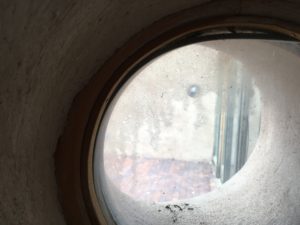
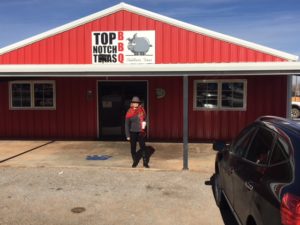 Because our B&B hosts didn’t offer the fancy hot breakfast we expected, we stopped early for lunch off Rte 287 in Childress, and stumbled into the Top Notch Texas BBQ. Here we enjoyed fabulous slabs of BBQ meats, pecan pie and peach cobbler! I casually asked the young waitress, “What happens in Childress?” She shrugged, “Nothing.” But then she added: “The state prison is nearby. It’s the big business here.” She gestured at the booth behind us, where two prison deputies, with guns in their holsters, were eating lunch.