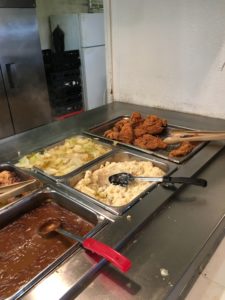
On our New Year’s Day drive from Memphis to Vicksburg, we looked in vain for a lunch spot. Everything was shuttered for the holiday. Finally at 3 p.m. we found a faded sign for “Simply Southern Café and Grill” in Grenada, MS. It was a modest African-American establishment, well worn but well-scrubbed. It offered an “all you care to eat, all-day buffet” for about $10. We had the place to ourselves, except for a young father and his two little kids. We had stumbled on a mecca of southern cooking: perfect fried chicken, collard greens, black eyed peas, peach cobbler and sweet tea.
Simply Southern buffet
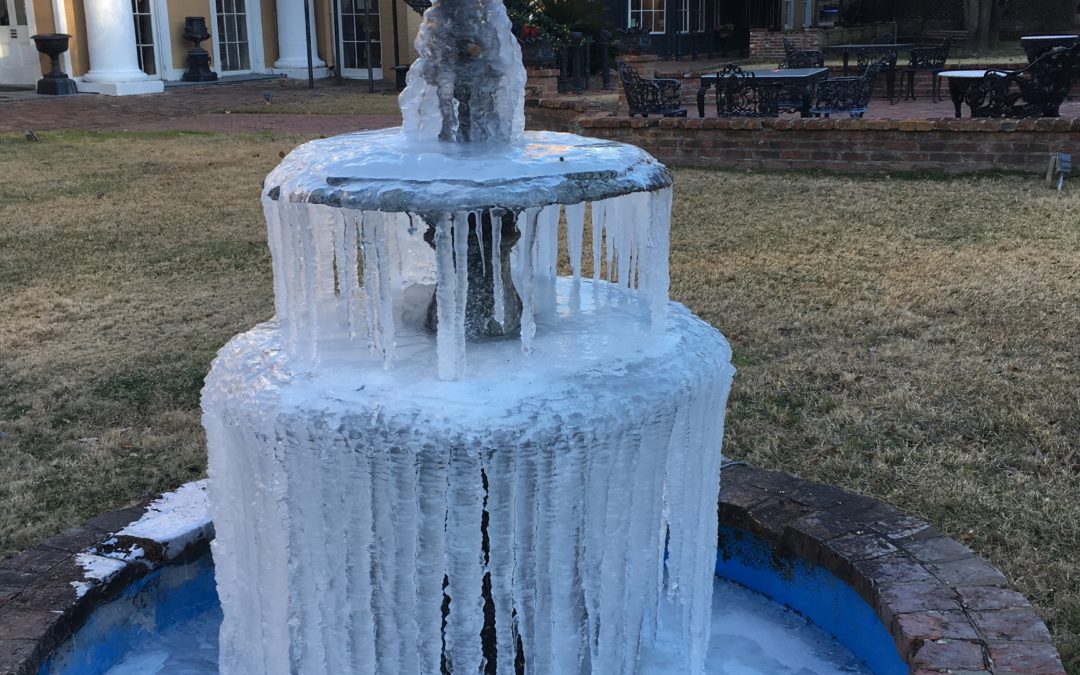
It was a good thing that it was getting dark when we finally pulled up to the Cedar Grove Mansion Inn, a walled-in antebellum estate with a colorful history. We couldn’t see much of its surrounding neighborhood, a place of dilapidated houses and apartments, broken down vehicles, and random trash. In Cedar Grove’s once-beautiful garden, the cascading fountains had frozen solid. No one had bothered to turn them off. The ceiling fans on the outdoor veranda were also turning, as if we needed further cooling. We shivered on the front steps in 20-degree weather.
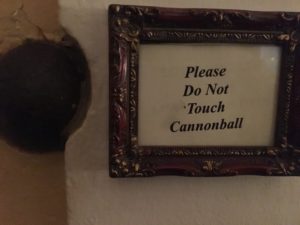
Finally a woman answered the door, seeming surprised to see us. We were to be the only guests, except for one other couple who had already disappeared for the night. We ate alone in the once-splendid dining room, eyeing the large cannonball that was still embedded in the wall. The empty tables around us were set with china, linen and crystal, for phantom guests who never came.
The cannonball in the wall
Cedar Grove’s original mistress was no ordinary Southern belle. She was General Sherman’s Mississippi cousin Elizabeth, who married jeweler John Klein, the richest man in Vicksburg. Klein, who also had banking and railroad interests, presented her with this house as a wedding gift. They had met in Natchez when she was 12, and Klein courted her until she married him four years later. General Sherman rescued her Confederate family as the war came to their doorstep, and when his Union Army overtook Vicksburg, he turned this manor into a Union hospital. The Kleins were allowed to return, and they continued living in suspense upstairs throughout the war, wondering when the Union soldiers would discover their safe of jewels, money and other valuables, in the family dining room. Miraculously, it was never touched. Klein had successfully hidden it in plain sight, disguised as an armoire.
Ready for the guests who never came…
As we retired for the night in a separate building on the estate, I could hear animals—or was it ghosts? rustling around in the woodwork. It was a bleak, cold night, without the cheer of a fire or the charm of other guests.
Day Six. Tuesday Jan.2 Battlefields
The next morning, we ate a rubbery breakfast of scrambled eggs and an impenetrable hotdog the cook tried to pass off as “sausage.” The white toast crumbled to bits when we tried to butter it. The other couple appeared in the dining room, and mumbled a few comments to each other about the toast. The gentleman introduced himself to us as a retired New Orleans police officer, with his lady friend from New York. They agreed that Cedar Grove, which he used to visit regularly, had fallen on hard times.
I asked him about his experiences during Hurricane Katrina. He hadn’t been on duty then, but he said that the storm’s awful impact actually had one beneficial side effect: It cleaned out some of the corruption in New Orleans, by disempowering the levee district boss patronage system established during the old Huey P. Long days. He told us to be sure to visit the Vicksburg battlefield nearby.
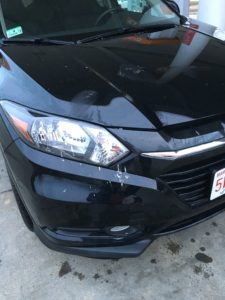
We left without knowing where we were going. The wifi hadn’t worked in our room the night before, and our new Honda HRV’s Garmin navigation system had no capacity for historic landmarks or cultural attractions. “Vicksburg Battlefield,” “Civil War battlefield,” “Jackson civil rights museum,” “Mississippi Civil Rights Museum” and “The Hermitage” all produced directions to random gas stations and cafes in different states. I wanted to hit the stupid dashboard with a frozen water bottle. (We had six or seven frozen half bottles rattling around the car, because anything left out overnight was solid by morning.) Our paper maps weren’t local enough to show the streets we needed to find.
Our noble vehicle, whose Navi was embattled
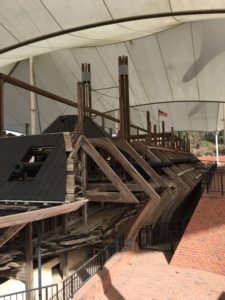
On Confederate Ave., we passed a wooden shack with a hand-lettered sign offering “Live Catfish” and “Fresh Buffalo,” but it appeared to be closed. Finally, thanks to a gas station attendant, we found the Vicksburg Battlefield national park just 10 minutes away. It was forested with stone memorials, scattered on gentle hills. These monuments honored fallen soldiers from Illinois, Iowa, Wisconsin and Ohio. As we left the park, we stepped onto the rotted wooden deck of the ironclad Cairo warship, dredged up from the Yazoo River bottom a few years ago. I wondered what the tour bus full of gray-haired seniors hoped to find here.
Dredged up from the Mississippi mud
Our next stop: the new Mississippi Civil Rights Museum in Jackson, a perfect counterpoint to the Vicksburg’s lost Confederate glory. This display of the horrors of slavery, reconstruction and the Klu Klux Klan reminded us that the white South’s American dream was everyone else’s nightmare. Before Brown V Board of Education, Mississippi offered only a few months of school each year to segregated black students, with twice as many kids in black classrooms compared to white ones, and only a tiny fraction of the money per student. After they were forced to integrate, many white families put their children into new “segregation academies.”
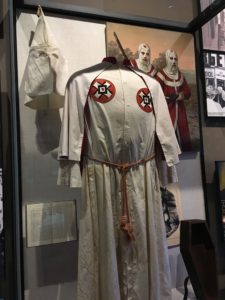
Most striking were the glass pillars listing every known Mississippi lynching, year by year. Mississippi was the leader in this form of terrorism. Crusading black newspaper editor Ida B. Wells, who was born a slave in Holly Springs, MS, went to England to lecture progressive audiences about how British textile companies were profiting from slavery in the American South. She and others are honored here for challenging the law and culture of the South. There were scary white KKK hoods and photos, along with videos of the Mississippi Freedom Riders, the NAACP and other resisters. We saw no mark recognizing that President Trump, who appears to believe in white supremacy, came to the opening of this new museum less than a month ago. The museum staff seem to be the only people on earth smart enough to ignore this man.
MS Civil Rights Museum
A black woman I passed by in the museum was telling her grandson, “Now look at this history. Learn it.” I wished that instead of tearing down all the Confederate monuments, progressives today would put up new plaques on them, explaining what these men and women thought they were fighting for, and why it was so wrong. A white volunteer stopped me to explain part of the civil rights exhibit, and I told him about the ongoing Not In Our Town (www.niot.org) initiative that helps American communities that have been torn apart by hate crimes. I hope he will spread the word to others. I’ll be volunteering some time with the NIOT team once we get to California on January 15.
“Its amazing that this is all one country,” John said as we drove into a carwash machine outside Patchatoula. A surprising rainbow of colored soap, raining down from above, brightened our outlook. The car had been encrusted with frozen white bird droppings ever since we parked it under a tree in Opryland. We could finally see through the windshield again. as we drove into New Orleans!
Monday Jan. 1, 2018 Day Five: New Year’s Eve at Graceland (part two)
It turned out that the real New Year’s Eve party was in the lobby, where piano player Rob Haynes was bringing Jerry Lee Lewis, Ray Charles and Elvis back to life. He was banging the keyboard not just with his hands, but with his water bottle, and finally, his feet.
A large man in a red suit and white beard started breaking out a few dance moves there in the lobby, which woke up the dozing senior citizens wearing tour badges. Arriving families put down their suitcases to join the party. Fancy guests who had escaped from the ballroom joined in. We all started to have a good time!
Suddenly the piano man slowed down and played “Dixie” as a patriotic hymn. He thundered into the “Battle Hymn of the Republic.” People were getting tears in their eyes. A woman’s fist shot up in the air. This was beginning to feel a little scary, as if it was all going to explode into a Confederate rally. But the piano man shifted to “Hushabye,” putting all those fervent passions back to sleep.
The next morning, we ran across the street in the 24-degree chill, to pay our respects at Elvis’s iconic mansion. “All my dreams have come true,” Elvis said in a TV interview being played in one room. Graceland was a funhouse of 1950s fantasies being fulfilled. There were Cadillacs, private planes and mink coats. The jungle room had a real waterfall and green shag carpeting on the ceiling.
The Jungle Room
There were three TVs all in a row in the media room, a pool table, a swimming pool, even real live horses outside in a pasture.There was always a chef on duty in the kitchen, 24/7, because Elvis and his entourage might be partying at all hours of the night.
It was time for us to go. Our own fantasy was to find Vicksburg before dark.
“You do not take a trip. The trip takes us.”—John Steinbeck, Travels with Charley
Thursday Dec. 28, 2017: Day One: The Cold Start: We left Boston on this bright sunny Thursday morning, hoping to say goodbye as quickly as possible to its temperature: only 6 degrees F. About an hour into our trip west, the turnpike in front of us was slowed to a crawl because everyone in our lane was looking across to the other side, ogling the aftermath of a disastrous accident. The rubberneckers were staring at the remains of a tractor trailer, whose entire metal side was ripped open. Bags of garbage that the truck was apparently carrying were now stacked neatly along the median. The maimed truck was surrounded by a dozen blinking emergency vehicles, including two official environmental hazard vans. The responders must have been there for hours, cleaning things up. The fate of the driver was unclear.
Ignoring this dark omen, we pressed forward toward our first goal: reconnecting along the way with dear friends. We asked for their advice. Reaching across the great American divide wasn’t going to be easy; how could we strike up a meaningful conversation about politics, with a stranger? “Ask, ‘what do you hope for’?” our New Haven friend suggested. I thought to add, “in 2018,” so that the New Year might be our excuse for a chat. The people from moveon.org had suggested starting with “What keeps you up at night?” as the icebreaker after you invited Trump and anti-Trump folks into your home to find common ground.
Neither one sounded like an easy line to drop into a passing conversation about football or winter weather, but we resolved to look for our opportunities as we stop in cafes, gas stations and laundromats across the Bible Belt.
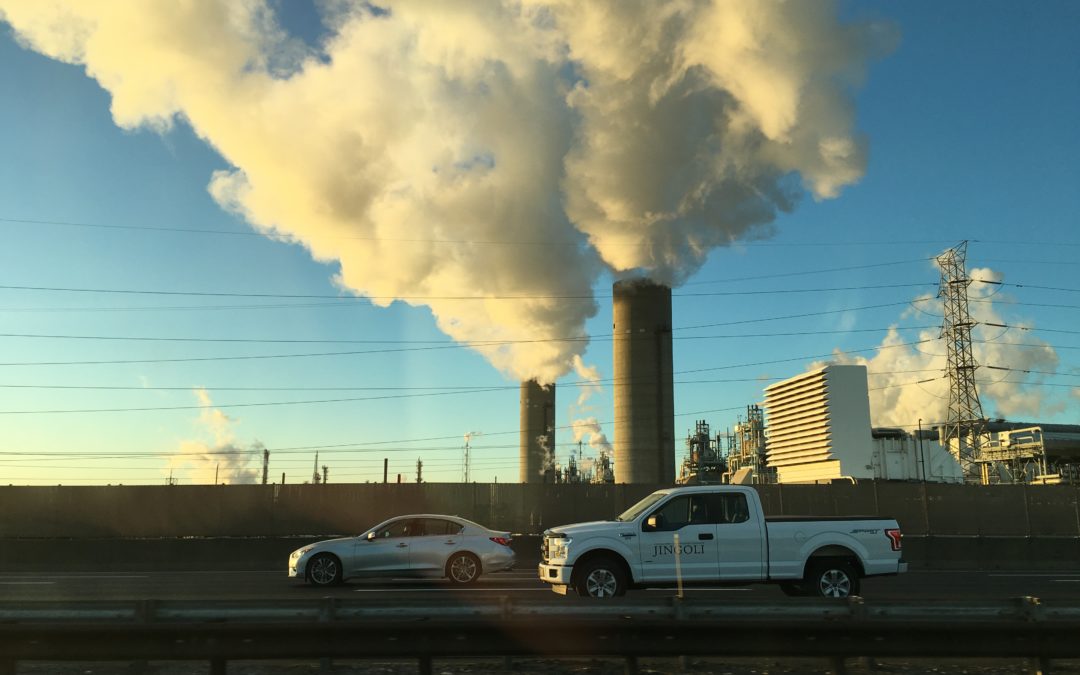
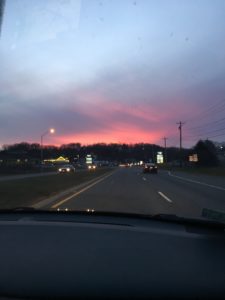
Our first day’s drive was too long. After a memorable lunch in New Haven, we inched south on 95, a miserable highway from Boston to Annapolis that is always choked with traffic. Who were all these people creeping along next to us, and why did they have to be on the road at the exact same time we were? The winter solstice sky darkened early, as we passed the smokestacks of industrial Newark. Our anticipated seven-hour drive, which started at 9:15 a.m., took us almost 12 hours! We covered nearly 450 miles, pulling up finally at 8:45 p.m. in the Annapolis driveway of old friends from my Washington days.
At the end of a cosy dinner, Susy, who is an experienced political operative, took up our invitation to appraise the current political mood in Maryland. People are optimistic, she said, because they see the Alabama and Virginia elections as a harbinger of change. Politics today are all about change, she said. And if the Democrats can be the change, they can bring the country back from the brink. They don’t have to have a national figurehead or party narrative for the 2018 midterms. Instead, the elections need to be about each individual candidate in each district. A national figure could even be a distraction, muddling the fresh flow of candidates and narratives necessary to reanimate the Democratic Party.
Friday Dec. 29. Day Two: We Are Victims of A Crime
We had brought in our many suitcases for the night, because there was a rumor of a past car break-in in the neighborhood. We didn’t anticipate the danger of an inside job. Our hosts’ two highly intelligent dogs, Ulla and Cate, in the darkness unzipped my briefcase, unwrapped and devoured all four sports bars I had stashed there. They purloined our new audio book of Truman, by David McCullough and put impressive fang marks into the fancy wrapped soap I was carrying as a hostess gift.
After discovering the canine crime scene, we enjoyed a jovial breakfast and hit the road at 10:30 a.m. It was more than three times warmer than Boston, but still freezing and overcast at 21 degrees F. Heading through the Shenandoah mountains west on 66 and then south on 81, we nearly stopped to see the Bull Run battlefield and the Luray Caverns. But the weather was too cold and we wanted to make progress. So we plunged into the famously poor Appalachian area of western Virginia, past farmhouses that needed paint, large mining company outposts, and the flattened hilltops created by their strip mining. Politically, this is a Trump stronghold where people feel left behind by the global economy, immigration and the metrosexual Democratic Party.
We stopped at a tavern for a hamburger lunch, admiring the football on the TV and all the craft beer options. I didn’t have the nerve to ask the family sitting at the next table for their thoughts about America these days. Maybe our plan to talk about politics to random strangers was a bad idea?
We ended up for the night in the small town of Christiansburg, where in 1774, the not-yet-famous folk hero Daniel Boone escaped his creditors by leaving for Kentucky. https://en.wikipedia.org/wiki/Christiansburg,_Virginia A century later, this jumping-off supply town for the travelers west was booming. New Victorian mansions lined the broad streets, optimistic landmarks of the Gilded Age. This was an era when social Darwinism justified economic inequality and the country was pressing its “manifest destiny” westward.
We found, on the second to last day of 2017, that Christianburg’s streets were utterly deserted, and its stores all closed up. There wasn’t even a bar to brighten the Friday night chill. We took a room in one of the magnificent old mansions, The Oaks Victorian B&B, and headed out to dinner in another old Victorian house, The Summit. The place had a bitter past. Its first owner in 1888 fell on hard times and had to swap houses, five years later, with his brother-in-law. The original owner’s fortunes improved again a few years after that, but his brother-in-law wouldn’t swap back. The family lived unhappily ever after.
Wishing I had the nerve to talk to the folks at the next table, during lunch at a Virginia tavern
Saturday Dec. 30. Day Three: Nashville
Driving past the exit for Dolly Parton’s theme park, on I-40 W, we started to appreciate the billboards:
“The World’s Largest Knife Store”
“Machine Gun Rentals”
“Land Shark Bar and Grill”
“Real Christians Love their Enemies”
“The State’s Largest Selection of Moonshine”
“WRECK?”-Five Star Attorney
“I Took Control of Myself and got HIV Testing”
We stopped at the Cracker Barrel in Knoxville for lunch , where we met a friendly woman willing to talk about politics. Too many Americans are motivated by fear, she said. “The American dream came apart with Vietnam…There is a huge backlash against Obama. There was no way this country was going to go from a black to a female.” The textile and steel jobs went away, and people “appreciated having someone finally notice.” There is no frame of reference for what Trump actually does. “Trump sends the news that people want to hear.” If they identify with the Confederacy, it’s because that’s a fixed identity that they can return to, in the midst of all this global change. As I listened, I wished that instead of tearing down Confederate statues, we could add new plaques identifying what these famous southern leaders were doing, and why it was wrong.
I listened to the Tennessee woman’s advice about conversing with political opposites: Mix moments of eye contact with walking or driving that doesn’t require face-to-face confrontation. For example, agree to meet someone for dinner. But then walk together, side by side, across the parking lot to the restaurant. It may be easier to talk about sensitive issues during the walk.
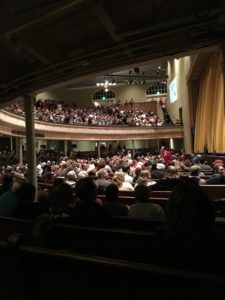
It was 20 degrees when we got to Nashville, but the Grand Ole Opry show at Ryman Auditorium was sizzling hot. The music and showmanship were world class, a pleasure to experience even from our obstructed side seats. We noticed that the crowd on and off the stage consisted almost entirely of white people. I was glad that the Old Crow Medicine Show front man at least paid special tribute to Chuck Willis, the first black Grand Ole Oprey star, who wrote “C.C. Rider.” As we flooded back onto the icy street, looking for the shuttle bus back to our hotel in Opryland, young revelers in shirtsleeves were thronging in and out of music bars and honky tonks, as if this were just another warm Saturday night.
My Nashville cousin and his wife joined us for breakfast Sunday. He said 2018 would be a bellweather for Tennessee politics, with both the Senate and Governor’s seat open. It could go either way, with strong experienced Democrats poised to do well—maybe. No one wanted to count out Trump’s ability to dominate the narrative, to his party’s advantage. “The greatest thing about America is our ability to muddle through,” he concluded, leaving us on an optimistic note as we plunged southward, through the Tennessee countryside, to our appointed New Year’s Eve at Graceland.
Sunday Dec. 31 Day Four: A Southern Duel before we get to Graceland
As we left Nashville, we stopped at the Hermitage, President Andrew Jackson’s estate, just a few miles from Opryland. Here we saw a re-enactment of The Duel. This courtly game of chicken was used to settle scores. Duels were illegal, and not actually fatal two-thirds of the time in the antebellum South. The Gentlemen involved, hoping to avoid legal problems, referred to their pistol showdowns as seeking “satisfaction” for an insult or a debt.
Duels both made and then ruined Jackson’s reputation with his peers as a Tennessee gentleman. Of course there were other behaviors that were more important: he was an unapologetic slaveholder and he orchestrated the genocide of Native Americans on an unprecedented scale. He is still remembered by some, however, for establishing the Democratic party as a populist, with a keen interest in defending the little guy against the powerful interests that ran American business. The ghost of Trump was following us everywhere, and seemed particularly vivid at Jackson’s homestead.
Most surprising, in this white supremacist’s homestead, was the staff at the Hermitage café, where we had a delicious home-cooked lunch. It was run by an Uzbek couple, whose cashier was Albina, a young woman from Ufa in the Ural mountains of Russia. We had noticed other immigrants, mostly East Asian ones, in the fortified payment booths at gas stations and convenience stores along the highway. I asked one gas station cashier how he happened to come to the American South from India, and he said he discovered the job opening on the Internet. Now said he now runs three such Tennessee highway convenience stores. Before our trip, we had heard a story on NPR about how immigrants working at a southern chicken processing factory had lined up the night before for the precious job openings, beating out the local Americans who came in the morning. Arlie Hochschild’s book, “Strangers in their Own Land,” retells how “Tea Party” (Trump) supporters in Louisiana see this differently: minorities and immigrants seem to be cutting in line in front of them on the path to the American dream, getting unfair advantages like Affirmative Action, all along the way.
New Year’s Eve at Graceland!–Part One
At 6 p.m. we pulled up to The Guest House at Graceland, a five star hotel which opened just a year and a half ago. Its fancy lobby and guest rooms were full of huge Elvis photos and loops of Elvis music playing on the TVs and in the gift shop. We quickly changed into our party duds and headed over to the ballroom for the New Year’s Eve champagne buffet with 19-piece-orchestra for dancing.
The Iowa man’s wife told the Australians that she runs three businesses in their small Iowa town: a gift shop, a flower store, and a Christian store. The woman from Australia looked dumfounded. “What is a Christian store?” she asked in genuine confusion. “We sell religious items,” she said, adding that some Christians don’t want to pay for what they pick up there because they “believe that God provides.” The four teenagers, including her own daughter, looked down at their phones. Soon we were all making discrete exits from the party. The orchestra “sounds like Lawrence Welk,” complained one silver haired granny, who like the rest of us, left early and headed for the lobby, where more exciting things were going on.
This party was a little bit lame…but there was much more to come outside the ballroom!
What is the truth about journalism?
Journalism is always a bit of a mess. People’s memories are usually flawed. Eyewitnesses differ about the same event. The moment a story passes from one person to the next, it changes. This is only human. And then there is a whole new category to worry about: opinion pretending it is news. Appealing stories, spread through our trusted social media sources, may be secretly designed to persuade us of something. It may be fake news that has no basis in fact.
The response: cynicism
In such a world, it is easy to give up on all news sources, even though we still need information from somewhere, in order to optimize our future. Conspiracies are attractive when we feel we can’t trust anybody but the ideas and people we already know.
How we are manipulated Reporters who are trying to figure out what is actually going on and tell it honestly–from an nonpartisan referee’s point of view–are increasingly dismissed as creating “fake news,” by the people who need them the most. It isn’t just the professional journalists’ execution of the news story that is questioned—it is their motive. This loss of credibility is a big problem for our entire democracy, as politicians make policy based on fake “alternative facts” that they make up, and attack the reporters who are actually trying—on our behalf–to hold these politicians accountable.
The truth
Are most of the mainstream media out to brainwash us? Of course not. Are the talk show pundits who are transparent about their biases more honest about the facts? It may feel that way, but actually–no! Are the “inside” scoops and conspiracies we are hearing about through social media truer than what we read in the newspaper? Probably not. Opinions are different from facts. We have to pay attention to know who truly has our back and wants us to know what’s actually going on—and who is trying to manipulate us.
We don’t want to be like Edgar Maddison Welch, who thought he was a superhero, blazing into Comet Pizza in Washington, D.C. with his assault rifle to save children from a sex ring he heard about on the Infowars website and social media, that doesn’t exist. He is serving four years in prison, for acting on what he later decided wasn’t “good intelligence.” (It was part of the huge fake news campaign against Hillary Clinton, some of it spread by Russian bots that many people still believe despite the evidence that it is all made up.)
The bottom line
Examining the motive of a reporter is a good thing. But simply deciding that they are all “enemies of the people” and trying to con us, is not the smart way to gather power and knowledge for ourselves. In my experience, it is charlatans with bad motives who are the ones most loudly telling us to mistrust the press in general, to ignore the referees of mainstream media.
The easy answers are rarely the most honest or helpful ones. Opinion is not good enough. Evidence is the key to navigating this crazy world.
The challenge
Just having the news story confirm what I already believe is a terrible basis for trust. Just listening to one type of news source or pundit, without understanding where they got the story, is also a fast track to being manipulated.
Take action to prevent being manipulated The next time I am told that what I am hearing is “fake news,” I will take a minute or two to look within the story for where the facts in the story came from, and what evidence is offered to back them up. Just saying, as Bill O’Reilly loves to do, “I have someone inside the organization” is not evidence.
What news sources are they are using (are they quoting people who actually have some expertise and evidence? Are they listening to only Republicans or only Democrats, quoting business leaders and not consumers, media pundits? Are they finding people who actually have deep experience with the subject?
What is the track record of this news source? Do they generally try to provide fair and carefully checked reports, or are they just spouting opinions without evidence to back them up? Stirring up conspiracies to make money or gain power from your support? If you challenge them, will they offer you real evidence to back up their claims?
You can save a lot of time by checking the story with the fact-checking organizations. Politifact,Factcheck.org and other fact-checking organizations’ tone can be annoying, but the facts they present about the most popular stories and myths may be an important correction to what we thought we knew. Knowledge is power. It’s worth our time to pay some attention to the details.
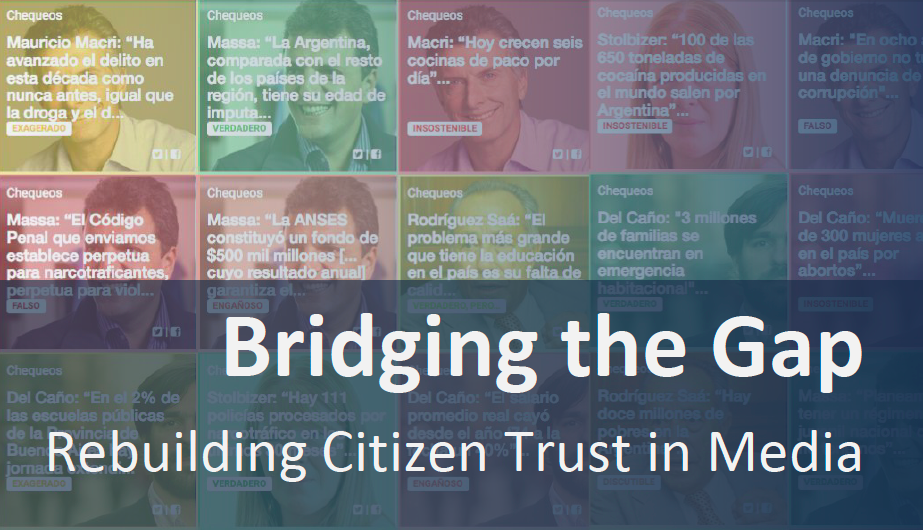
I worked with Anya Schiffrin and her team of experts from Columbia University, to help sort out the journalistic truth-tellers from the “fake news” opinion pundits. For further study of this issue, here is the report, Bridging the Gap.
We are driving across America! As 2018 begins, we will be starting in snowy Boston and heading West to San Francisco. Along the way we hope to learn more about current state of our beautiful, embattled and deeply divided country. Begin Here!





 At the end of a cosy dinner, Susy, who is an experienced political operative, took up our invitation to appraise the current political mood in Maryland. People are optimistic, she said, because they see the Alabama and Virginia elections as a harbinger of change. Politics today are all about change, she said. And if the Democrats can be the change, they can bring the country back from the brink. They don’t have to have a national figurehead or party narrative for the 2018 midterms. Instead, the elections need to be about each individual candidate in each district. A national figure could even be a distraction, muddling the fresh flow of candidates and narratives necessary to reanimate the Democratic Party.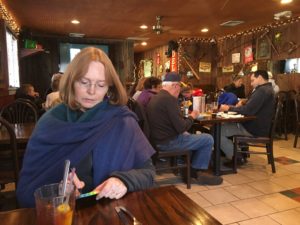
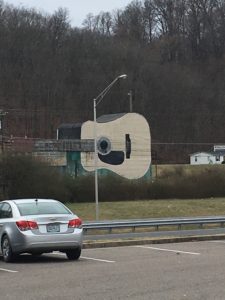
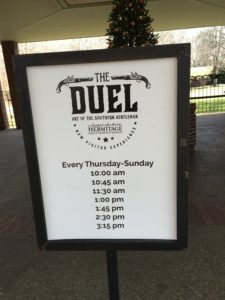 Duels both made and then ruined Jackson’s reputation with his peers as a Tennessee gentleman. Of course there were other behaviors that were more important: he was an unapologetic slaveholder and he orchestrated the genocide of Native Americans on an unprecedented scale. He is still remembered by some, however, for establishing the Democratic party as a populist, with a keen interest in defending the little guy against the powerful interests that ran American business. The ghost of Trump was following us everywhere, and seemed particularly vivid at Jackson’s homestead.