…MIT Prof. William Uricchio observed that old media make us feel like “a passenger in the back seat of the car, howling at the driver.”
…Phil Balboni debated a skeptical MIT student about news “objectivity” at Balboni’s new online GlobalPost venture.
…Harvard’s Shorenstein Center handed out prestigious Goldsmith investigative reporting prizes to mostly old media folks.
…And across the river, people started hearing the death rattle of the Boston Globe.
Even for the optimists, the media landscape remains a minefield of unresolved questions:
Is it enough that anyone can be in the driver’s seat now, creating and re-creating content, consuming whatever we like, and the hell with the rest of it?
Is news more authentic now?
Will my friends and colleagues spread the story to me if something relevant is out there?
Aren’t we glad to be washing our hands of “objectivity” and other myths?
Isn’t it glorious to be in the age of more information than we can possibly use?
Every day I am surrounded by people who have moved on from the mainstream news media with no regrets. The media didn’t tell us about the Bush Administration lies about weapons of mass destruction in Iraq. They didn’t warn us about the pending financial collapse. …it’s all much better now that we are getting our news from real people.
My bottom line has always been: how can people understand their real choices for shaping their own lives and communities? How can the flow of news actually promote personal and community agency? This is why the future of journalism and civic media are important to me.
Many of my truly smart civic media colleagues believe that crowd sourcing and individual participation will fill in the gaps and do a better job than the mainstream media have done with this, offering better watchdogging of political, economic and cultural institutions. I would love to see this. The projects that have worked—such as the Ft. Myers newspaper expose of a corrupt sewer contractor, and the Sunlight Foundation’s efforts at illuminating what is actually in the budgets and laws being passed, are wonderful examples of what is possible. But for cultural rather than technological reasons, they are far–-very, very far–from covering the waterfront. In Clay Shirky’s Here Comes Everybody, wonderful examples of civic media prowess are given but in each case, they seem to require the MSM megaphone at some point, to actually affect policy and change things on the ground.
Others note that news audiences haven’t really left MSM. They are flocking to the best MSM websites. It’s just about a broken business model. Yes, but… it’s about a shifting culture as well. If the best and brightest young folks don’t value agnostic, professional journalism, even a dozen new business models won’t work for long. I am waiting for a public relations campaign to argue the virtues of Kovach and Rosenstiel-style journalism (http://www.journalism.org/node/71), combined with a comprehensive news literacy curriculum at all levels, in all countries, that invites people to produce, consume and pay for public service news.
Fair, important, earth-shaking journalism is actually hard to do. It’s harder than simply repeating what anyone tells you, or selecting the facts that support your own biases. That is what all the fuss is about as newspapers around the country collapse and die. Look at the winners of the Pulitzers (http://www.pulitzer.org/awards/2009) and the Goldsmith awards. They have demonstrated real expertise at teasing out something important that others didn’t want them to know. Their legitimacy came from their honest broker status, rather than their witty personas. Some became expert at reading obscure documents, figuring out the proper context and meaning of them, and then using their institutional clout to make their findings matter. Some used new algorithms and other computational tools. Others, like my former Wall Street Journal beatmate Jane Mayer, insisted on verifiable evidence and persuaded people to trust her with what they knew about top-secret U.S. torture policy (http://www.harpers.org/archive/2008/07/hbc-90003234.) This work takes not only skill, but time and, alas, money.
A feature of the new participatory ad hoc media is that people can participate anonymously and briefly, and then go away. This can capture moments of expertise that would have been wasted before. But no one can criticize them for letting down the public or making things up. They can just click away from that activity whenever it grows tiresome to them. So our challenge is not just how do you obtain the journalism you need without a professional group of experts being paid to do this, but also, how do you organize amateurs who wish to participate sporadically with acts of journalism, in a way that has value both for them and the publics they wish to serve? Will these mechanisms provide adequate information on which to base critical policy and voting decisions?
To be sure, what has called itself journalism has too often been a hack job, a pile of missed clues and mistaken identities. It’s not just about messing up the facts. It’s about misunderstanding what they mean. Stupid journalism is just like stupid anything else. It’s demonstrably bad and people should expose or ignore it.
It’s not about the platform, even though too many MSM moguls have lost their shirts by responding as if it is. Many fine journalists are net-based and have never set foot inside an MSM organization. Joshua Micah Marshall is I.F. Stone2.0 (http://www.talkingpointsmemo.com/). I see exciting new civic media possibilities on the horizon. Twitter is dazzling, as a headline service and a conversation. But I need more than Twitter, YouTube and my Facebook social network to understand this complicated world.
Phil Balboni’s talk at MIT inspired another installment in the debate about objectivity. Students seemed uniformly skeptical when he advocated objective news. Objectivity means less transparency. Why hide your inevitable biases? Why would anybody prefer a journalist who won’t tell you what she thinks about what she’s witnessing?
“Objectivity” was impossible, of course, but the effort to achieve it was the journalist’s shield against the influence of the advertisers, political bosses and owners. It required real discipline. It was an act of idealism and selflessness, an effort to step back and honestly present what one witnessed as truthfully as possible, even if it didn’t reinforce one’s own beliefs or the politician’s or advertiser’s wishes. For example, there was the day my colleague and I had a lead story in the Wall Street Journal documenting how everyone around President Reagan—including Mrs. Reagan, Vice President Bush and virtually the entire cabinet—thought Attorney Edwin Meese should resign. But theJournal’s editorial page, on the same day, thundered that the only people who wanted Meese to resign were the liberal critics of the Reagan Administration.
My belief in the value of agnostic journalism—to offer facts on all sides of the issue, and trust the ability of my readers to connect the dots—was tested when I wrote about people like Black Muslim leader Louis Farrakhan and conservative prankster Terry Dolan. I forced myself to be open-minded, to understand and present what they thought of themselves, and what their admirers as well as their critics saw in them, instead of simply lining up my own objections. Now newsmakers can offer themselves to the world through their own platforms, and they don’t need journalists like me to paint their portraits. But are we better informed now, better protected against bias because we don’t believe in trying for objectivity anymore? Is the personal lens always the best model for every news situation?
Roger Ailes—the GOP media guru who now runs Fox news—once told the students in a class I was teaching at Harvard that journalists got up in the morning with a goal of tearing down his GOP candidates. Did he really believe that? That wasn’t what we thought we were trying to do. We asked unpopular questions in order to hold the powerful accountable. A few months before Ailes made his comment, I had been a Wall Street Journal reporter questioning Ailes’ client, GOP Vice Presidential candidate Dan Quayle in a “press availability” in Huntington, Indiana. Quayle complained that I was unpatriotic to question his finding a personal safe haven in the U.S. National Guard during the Vietnam War, while others were being drafted and dying in a war he vigorously supported. I took more heat than Quayle did for the exchange, which was captured live on CNN. Critics said I seemed disrespectful and “biased” against Quayle. I thought it was our job to ask uncomfortable questions, not to seek accolades as celebrity pundits in a patriotism contest.
But without cultural support for that kind of insolence, journalists have made popularity their Faustian bargain with the bottom line. Bloviators are hired on radio and cable TV for their ratings rather than their honesty or wisdom, and a news story’s spreadable popularity (as the most emailed or highest ranked on sites like Digg) establishes the journalist’s value to sponsors. Few noticed untilafter Hurricane Katrina, the faltering of the Iraq War and the economic meltdown, that the unpopular questions were not being asked effectively beforethe crisis. This has always been a challenge, of course, but it is more so when the paying customers prefer faith over facts.
It’s been an extraordinary privilege to serve for 18 months as research director at MIT’s Center for Future Civic Media. The work has been highly experimental, creative and public-spirited. This is a wonderful place to invent communication technologies and practices that promote civic engagement in local settings. Some of it is already a lot more promising than old journalism ever was. We need to apply these new media affordances for civic good. How can people build cultural practices that use communication technologies to best advantage personal agency and healthy communities, all around the world? Let’s all keep working on that, even as we see the terrible and stirring pictures and words coming out of Iran, Gaza, and other crisis areas.
Part of the original C4FCM team is breaking up, as Henry Jenkins moves on to USC, and outreach director Ingeborg Endter and I depart MIT. But the Knight Foundation grant work is in excellent hands with two of the original creators of the Center, C4FCM Director and Principal Investigator Chris Csikszentmihalyi, and Associate Director and Principal Investigator Mitchel Resnick, as well as C4FCM’s new administrator, Sarah Wolozin.
As I leave to take up a new life in Budapest, I will be working on a book, and updating my monograph, “Tabloids, Talk Radio and the Future of News,” (Annenberg Washington Program, 1994), which predicted the demise of journalism and started my thinking about technology’s impact on news. Please keep checking in with me through my website, www.ellenhume.com
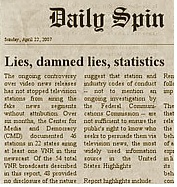
Published in the January 2005 issue of Nieman Reports Magazine.
Journalism will survive, but it might appear in the form of Web sites designed for people who want to check in on the real news when they don’t get the jokes on the Jon Stewart’s “Daily Show.”
It is tragic that we’ve come to this. For years we’ve been warned that great journalism is being tainted by all this ersatz stuff. Too many reporters are chasing too few stories and conveying them with more hype than meaning. People are suffering from news fatigue, along with compassion and political fatigue.
Audiences flee to the blogosphere and talk shows, where the chatterati seem more candid and therefore, honest, seducing audiences by confirming their prejudices. The passion for “attitude” plays well in our attention economy, but it’s bad for news. Journalists become no different than salesmen and jesters, except they’re usually less amusing.
Real journalism will recover, but only if its supporters take action. First, they should get out the plastic sheeting and duct tape and wall off everything about celebrities, movies, Laci Peterson, rumor, prediction, and a lot of other popular stuff. Take a page out of factcheck.org – the most admired Web site of this campaign year. Stay with the basics. Don’t just repeat someone else’s story. Do original reporting. Help us understand what’s a lie and what’s the truth, and why this matters.
Journalism that still tries to do this is better now than ever. It is found in the detailed take-outs in The New York Times and other newspapers which separate myths from realities, about aluminum tubes in Iraq, John Kerry and George Bush during the Vietnam era, and other hotly debated issues. But these days this kind of careful, researched journalism has more enemies than friends. “You’re either for us or against us,” President Bush declared after 9/11, in message that was absorbed too well by the U.S. media.
To win back people who want to know what’s really going on, journalists need to return to what they do best: providing verified information that is, in Bill Kovach’s and Tom Rosenstiel’s phrase, “comprehensive and proportionate.” News outlets also need to get more credit when they do this; even their best work is often taken for granted by those who pay close attention or dismissed by those who do not.
It’s time to launch a public education campaign and take back the phrases “fair and balanced, and “no spin” from those who claim them, but do just the opposite. Journalism doesn’t need to give up and join the overtly biased. Instead, it needs:
- A effective consumer movement
- An educational effort
- New business models
- A lot more lawyers
It’s way overdue to use these tools to reverse the 35-year cultural war against the mainstream media, led by folks like Roger Ailes on the right and Noam Chomsky on the left. These critics, who never appreciated the honest efforts of good journalists, exaggerate and exploit high-profile mistakes by major news organizations. When the federal government, which rarely finds scrutiny convenient, subpoenas reporters to hand over telephone records that go far beyond the scope of the Valerie Plame inquiry, a lot more lawyers are needed. When reporters can’t protect sources, they can’t hold the powerful accountable.
Fortunately, a long-needed media consumer movement is gaining momentum. Organized through the Internet, people successfully challenged Sinclair Broadcast Group’s decision to provide blatantly erroneous, partisan content during the president election. Before that they forced the Federal Communications Commission to rollback its loosening of cross-ownership rules. Journalism companies should get on the right side of this issue, even though the business model for independent journalism is under severe stress.
The rise of factcheck.org is evidence that journalism can morph into new formats and succeed at its core task of holding the powerful accountable and providing access for citizens to information they need. But it’s a nonprofit operation. Most journalism cannot enjoy that protection. Mainstream journalists often confront market-driven executives who demand cross-promotion of entertainment products by their news divisions. Niche markets might be journalism’s best hope, as National Public Radio illustrates, even if news balkanization is not good for democracy. Better business models must be found, fast.
Finally, a return to a civic education curriculum would help. Those who teach media literacy should move beyond deconstructing messages to helping students find reliable information. They need to show how to value real journalism – by looking for transparency, verification, independence, context and proportionality. Let’s be sure that when the audience comes back to look for this, they’ll be able to find it.
My premise is that the facts matter, and that journalists are in an ideal position to hold the powerful accountable. This is what I tried to do for 19 years as a reporter. The news media also must be held accountable themselves-because they, too, are among the powerful forces that shape our policy, politics and preoccupations. That is why I quit journalism in 1988 to be part of a group that is trying to hold the news media themselves accountable, and to improve their quality and role, from within the business.
Before I became a full time teacher in 2003, I saw enough candidates, presidents, and political campaigns up close to be hard-hearted about politics. Nevertheless, I was particularly disheartened by the 2004 presidential election. It was a huge victory for those who set out to destroy the ability of the news media to serve as watchdogs.
Now…don’t get me wrong. The news media have done a lot to wreck their own watchdog role since Watergate. We journalists have been own worst enemies! If we hadn’t done a lot of stupid things -and failed to be more transparent about our own limitations, mistakes and yes, biases-we would have more credibility when we write about the realities of Iraq, the reality of changing tax policies, the reality of the Social Security situation, the real costs and benefits of job outsourcing, the choices our government faced about securing the homeland or pouring money into the Iraq war, when we write about global warming, the plight of women, the Soviet style leadership of Putin, and so on.
The news media–the broadcast networks, the newspaper chains like Gannett, the talk show culture across all media– have too often gone for the commercial gold instead of the real news. They have too often degraded us and themselves, by focusing so much on sex, crimes, and celebrity nonsense. All along, real journalists also have been hard at work-all across America and in Sudan, Iraq and Afghanistan, Bosnia, Chechnya. But they are hardly noticed in the din of talk shows and partisan attacks.
That is why no one blinked when Gen. Tommy Franks, whose miscalculations in Iraq have led to unnecessary bloodshed and backlash against America, said on Fox News after a presidential debate this October, that it was the media’s fault; we had built up expectations too high about Iraq. No. It had been Tommy Franks and his colleagues who told the media what glories to expect in Iraq, and journalists reported their assessments. This time, it was clearly NOT the media’s fault. Who now, will hold Tommy Franks accountable?
The assumption that it IS the media’s fault may be part of why no one especially cared when the New York Times reported just before the election that the Administration had plenty of warnings about the bogus intelligence that led them into Iraq in the first place. And it is part of why CBS became the issue-rather than George Bush’s integrity, which is what the National Guard story was about. The public chose to believe honorable a man (Bush) who clearly ducked his responsibilities during Vietnam, over a man (Kerry) who risked his life and saved others there. It is important to note that many people felt that all of this was simply in the past, and believe (I think correctly) that Bush is now a better man than he was, a born again Christian who has found a way to manage his alcohol problem, who now steps up honorably to his responsibilities. But he was not then; the facts are very clear, with multiple sources to prove them. Many chose instead to believe it is all about CBS and bias.
When President Bush can get away with shrugging and saying, during a debate where his facts are being challenged, that the New York Times is not credible because “you know, the media…” then we have lost our watchdog press. The attacks on the professional mainstream news media have worked. The public has accepted his dismissal of real journalism. Watergate is forgotten.
And we news consumers are partly to blame for this, too, because we are of two minds. We have access to serious news, presented in a sober and factual way, but we click away or fail to pick up the newspaper because it isn’t amusing. It tugs too much at our consciences, it annoys us, it brings a ‘downer” to us when we have enough challenges already in our lives. And when we do get the news, we love the gossip and trivia. It’s fun, and we like to hear what our favorite celebrities are doing. We like to look at beauty and hear about its secret lives. Unless we think there’s a terrorist attack, or our loved one is on the battle lines. Then we go to the media where we will get what we want, rather than be challenged by something we don’t want to hear.
It is particularly galling to note in this media landscape that the news organizations which are least likely to observe the standards of verification, fairness, comprehensiveness and proportionality (the hallmarks of good journalism)-those news organizations are the very ones who with impunity call themselves “the no spin zone” and “fair and balanced.” Joining Fox and Bill O’Reilly in particular are now Chris Matthews and MSNBC. They are not more honest, they are only more effective.
If the New York Times were simply out to elect liberal Democrats, as the GOP/Bush campaign constantly alleged, then why were they the original critics of Bill Clinton’s new presidency? They savaged him about the Whitewater scandal, in page one investigative reports and editorials that called for a special prosecutor. Clinton gave them a special prosecutor, who was a Republican who then picked up the Monica Lewinsky sexcapades and turned that into an impeachment process. It was the “liberal biased” New York Times that wrote some of the negative profiles about Kerry throughout the primaries and into the general election. If they were in the same business as Fox and the talk show culture, they would have always come back to a refrain of support for their man. They did not. They were actually trying to be fair and balanced.
So where do we go from here?
Journalists need to keep struggling to do honest reporting. Live in truth, Vaclav Havel counseled people who were surrounded by lies during Communism. Let everything you do and say be as true as you know it. Don’t build up the lies in order to have balance. Prove that they are lies. Secondly, to the public: pay attention to the watchdogs even if they are unpleasant, or annoying. See if they are right before you change the channel. There are limits to what journalism can do. It takes people to act on the facts they uncover. Insist on government accountability as much as you worry about media bias. The first is a far more serious problem, no matter what you’ve been told. If the journalists are dismissed, then who will hold the government accountable and tell the citizens what choices they really have?
It is tempting to accept news as fact if it’s coming from a neighbor, a funny blog, a likeable person, or someone else who seems to start from a grain of truth. But there are people who like to take that small truth and use it as a talisman to lend credibility to some spurious idea they may have, however fantastic or untrue. They use false analogies, deliberate misquotes, they change the context entirely, or they omit key facts to distort the meaning of the original fact or statement. Check out Bill O’Reilly and Michael Moore, to see two very popular propagandists who are experts at this art of distortion, It is appalling that both are becoming rich not as satirists and propagandists, but as “truth tellers.” Beware of the way they string together their facts! Two and two do not make ten.
The Swift Boat controversy is another frustration to those of us who care about accuracy and accountability. Cable TV pundits are reporting on this without doing their core job of determining who is telling the truth. Thank heaven some newspaper journalists are tracking down the facts. Some veterans who profoundly dislike John Kerry for his leadership in the anti Vietnam War movement, and resent his testimony (which Kerry acknowledges now was over the top) about soldier atrocities, have decided to say that he did nothing good during the war, didn’t deserve his medals, didn’t get wounded very badly, and thus is lying and doesn’t’ deserve to be commander in chief. Meanwhile, virtually everyone who served most closely with Kerry, on his own swift boat, — including a guy whose life he saved–say that these complaints are nonsense and that he was a courageous, creative and effective leader during his Vietnam service. Even President Bush has acknowledged belatedly that Kerry should be proud of his war record, something Bush cannot say about himself since he didn’t fight in the Vietnam war he supported and it’s not even clear that he served out his full alternative service in the National Guard.
This acrimonious dispute has apparently hurt Kerry in the polls, but it may backfire on President Bush in the end, as more and more favorable character witnesses for Kerry from the Vietnam War pop up out of obscurity, and as GOP operatives turn out to have funded and helped to organize the supposedly independent Swift Boat critics. This whole episode has turned up a surprise for me personally: my former colleague at the Los Angeles Times, Bill Rood, emerged as a Vietnam Swift Boat veteran who broke decades of silence about his own experience to vouch for Kerry’s side of the story. When I worked with Rood, he was a very professional but tightly-wound reporter and editor, who never talked about the Vietnam experience. He was obviously reluctant to open up those painful memories, either then or now.
I trust Rood, who now works for the Chicago Tribune. If he says Kerry did the right thing-and in fact, was an exemplary leader under life-threatening and difficult circumstances-I believe him. In the meantime, please join me in blowing the whistle on those who deliberately lie or distort the truth.
Boston, Summer, 2004–Political conventions are the perfect time for mischief. In the 21st century they don’t have a real job to do because the primaries have selected the presidential nominee. Yet they get the world’s media spotlight for four days, as if they were up to something important. Think about it: a phenomenal 15,000 journalists will be scouring Boston in July, looking for a story. It is the dirty prankster’s dream.
That is why it was so easy for the political nut Lyndon LaRouche to spread a false but damaging story about Michael Dukakis’ mental health at the Democratic Convention in 1988. Surely there will be a repeat attempt to scoop the world with some as yet undiscovered fatal flaw in Kerry during the four-day fest in Boston July 26-29. The Democrats may dig for some new scandal to push at the GOP convention in New York in August. But President Bush is much less vulnerable to such political mudslinging at this point, because the voters already know what he is like as president, and they have seen the real results of this leadership.
So in Boston, in July, Kerry, an unknown quantity in the White House job, is the perfect quarry. Watch for the purported mistresses who will suddenly appear, either in person, pushed before the microphones by Republican operatives, or in whispers from the Internet. There will be dueling Vietnam veterans, those who admired Kerry’s war record and those resentful of his antiwar activism in the 1970s. There will be Boston cops and others who will talk about the rich Kerry-Heinz family seeking special privileges, like moving the fire hydrant to create a parking spot in front of their house in Boston. No story is too small to be blown up by 15,000 journalists without anything real to cover. Few will bother to ask, what are the biases or credentials of this critic? why does this matter? compared to what?
Watch for picket lines by aggrieved parties whether it is religious groups opposed to Kerry’s stands on abortion or the police unions pushing for maximum advantage in their contract negotiations with the Mayor. And watch for the lobbyists, whether they are the fat cats, pressing their advantage even further, or the ideologues, preaching about taxes or the End of Time. They are all licking their chops: 15,000 journalists! What an opportunity to tell my story!
Every crackpot has this city, and the Kerry campaign, over a barrel because these hosts want the convention to be a happy showcase. It is so easy to spoil a party, so hard to put it on right. Somewhere, partisan scoundrels are plotting, at this very moment, how they will drop their poisonous morsels into the media food chain. Will it be Drudge this time? Or Rush Limbaugh, to help him with his recovery? Will it be Fox News? No one will be able to resist the story, whatever it is. The old boundaries of taste and verification are fine for some other time and place. But they don’t exist when you are in a firestorm of 15,000 journalists, swirling around a hot rumor.
Some scholars watch this picture with equanimity, saying that scandal and passion are helpful for motivating people to vote. But many other observers, including this one, will watch with dismay as clowns, assassins and anarchists have a field day with the real issues facing this nation. It is so much easier to destroy something than to build it. Just ask President Bush, and the people of Iraq.
The core mission of independent watchdog journalism is to hold the powerful accountable on behalf of the “little people.” This seems a hopeless dream in our era of corporate media conglomeration, but in fact there are pockets of success. Courageous journalists are struggling to work even in the most dangerous corners of the earth. “Media Missionaries,” my updated report on American international journalism training, shares stories from the front lines of this global battle to tell the truth.
“Talk Show Culture,” my second new report available on this website, shows the opposite side of today’s media culture: the degradation of journalism into theatrical shouting matches, with collateral damage to civic life. Citizens are numbed by a constant barrage of assertions and attacks, presented by disingenuous “commentators” and “hosts” who are making money without any moral scruples about the lies they promote. Ann Coulter, for example, attacks as “treasonous” anyone who doesn’t agree with her extreme views. For sport, fame and money, she and her clones are knowingly poisoning Americans’ urgently-needed discourse about the very real and frightening challenges we now face.
That is not to say that the left’s favorite media analyst, Noam Chomsky, is a trustworthy guide either. He may be more intellectually honest than Coulter (it’s hard not to be) but like President Bush, he is driven by faith rather than knowledge. Watch out for neat theories! They bear no resemblance to messy reality. The corporate ownership of media companies is a big problem, and is undermining good journalism in many situations. But it is not by any means the whole story; true and important information is being verified and broadcast or printed every day by journalists working in this media marketplace. Those who dismiss the whole thing as hopelessly corrupt are simply too lazy to search out the real ground on which the truth stands.
It takes work to find what is real. But is is vital to do so. Particularly as the American presidential election nears, this is no time for sanctimonious ego-trips or leaps of patriotic faith.
Ralph Nader suffers from the first malady (of thinking if he’s not running for president, no one will represent the True Way), and as a result, he will likely cause real damage to the very values he claims to espouse. The world situation requires all of us to make real choices. The differences between Bush and Kerry are clear to the observer who is willing to look for verified facts rather than Hollywood atmospherics; whoever wins will affect generations to come on such issues as: American security and global stability, the direction of the Supreme Court, abortion rights, human rights, civil rights, women’s rights, scientific research, Social Security, health care, education, and of course, the environment.
Some voters act as if they’re picking a husband, or a beer buddy. Television makes it seem personal because the candidate is in your home, larger than life. You are voting for the leader of the free world. Choose a person who will have the knowledge, values and judgment to make the right choices that will affect everyone. Is their sex life, or their personal charm, really what matters here?
A group of student journalists at UMass Boston and Harvard are willing to throw themselves into these culture wars, despite the cynicism spewed out by the conservative Coulters and the leftist Chomskyites. These students have not given up on this sorry world nor on trying to do honest work. When the Democratic Convention comes to our doorstep in Boston this July, they will be putting out a small convention newspaper, on media issues, for the conventioneers. Keep an eye out on the web for “Media Nation,” coming your way in mid-July.
“Dangerous Intersection: News Media and Politics” is the theme of a conference we will be hosting April 7 at the University of Massachusetts Boston’s new campus center, to celebrate our new Center on Media and Society. We will be focusing on two themes: The News Media and Political Power (which I am teaching this semester) and Ethnic and Community Media. We begin with a breakfast with ABC’s George Stephanopoulos, then host a roundtable of local ethnic and community journalists to consider what Sandy Close and her New California Media collaborative have done out west (ethnic Pulitzer Prizes, story exchanges, etc.), and then on to lunch with Harvard Prof. Thomas Patterson explaining the relationship between news consumption and voting patterns, UMass’s Lou DiNatale will release a new Massachusetts poll including findings about local voters’ news preferences and political views. In the afternoon, a panel from Facing History and Ourselves will discuss an exciting curriculum we are developing together to teach about how media, history and identity can be used to help students make moral choices today. If you are interested in attending the conference it is free but the tickets are going fast. Contact me atellen@ellenhume.com if you wish to attend.
The Buzz: We have a rare opportunity to teach about how journalism and politicians interact as the Democrats bring their national convention to our city (July 26-29) and prepare to nominate a native son (John Kerry) as their standard bearer. To enable students to experience high-stakes national politics close up, the Center will publish a special student newspaper, THE BOSTON BUZZ, about media issues and other political news, for the conventioneers. This project is a joint venture between UMass Boston and Harvard University’s Nieman Journalism program, including student journalists from UMass, the Harvard Crimson newspaper, and the Kennedy School’s Institute of Politics.
Other news: A new edition of my Media Missionaries report is about to emerge from the Knight Foundation’s presses, and also will be posted on this site. It has been updated from the original 2002 report.
Training: I led a workshop on investigative reporting in Addis Ababa, Ethiopia last October, and visited a reporter who had been beaten by police and left for dead. It reminds us how hard it is to do real journalism in most countries. The young journalists I met were dedicated and optimistic, despite all the challenges they face daily in trying to report what their government is doing.
Journalists around the world continue to give up their lives in trying to do their jobs. This is true not only in active conflicts, like the Iraq war, but in countries where murder is used by governments or shadowy powers to intimidate and silence witnesses. Angela Morgenstern of KQED has created a remarkable website, to go with a PBS series, describing the patterns of murder in recent years across the globe. Click on the section called “In the Line of Fire.” Here is the link: http://www.pbs.org/frontlineworld
In a time of war, we must all do our part. For the journalists, that means simply: do your job. You are not a soldier, nor are you a political policy-maker. You are the professional skeptic, the one who must ask the questions no one else is asking, and who reports the news even if it is painful.
There is a lot of talk around America these days that the normal journalist’s role of reporting flaws and disagreements in U.S. government policies should end, now that the war against Iraq is underway. Some believe that raising questions about the basis and roll-out of this U.S. attack on Iraq is unpatriotic and endangers the lives of our military. But I believe that history teaches us just the opposite lesson: questioning the basis and the methods of waging war is essential if democracy is to work. Only through scrutiny can government be held accountable. Our nation especially should understand this lesson, after the painful experience of our war in Vietnam.
Many Americans join others around the world in raising questions about this war. Some are concerned that it may actually do more harm than good, by inciting more anti-American terrorism and instability in the world. These critics are sobered by the fact that this war is exactly what Bin Laden was hoping for. He wanted to ignite a global conflict that looked as if America was an imperialist evil empire, waging a crusade against the Muslim world. Using all the might of the world’s only superpower, without the support of the United Nations and our historic allies, we seem to have taken Bin Laden’s bait. Yet those who point out these problems are declared persona non grata by many fellow Americans.
What is the role of the journalist in such a time of national crisis? Because the critics within our political system are being intimidated and vilified by those who think any dissent is inappropriate, it is more important than ever for someone to ask the tough questions. To report what is actually happening. To hold officials accountable. That is always the role of the journalist.
To be sure, there are special rules that apply when one’s own nation is on the battlefield. One rule is that journalists don’t endanger a military operation that is underway. They don’t report in real time (unless given the green light by the military) on troops in motion, or reveal battle plans in advance. They balance the public’s need to know with the military’s need to hold some things secret, at least for a time.
I agree with the Committee of Concerned Journalists’ advice about the journalist’s role in this time of war:
“Act as a professional observer, providing citizens with the information they need to understand and evaluate the situation and their own safety for themselves. That often means providing people with information they may find difficult to hear. This implies that just as a doctor or lawyer helps make our society work by taking on unpopular but vital roles, providing this information is how a journalist expresses his or her patriotism, his or her commitment to the U.S.”
This means that American journalists are properly doing their jobs by helping Americans understand foreign responses to the U.S. position. They must help us understand who we are fighting against, even if this means spending time with the enemy. They must report on errors by U.S. commanders in the battlefield, which could possibly save lives next time. Airing criticism of how the war is administered is not unpatriotic, and is not an expression of disloyalty to the U.S. military. Quite the contrary, it is protecting them from giving their lives in vain, in conflicts that are ill-conceived or poorly executed.
On Oct. 17, 2001, when Ted Koppel presented a program on ABC Television’s “Nightline” about bio-terrorism and anthrax attacks at the Capitol, he anticipated concern from his audience about whether he should be discussing these matters. “Let me ask you to briefly consider a world in which we essentially shut down our information-gathering process,” he said at the outset of the show. “In most countries of the world the…government decides what is in the national interest and the media disseminate the information…You may find yourselves wondering tonight…whether that might not be a safer, more reassuring environment. But be careful of what you wish for. Americans are accustomed to knowing what is going on in their world and bad news is a necessary part of that. It is how we analyze our problems, how we find solutions, but above all, it is also how our public officials often are held accountable.”
Many patriotic Americans have not spoken out because we want to support our President and our men and women in uniform. Others are simply confused and scared. Just as antiwar demonstrations started to gain attention around the world, our government declared Code Orange, and advised us seal ourselves in our homes with plastic sheets and duct tape.
Now the March 17 deadline for war is at hand, and we must finally speak up, as former president Jimmy Carter did today. Mr. Bush, we are not a focus group. We are hundreds of thousands—perhaps millions—of America’s most attentive and loyal citizens, using the best tools that our democracy allows. We urge you, as strongly as we can, to regroup. Do not open this Pandora’s box in Iraq.
Whatever happens on the ground in Iraq, it is not going to resolve what is really endangering America. CIA director George Tenet and FBI whistleblower Coleen Rowley have both warned that this attack on Iraq will actually reduce our security as a nation, by fueling more terrorism against Americans.
In a breathtakingly short time, you have reversed the sympathies of most people post 9/11 and obliterated America’s true source of security—our over 200-year contribution to the world as a beacon for freedom, justice and truth. We have gone from being the world’s most favored nation, to its most hated one. We may end up turning Saddam from a monster into a martyr.
Your military bravado, your defiance of the United Nations and other international alliances that have been struggling successfully to contain an unruly world since World War 2, and your arrogant dismissal of treaties regarding international justice and the environment have contributed to a global backlash against America. Many people around the world see this defiance of the international community as worse than the defiance of Saddam Hussein, because we, too, flaunt international agreements, but we have far more weapons of mass destruction than he does.
The Democrats in Congress voted for the Iraq war resolution because it was a way to support America’s bid for an international coalition. That bid has failed. Because you do not understand the complexities of world power, you have left us isolated and vulnerable. It is not too late for you to lead effective multilateral efforts to contain both Iraq and North Korea, discrediting both regimes with incremental military pressure accompanied by a global campaign for democracy and justice, including aid to poorer nations. That will win us respect, instead of enmity. If instead you go forward as planned, with an all-out “shock attack” on Iraq, you will surely inspire more recruits to the terrorists’ cause. Our children will face generations of anti-American suicide bombers at home and abroad, and an economy crippled by this $95 billion mistake.
Please, Mr. Bush, turn back before it is too late. You are holding a lighted match to the tinderbox of the world.
Ellen Hume