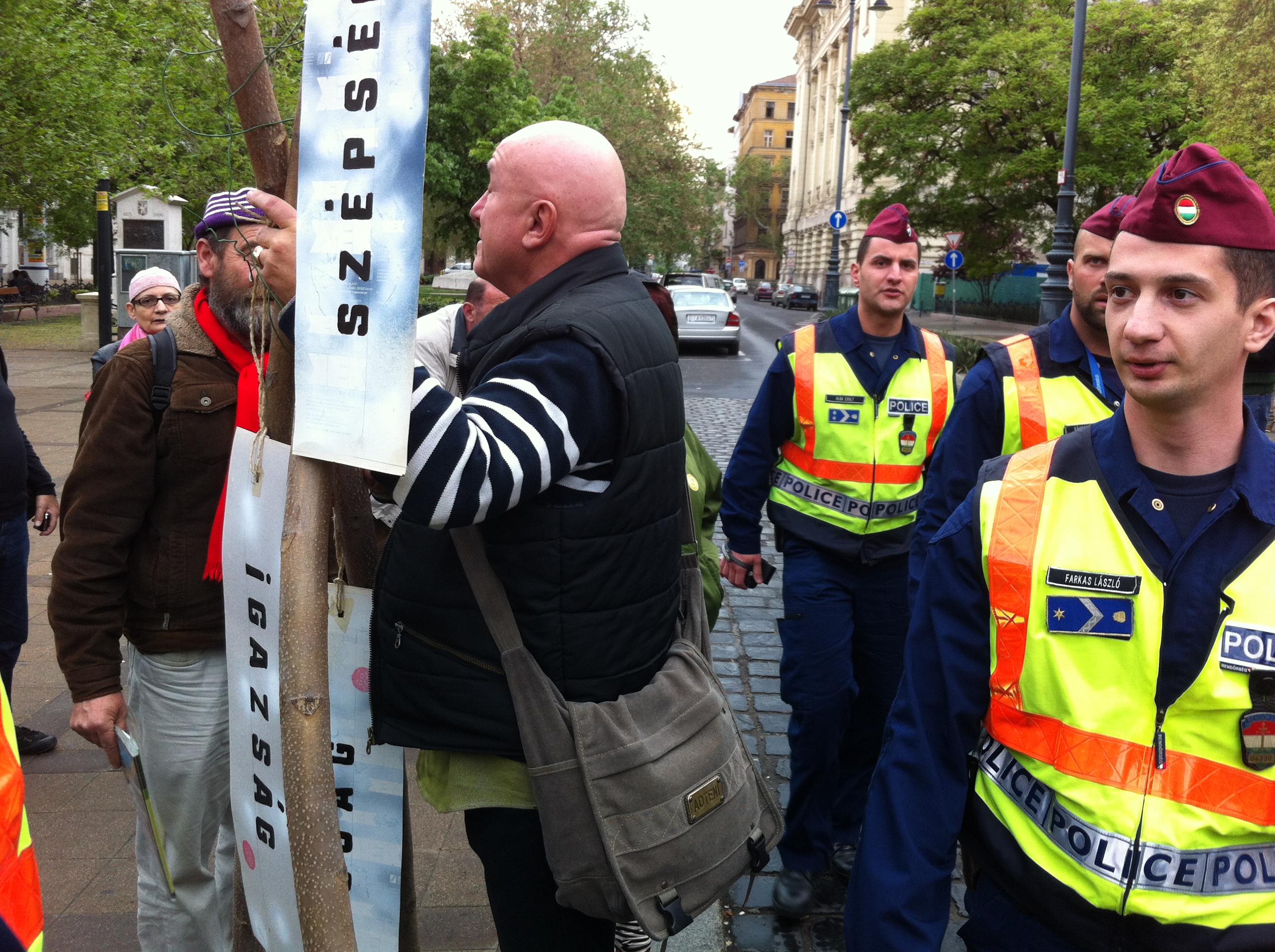
Walking home today from an Easter Monday walk in Budapest, we unexpectedly came upon an artist, Tibor Szilagyi, trying to challenge the government’s “Germany Made Us Do It” statue project in Freedom Square. Tibor wanted to protest the government’s planned statue, which aims to absolve Hungarians from any Holocaust guilt.
Tibor’s art installation was three large tree branches formed into a “tree,” each carrying one word written on a white streamer: “beauty,” “truth” and “goodness.” Two police stood warily nearby, guarding the site. This has been a confusing assignment for them. Every day the government’s workmen try to build up the base of the statue, and every day Hungarian protesters politely deconstruct it piece by piece. The police video this illegal activity, but aren’t arresting people yet. They wait and watch as people like Tibor work to create a counter-message on the site, one that seeks to honor the 560,000 Jews, Roma and other innocents killed almost entirely by fellow Hungarians during World War 2. Hungary was Germany’s ally until near the end, when the government tried to change sides, as they saw the Axis losing the war.
Some, like Prime Minister Viktor Orban, argue that Hungary had no choice, because if it didn’t ally with Germany from the beginning, it would have been invaded, like Czechoslovakia, and the Jews would have been killed sooner. Hungarian Regent Miklos Horthy tried to protect the Jews, under this interpretation, and nearly succeeded until the end of the war, when the Germans marched in to Budapest, rounded them up and send them to Auschwitz. But this account overlooks the decades of official Hungarian anti-Semitic laws and activities, including willing Hungarian complicity throughout the war in creating Jewish and Roma slave labor camps where thousands died, episodes of rounding up Jews from the countryside, and killing them; and the wholesale theft of Jewish businesses, property and jobs well before the Germans took over in 1944. Hungary allied with Germany in World War Two to get back the lands it lost the last time they joined together, as allies in World War One. In the end, it was Hungarians who shipped the Jews off to the death camps, or tied them together and shot them into the Danube in 1944. Only about 200 German troops were in Budapest at the time.
We were amazed to see how, in front of Tibor’s “tree,” the embattled scaffolding for the government’s statue has become a beautiful protest memorial of handmade signs, pictures, stones, and candles to honor the Holocaust dead. Someone placed two empty white chairs facing each other, to represent the lack of dialogue in Hungary about this painful history. Hungarians’ real roles are not discussed openly or honestly in most official textbooks; Holocaust guilt is not a widespread source of concern here. But the Fidesz government, to promote nationalist pride, has gone too far now, blaming Hungary’s German allies for everything that happened.
Tibor was taking the makeshift Freedom Square anti- memorial to a new level. The police decided today to call in reinforcements. Soon there were eight uniformed officers huddling around the artist. He smiled and chatted with passersby, while the officers looked puzzled about what to do. We were delighted to see the U.S. Charge D’Affaires, Andre Goodfriend, taking pictures of the scene and inquiring about what was going on.
We all took pictures, and, sensing that there was no violent confrontation in store, went home. If this shows up in the news here tomorrow, it will almost certainly be about a troublemaker who wanted to erect an illegal monument and disrupt the civil order. And it could well be about foreigners who don’t want Hungarians to be proud.
I hope Tibor is proud, and I would like to respect the pride of all Hungarians. But that would require that these whitewashing official historians face the truth honestly. That is the only way to build a future that can’t be torn down, plank by plank, every time a new government comes to power.
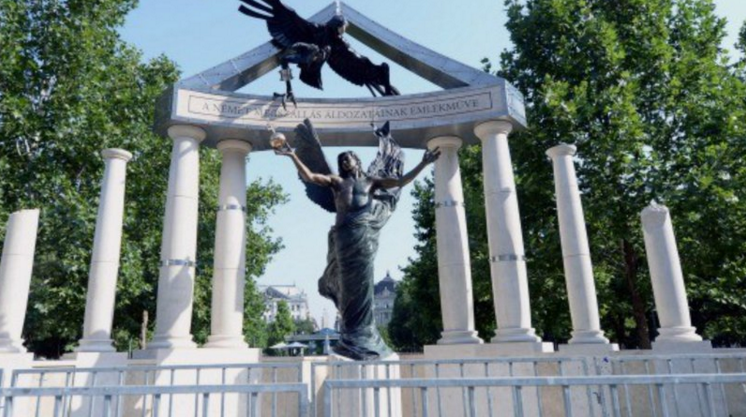
Today officially marks the 70th anniversary of the Hungarian holocaust. A few Hungarian government officials will put flowers by the Danube, where hundreds of Jews were tied together and ordered to take off their shoes. Only the first and last in the line were shot, but the rest, who were lashed to them, died by drowning as they were all pushed into the river. That way the Hungarian Arrow Cross government could save bullets.
Last night I watched as ordinary Hungarians, old and young, Jewish, Christian, dark, light, men, women, and children, worked nearby to stop the construction of a new statue in my Budapest neighborhood. This monument is a personal project of Prime Minister Viktor Orban, to blame Germany for the 560,000 Jewish, Roma and other Hungarian Holocaust murders during World War II. The international community has protested this statue, which denies that Hungary was Hitler’s willing anti-Semitic ally throughout most of the war. This memorial aims to airbrush away the fact that it was Hungarians, not Germans, who carried out most of the official roundups and murders here, after decades of laws discriminating against Jews. https://www.youtube.com/watch?v=XpFHbKbCCzc
Much has been made of the far-right party Jobbik, which did gain more than 20% of the votes in the April 6 election. But they are the only effective opposition party these days, so many of their voters came to them despite their neo-Nazi ideology. I am more worried right now about Prime Minister Orban’s victorious Fidesz party. They have adopted many of the worst aspects of Jobbik, under the guise of a “center-right” approach, and they are playing with fire.
The government delayed the statue project briefly before the April 6 election, but Orban began construction a few hours after his victory was assured. If ever anyone had the capacity to be magnanimous, it is someone who has just won re-election with a contrived two-thirds supermajority. But apparently Orban is not in a generous mood. He remains unconcerned that he is creating a “soft” form of Holocaust denial in the heart of the bloodlands where it occurred. These unhappy historical facts get in the way of his signature effort to help Hungarians be proud of themselves. In Orban’s world view, whatever goes wrong here has been the fault of the Turks, the Germans, the Russians, and now, the liberal West. Orban loves to beat up the EU, which gave Hungary 24 billion more Euros in support from 2007-2013 than Hungary provided back—and the USA. Hungarians, seeing this narrative every day in their media, believe Europeans and Americans are actively plotting to deny them their birthright and their pride.
It is part of an ugly pattern that everyone here–especially here!–should resist. It was this same approach that German’s Hitler and Hungary’s Admiral Horthy used, to blame conspirators for their nations’ ills. While Germany has moved on, being exceptionally clear about acknowledging the mistakes of its past, today’s Hungary has done the opposite.
It is such a waste. Hungary, which boasts a traditionally well-educated and hard-working population, could yet become a strong and admired country. Its geographical and political location at the crossroads of East and West could make Viktor Orban a world leader, brokering needed peace and economic agreements among Iran, Russia, and the West. Instead Hungary has lost the respect of international businesses and governments who are looking for a sound economy, based on the rule of law and relatively honest work. Orban nationalizes and blames others for Hungary’s bad reputation in the West.
Viktor Orban, who once was a dissident against the Communists in 1989, and won a scholarship paid for by George Soros, could have won his recent election fairly, because many people here like him, and the opposition was such a mess. But international observers have concluded that his Fidesz party was able to capture the “supermajority” with only 44% of the popular vote because they changed the election laws to favor their districts, their candidates, media access, new diaspora absentee voters, and much more. http://krugman.blogs.nytimes.com/2014/02/28/hungary-an-election-in-question-part-5/
One couldn’t even find posters for the opposition candidates, whose television spots were also effectively barred from the airwaves before the April 6 vote. What we saw everywhere was prime minister’s ubiquitous portrait, with the phrase: “Viktor Orban, Hungary’s Prime Minister,” and another poster depicting the opposition figures as clowns. I even got a text message on my cell phone on election day, reminding me to vote for Orban. That would have been illegal, of course. As a foreigner, I am not registered to vote here. The government apparently seized the phone companies’ customer lists to push out its partisan message. Opposition candidates did not have that option.
The police today are shooting video of every person dismantling each plank and metal piece of the statue. Once they are arrested or subdued, it is likely that in a matter of days, the statue will be rushed to completion. This huge project will dominate Szabadsag Ter, “Freedom Square,” home of the US Embassy (where Cardinal Mindszenty found asylum from the Soviets after 1956), the Soviet obelisk (thanking the Russians for defeating the Germans in 1945), dwarfing a lifesize Ronald Reagan statue (thanking the USA for helping to defeat Communism) across the park. The dismantlers will gain nothing for this act of rebellion, but their souls. It is particularly outrageous that the monument’s construction is undertaken during not only Passover and Easter week, but the 70th anniversary week officially remembering the Hungarian Holocaust.
While they have little gain, these protesting Hungarians have a lot to lose. The Fidesz government now seems to have virtually unchecked power. To be sure, Hungary is in the European Union, but only barely. It is moving farther and farther away from democracy and a market economy. I could be depressed, watching this regressive behavior, the predictable election results and the mass media here, which are afraid or unwilling to tell the truth. But instead I am impressed, deeply impressed, with these other people who are taking real personal risks in a state that is creating a new era of intolerance and autocracy. They don’t know what the government will do to them, but they are willing to take their chances.
We foreigners are watching, and will bear full and loud witness to what happens next.
Hungary is struggling with how to remember the 70th anniversary of the Holocaust —when 560,000 Jewish and Roma Hungarians were assembled, robbed, tortured, and executed, most in an unprecedentedly fast four-month blitz at the end of the war. The attempted genocide was carried out by Hungarians—thanks to the governing Hungarian Arrow Cross party–and the nation’s German allies, at the very end of World War II. (http://www.ushmm.org/m/pdfs/Publication_OP_2010-01.pdf)
Many people here still don’t regard the Jews and Roma of Hungary as real Hungarians. So the seeds of that original disaster remain in the culture. The far-right Jobbik party actively campaigns on these themes, blaming them for Hungary’s stagnant economy. The ruling Fidesz party—which will win re-election in April—is more duplicitous about this, speaking out of both sides of Prime Minister Viktor Orban’s mouth. But lately Orban’s government has tipped the balance to the anti-Semitic, anti-Roma nationalistic side, hoping to steal Jobbik’s votes for their own Fidesz party in Hungary’s April 6 parliamentary elections.
Of course it isn’t easy, after all those years of Communism, to build a national economy that works. It’s even harder to create enough equity and mobility to inspire people to get a better education, take innovative risks, and build a safe and just community together. This requires accountability, and trust. These two qualities are hard to find in Hungary. Instead, the current political leaders like to blame some “outsiders” for conspiring “against the state” for their own gain. They say it is the Americans, the European Union, the socialist opposition, and, increasingly, it is the “Gypsies”, and the Jews. They are the reason the elected leaders cannot give you a decent life. These political leaders don’t seem to worry that are playing with fire; it’s not their responsibility to think about the Holocaust carried out by their relatives sixty years ago, in these very neighborhoods where I live and walk every day.
A recent visit to the Budapest Holocaust Memorial on Pava St. offered me the exact names, faces and fates of many of the people where were murdered by their countrymen during World War II. There are Hungarians living here today who looked the other way as their Jewish and Roma neighbors were carried off and murdered. Perhaps they even participated personally in the roundups. They had a lot to gain, especially the apartments and goods and jobs of the Jewish Hungarians, who were vital leaders of the Hungarian national culture and economy. In 1920, 22.7% of actors, 27.3% of writers and scientists, 17.6% of painters, 23.6% of musicians, 50.6% of lawyers, and 59.9% of physicians were Jewish, according to Yale historian Eva Balogh, who writes an anti-government blog, Hungarian Spectrum. Many of Budapest’s most admired buildings were designed by Jewish architects, but today’s school children are ignorant of these facts.
Even though the Hungarian government claims to be mobilizing the nation to remember the Holocaust under an international spotlight, there is no evidence of an honest discussion now in Hungary—or interest in showing school children the deserted memorial exhibit on Pava St.—to understand what happened, who did it, and how that could have been possible. This is in sharp contrast to Hungary’s ally in both world wars—Germany—which of course has always borne the greatest burden of guilt for the Holocaust, and has also done the best job of educating subsequent generations about the dangers of anti-Semitism, eugenics and race-based conspiracy theories.
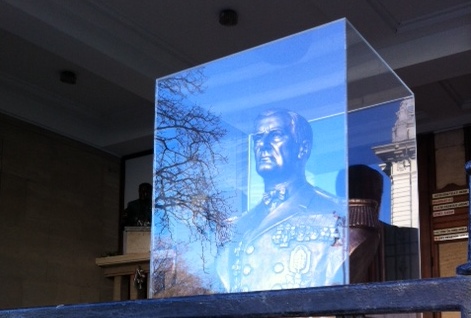
A different history is being invented in Hungary these days, with new statues being erected in prominent locations, in order to exonerate Hungarians of any wrong-doing. The narrative is that brave Hungarians have always been the victims of outsiders—in the case of 1944, they now want to say it was all done by the Germans, plain and simple. There is a new statue, put up by a church that is officially sanctioned by the government, lionizing Hungarian Regent Miklos Horthy, who, they don’t care to mention, voluntarily allied Hungary with the Germans during World War II. (See the thumbnail picture of the Horthy statue at the top of this blog.)
The aristocratic Horthy, who presided over the laws robbing Jews of their property, jobs, and freedom to marry non-Jews, forcing them into slave labor, and causing the unnatural deaths of at least 60,000 Jews before 1944, has a contested legacy because of his attempt to change course in the final days of the war. He had entered into an alliance with Germany from the beginning, supporting the Nazis with soldiers, material, Jewish laborers, and propaganda, until they started to lose. In 1944, he tried to secretly withdraw Hungary from the Axis, but Germany found out, invaded Hungary, pushed him aside, and installed the more extreme Arrow Cross government. Together these Arrow Cross Hungarians and their German partners killed half a million Jews in the final four months of the war. A garden at the beautiful Dohany St. Synagogue—the second largest in the world—was originated after World War I to honor the Jews who had built the Hungarian nation and defended it during the war. In 1944 the garden instead became a mass grave for Hungary’s no longer “honored” Jews.
The statue of Horthy depicts him up as a nationalistic hero worthy of emulation. Now a second new statue–a project passionately put forward by Prime Minister Viktor Orban—will further depict the Hungarians as victims of the Germans. This fits well with the House of Terror museum, which Hungarian school children ARE taken to, in the former headquarters of both the Arrow Cross and the Communist secret police. There is a lot of blame here against the Allies who dismembered greater Hungary after World War I, against Communists, and against Germans. But there is no accountability here for what the Hungarian government did to its Jewish and Roma citizens during World War II, which is laid out in exquisite detail at the much less visited Pava Street memorial.
The good news is that there is international pushback against this second statue, which is an official project of the Orban government. Prominent Hungarian and American Jewish groups have withdrawn from the 70th anniversary Holocaust commemorations, and the controversy has stained the Orban regime. Hungarians who know him say that Orban is not himself an anti-Semite or even an anti-Roma racist; rather he finds it useful to stir up these nationalist emotions in order to further accumulate and exercise power.
Orban tries to have it both ways, deploying his EU-friendly cabinet officers to mollify the West, while actively funding anti-Semitic projects and people, winking as government-funded church schools re-segregate Roma children, and as government-supported apparatchiks rewrite the nation’s history. His government loses lawsuits and diplomatic skirmishes with the European Union, but nevertheless proceeds with impunity.
The most vulnerable and despised citizens in the Hungarian national narrative are the Roma (gypsy) people, who remain caught in a centuries-old complex dynamic of poverty, illiteracy and discrimination across Europe. The Hungarians have received millions of dollars from the European Union to help integrate their Roma population, which has lived here for over 400 years. The government has little to show for this investment. Here is a unique feature the Orban regime has introduced: if you declare officially that you are a member of the Roma minority, you are allowed on April 6 to vote ONLY for the Roma ticket—which features candidates only from Orban’s Fidesz ruling party.
A new report by my friend Magda Matache at Harvard’s FXB Center shows how anti-Roma violence is rising in Hungary. Zsolt Bayer–a racist who holds a top editorial job at a newspaper sanctioned by the Orban government , is a founding member of the Fidesz elite, a friend of Orban’s and a beneficiary of government funding–wrote in January 2013 that Roma are no better than animals, who do not deserve to live with the rest of us humans. Is this not what happened in the run-up to the Holocaust?
It is hard, in the face of all this, to live in this country. But even though I am a foreigner, I have found a way to stand up. I have sought out wonderful Hungarians who are working against these racist themes and practices. We have linked and energized each other with a project inspired by the Not In Our Town (www.niot.org) movement in the USA. We have had support from the US and Norwegian embassies, Central European University, and scores of Hungarian activist groups. ELTE social psychologist Gyorgy Csepeli, a prominent Hungarian scholar and public intellectual, is among those working with us to actively defuse the dangerous anti-Roma narrative. He is conducting workshops in towns around Hungary, talking people-to-people, trying to avoid the party politics that make honesty so difficult. Some times the Hungarian government is even on our side. It may be tokenism, but every bit of help is appreciated.
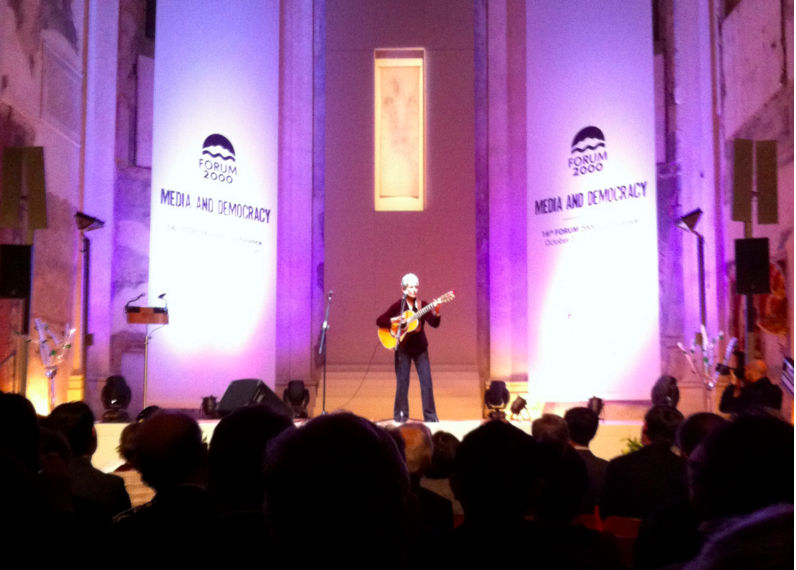
Hundreds of us gathered last Sunday night in Prague, to conjure the spirit of Vaclav Havel at the first Forum 2000 conference in 16 years that he wouldn’t attend himself. Olda Czerny, who faithfully served in Havel’s cabinet and ran these conferences, also died last year. We were feeling sad about all this when Jan Urban, the journalist who taught us how hard it is to “teach old cats to bark,” introduced a video of Havel onstage, carrying a guitar. Havel was joking that he wasn’t really a philosopher, playwright or politician, he was just a “guitar carrier,” a “roadie,” he said, for Joan Baez. When the lights came back on after this video, a luminous Joan Baez stepped onto the stage in person, and we sang “We Shall Overcome” together.
The next morning the Dalai Lama was there, in a video, exhorting that “we should feel more sense of responsibility” now that Havel is no longer on this earth. “His spirit we must carry.” He and Havel were essential allies. “Good things must start from one individual,” the Dalai Lama said. “Develop new ideas. We must implement.”
How can we channel Havel’s philosophy about how to promote human rights in difficult places? People came from Burma, Venezuela, China, the Roma ghettoes of Romania, India, Egypt, Japan, Kenya, Morocco, Russia, Belarus and elsewhere to share their strategies and concerns about this. Hundreds of students also participated, asking penetrating questions.
“The still very rich western world got more deaf and blind than before,” said Czech foreign minister Karol Schwartzenberg, in the clearest voice I have ever heard him speak. But this only means we must work to open their eyes, he said. “The chances are bigger. In Burma, I saw the effect again…Use the power of the powerless. It works.” Madeleine Albright also offered hope and advice. “Modern technology has made it harder to conceal facts,” she said. “We need to use technology to educate, not to enflame.” My favorite Czech storyteller, Jiri Stransky, advised with Havel-like simplicity that we must “educate by telling stories.” Stransky , who served 10 years in communist prisons, including 6 1/2 years of hard labor in a uranium mine, said he was taught by the “best brains” of Czech society since they were there in prison with him. “I have a doctor of prison sciences,” he joked. Romanian Valeriu Nicolae showed a clip from the film he is making about his club for Roma children who want to learn how to read, write and do math.
The new supranational institutions, such as the European Union, make it “harder to demagogue,” and make nationalist appeals “less of a factor in harming the destiny of people,”
said Enrique ter Horst of Venezuela, former UN deputy high commissioner for human rights. While there was a spirit of grace and determination at this gathering of people who are working in the hardest places in the world, we also heard some urgent warnings. Ukrainian and Belarus opposition figures talked about how bad it is. A panel pondered “Is Hungary a Democracy” and had a difficult time concluding that it is. Chinese blogger Michael Anti said that Google should leave China because all the servers in the country are in Beijing, in the hands of the government. There are no independent servers, neutrally passing data through the networks. When Chinese people put emoticons on their Chinese knockoff social network pages and microblogs, the government is mining that information to learn their opinions and gauge public sentiments at all levels, he said. Not surprisingly, the best comments were from Havel himself, shared by his English translater Paul Wilson. Wilson said the Havel presidential library should have over its mantel, his simple summary of how they brought down Communism: “We did what we could, and that meant we could do more. So we did more.”

If everyone is now a journalist, thanks to mobile media tools, how can consumers create a nutritious news diet for themselves? How can they sort out what reality is captured and what is constructed and therefore presumably less authentic?
This was the question we were chewing over at Gerbaud’s legendary Budapest patisserie yesterday. I was with two of the most experienced and creative thinkers about global media: Rosental Alves of the University of Texas, who knows everyone and everything about Latin America journalism, and Behrouz Afagh, head of the BBC’s Asia and Pacific news coverage. The day before, we had all heard a terrific idea from Fred Ritchin, the USA dean of news photographers, now a New York University photography professor because he left as photo head of the New York Times in 1982.
Here is Fred’s idea: when you digitally publish a serious news photo you imbed a link on the left corner of the image, that when moused over, shows a “before” image taken of the same subject just before the selected image, and in the right top corner, a link that shows an “after” shot taken just after the main image. It’s a way of seeing whether the selected image was constructed or was actually taken–as authentic photojournalism is supposed to be– from a real flow of action. This process itself could be faked, of course, as can almost everything now. But there would be a low incentive to fake these contextualizing “before” and “after” shots, since the point is that they would be voluntarily included by those who are trying to hold themselves accountable to a professional standard of veracity.
This kind of device, which unfortunately didn’t capture the imagination of our colleague Ethan Zuckerman at the MIT Media lab when we posed it to him as something we would like to see his designers create, is related to my own long-fantasized authentication tool. I would like a tool that would enable those who want to be held to a veracity standard (a “Good Housekeeping Seal of Approval.”)  The creators and spreaders of information would imbed a visible bug in any image, video selection or piece of text, that would carry its provenance. Where did this “fact,” image or story originate? We might also create a function to track where has it been since? It would automatically create a history like those we can access now for any given Wikipedia entry. The content that would be “bugged” would have to be fixed, like a pdf, which would make it difficult to remix or tweak. But that’s exactly the point. Its the raw material of fact, before it gets thrown into the great mixmaster of the web.
Of course, those doing risky communication would forgo using this history bug, in order not to be tracked down. This is sort of the opposite of Tor. (All tools can be used for evil. That doesn’t mean we should shy away from creating new tools.)
For those who are working hard to offer or find verified, authenticated facts and images, this little bug could offer a missing accountability factor. If people understand where a story (or image) comes from, they might know more about what credibility to give it. It could be introduced on a voluntary basis by the purveyors whose vetting is considered essential to their brand (New York Times, BBC.) This wouldn’t solve all the problems of critically evaluating the flow of content, but it would give us a tool we could sorely use.
If you add another feature—an automated or nonautomated micropayment feature that is tied to the authentification—then you might just have an interesting tool that would not only help people figure out what to take seriously, but would pay for this higher veracity stuff, supporting the often expensive production of investigative journalism and other hard-to-get vetted and contextualized news items.
Anyone like/hate these ideas? Your feedback is awaited.
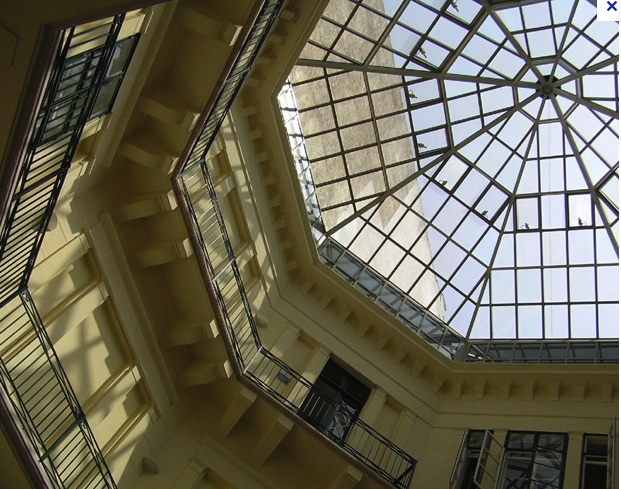
Central European University is a unique place, a gem. It is fragile. What happens here is extremely difficult to do. CEU takes people from damaged countries and helps them work for a better world. It encourages critical thinking, and seeks an honest engagement with history. It has no dominant nationality; students and faculty are drawn from over 100 countries. They embrace change, but work to channel it in positive directions…
It is to the great credit of George Soros that he invests and cares about this, rather than just going for the high-octane, easier tasks of lining up stars from Princeton, Cambridge, LSE, Oxford, Shanghai and Singapore. People from these places came this week to help launch CEU’s new School of Public Policy and International Affairs, whose motto is “purpose beyond power.” These luminaries are doing something great in their own settings, but it is frankly less ambitious than what we are taking on at CEU. And no matter how brilliant they may be, the things they know are a shadow of what the CEU community knows and does.
I am seeing a Dalit woman and a Roma woman, both of whom came from utterly outcast families, growing up barefoot with no prospects, come to CEU and flourish, with inspiring contributions to make to the larger world as well as their own embattled communities. In order to build a university that takes advantage of their experiences and ideas, and equips them to contribute to society, there are people who are working around the clock, and on weekends, with every bit of genius and energy they can muster. These are people who could have had easier lives at other universities. I am talking about John Shattuck and Wolfgang Reinecke, Liviu Matei, Noemi Kakucs, Kinga Pal, Kati Horvath, Ildiko Moran, Janos the driver, Sybil Wyatt, Peter Almond, Stephen Fee. High and low, they give it absolutely everything, to the detriment sometimes of their own health and personal lives.
A film that captures some of these stories is in its final editing phase. It is complex, subtle, and wonderful. I look forward to sharing it soon with all of you.
So how far should real journalists go in saying that someone is “misstating” the facts, i.e. lying? This was raised recently by the NYTimes ombudsman.
http://t.co/rn2GLZrx …Everyone came down on the poor fellow to say DUH, of course, that’s what real journalists are supposed to do! But it’s not so simple. Most politics is entirely faith-based. Why else would someone listen to those blow-hards on radio and tv, who lie day after day to paint a scary world full of conspiracies? Look for example at all the “documentaries” that claim the US government actually created the terrorist
http://freedocumentaries.org/int.php?filmID=94 attacks on the World Trade Center.
Or on any day of the week, look at how Glenn Beck or Bill O’Reilly or Ann Coulter or Laura Ingram push their mythical versions of Obama and US history out to the public. Are they lying? Yes! Do they know they are lying? I’m not sure. Reality and fantasy have merged into a coherent political vision that has real traction out there. Just look at the Tea Party guy who didn’t realize the “government” that he hates provides the Medicare that he loves.
So maybe its time to organize some more effective journalistic fact-checking. We need to take the great fact-checking websites: http://www.snopes.com/ for urban legends, and http://www.politifact.com/ and http://www.factcheck.org/ for USA political assertions, and connect them with red and green hyperlinks from the news texts to their findings.
So if a story about Obama or Romney making assertions is filled with green words, that means the links will show those statements to be factually pretty good. But if they are filled with red words, that means the links will show how the statement is distorted or untrue. By clicking on each green or red word, you could read each reference (like a footnote) that would tell you why it’s demonstrably true or false.
If the journalism is presented in paper, rather than digital form, you could place the story in the middle of white space, and then have cartoon balloons going off on all sides framing the story, each telling whether the phrase is true, and on what basis we determined that.
I have long fantasized about having a tag on information that floats around the internet—kind of a “Good Housekeeping Seal of Approval” that would indicate transparently the story’s original source and verification. The food chain of a factoid would then be visible—we could see whether it started out as malware, or whether it really appeared in that official budget document.
The sad part is I don’t think proving something is false will automatically take away its power to appeal. I’m remembering the “Swift Boat veterans” lying about John Kerry’s role during the Vietnam War, in a tremendously effective attack that he failed to counter. A woman interviewed by the NYTimes was asked if she knew the allegations were false, and what she thought when she was shown conclusively that they were. “It doesn’t make any difference,” she said; she still hated John Kerry.
Fairy tales would be fine if they weren’t the basis for going to war, and electing those who might choose do that again on the basis of other fairy tales. So we have to keep looking for ways to persuade people not only to figure out what is true and false…but to care and act on those facts.
It was a bit dizzying to have both Larry Lessig, who loves the Internet and social networks, and Evgeny Mrozov, who doesn’t, in town the same week. Larry held forth Monday on how money drives the legislative process in Congress, and Evgeny gave us some dark thoughts on Friday from his Net Delusion book about how slacktivism can divert us from genuine civic activity, even as dictators effectively nail folks down with heat-seeking propaganda tools and tracking technologies.
@Alaa Abd ElFattah was extended today for another 15 days.
Ahmad said that a turning point in the revolution came when the Mubarak’s regime actually shut down the entire Internet in the country. This required the activists for a time to resort to medieval catapults to lob their news bulletins out of the encampment on the square, to the periphery where theoretically people in the shadows would retrieve them.
Meanwhile, a rumored Occupy Budapest movement this weekend failed to materialize in nearby Szabadsag (Freedom) square. The police seemed to know in advance that something was up; a band of them were waiting just around the corner. A delegation of European press freedom advocates arrived Sunday night for three days, including meetings with government officials, to challenge the new Hungarian media laws. A study, to be issued this week by the Center for Media and Communication Studies where I am a fellow, will show that the Hungarian media laws are indeed out of line with European Union norms, despite the Hungarian government’s claims to the contrary.
So democracy is an ongoing struggle, with or without liberated media and communication tools. On the good news front, all of us—the Egyptian army, the embattled bloggers, the money bags in Congress and their critics, the Hungarian government and its critics–all of us apparently dodged an earth-crushing asteroid last week. To celebrate, I’m heading to the USA on Tuesday to see for myself how the home fires may be burning there as the winter begins.–Nov. 13, 2011
The quote of the day comes from, of all people, a GOP President of long ago:
“Now it is true that I believe this country is following a dangerous trend when it permits too great a degree of centralization of governmental functions. I oppose this–in some instances the fight is a rather desperate one. But to attain any success it is quite clear that the Federal government cannot avoid or escape responsibilities which the mass of the people firmly believe should be undertaken by it. The political processes of our country are such that if a rule of reason is not applied in this effort, we will lose everything–even to a possible and drastic change in the Constitution. This is what I mean by my constant insistence upon “moderation” in government. Should any political party attempt to abolish social security, unemployment insurance, and eliminate labor laws and farm programs, you would not hear of that party again in our political history. There is a tiny splinter group, of course, that believes you can do these things. Among them are H. L. Hunt (you possibly know his background), a few other Texas oil millionaires, and an occasional politician or business man from other areas. Their number is negligible and they are stupid. –Dwight D. Eisenhower http://bit.ly/aGUbaP
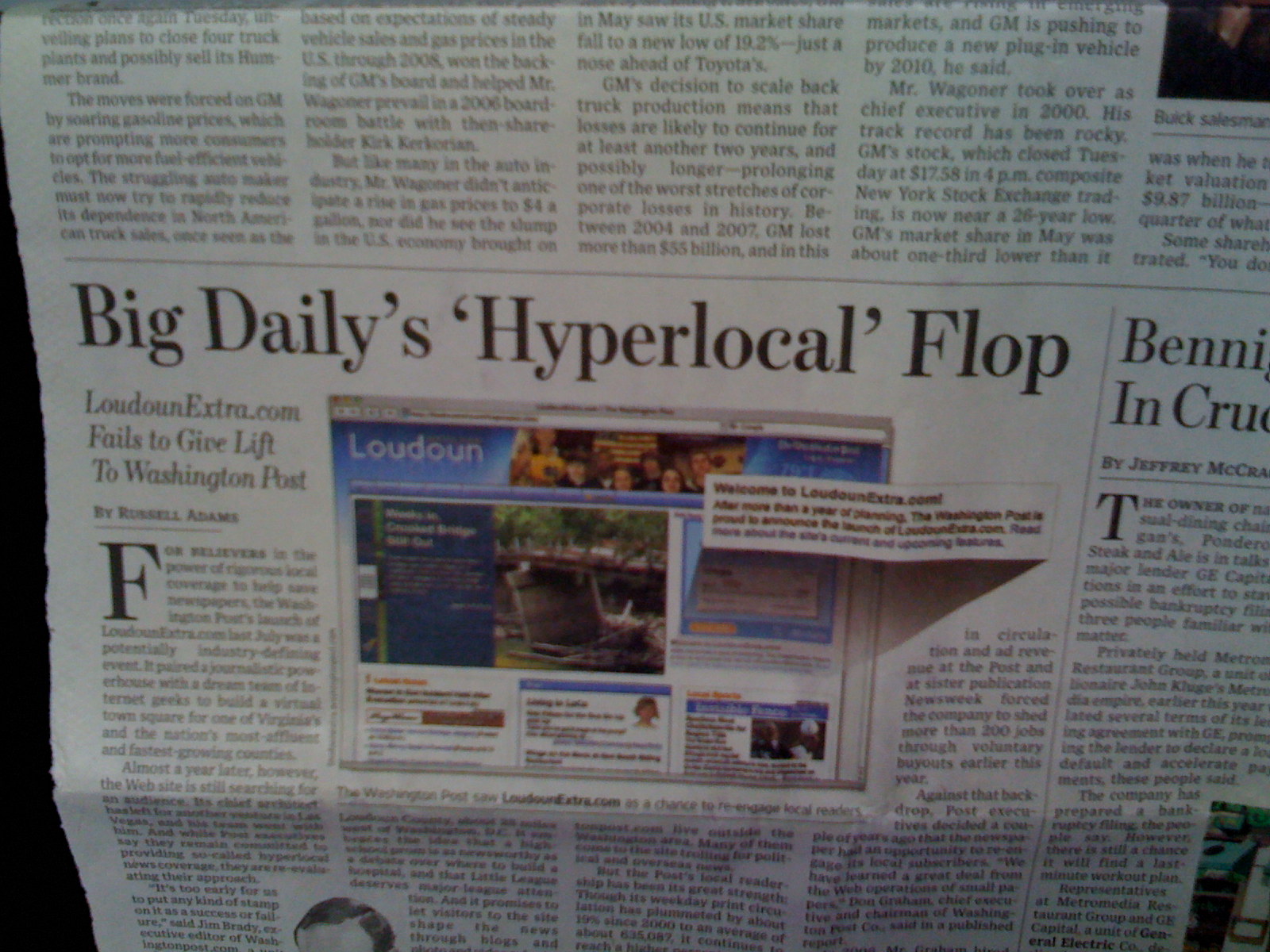
Why should we worry about the death of newspapers?
Reading any newspaper is pretty much a two-dimensional, impersonal, top-down, one-way, and often stupefying experience. News reports are infuriatingly self-referential and incomplete. If they stir us up they don’t give us any place to go. Is this civic engagement? The endless stream of revelations and problems, celebrities and disasters, seems disconnected from our own personal choices and public solutions. Too often, newspaper readers feel like “passengers in the back seat of the car, howling at the driver,” as MIT Prof. William Uricchio once put it.
Now we, the public, can be the drivers in a three-D world, with enticing participatory media that are upending power relationships, changing the links between user emotion and action, creating and engaging communities, providing platforms for people to do things for each other, and allowing a new sense of public space. We get more information than we can use, including original documents and expert opinions. We can all be prod-users: publishing our news to the world through Twitter, Facebook, YouTube and a wealth of cellphone tools that allow us to collect, geotrack, prioritize, keep and spread stories, pictures, videos and images.
These tools enable people not just to have more fun, but to contribute to political campaigns, bear witness to official misconduct, arrange meet-ups to deal with local problems, crunch and visualize data, and write rough drafts of history for public resources like Wikipedia. If watching television disengaged people from community, as Harvard political scientist Robert Putnam asserted in his famous “Bowling Alone” study, new media technologies are drawing us together with extraordinary results.
So why don’t we wash all that ink off our hands for good?
We certainly can give up the ink and paper format. But we are suicidal idiots if we give up the professional service that newspapers provide. Newspaper journalism is the foundation of the watchdog news chain. The best newspaper journalists have our back and work on our behalf to sort out what’s true and publicly relevant, whether they or their advertisers like it or not. That is what they mean by “objectivity.”
Good independent journalism is hard to do. It costs money. It also requires a popular culture that supports unpopular questions and answers. It asks citizens to live in the real world and care about what is factually true. It requires a support structure based on something other than the voyeur pornography of violence, sex and celebrity.
At their best, newspapers provide what Alex Jones calls the “iron core” of news, the honest, time-consuming effort by paid professionals to hold the powerful accountable. Television and radio newscasts, Google news, Jon Stewart, Rush Limbaugh, and the people who run the world still depend to a large extent on the flow of facts and assertions vetted, organized and prioritized by newspaper journalists. Internet advertising without subscription fees cannot finance “iron core” journalism. So newspapers, even as they adapt to the web and cell phone platforms, are going bankrupt and journalists are losing their jobs.
Technology is not the sole culprit. Neither journalists nor the public have adequately differentiated good journalism from bad, nor defended newspapers when they have been under attack from self-interested ideologues. It has been increasingly hard for news organizations to resist offering simply whatever the public wants, instead of fighting for what the attentive citizen needs to know. Journalists too often have abandoned the qualities that made them both controversial and essential.
For new business models to work, journalists need to provide news services of unique value and promote their credo as effectively as the critics have attacked it. Media literacy training should be part of basic education for everyone, as power and responsibility for evaluating the news moves from the elite to the street. Technology alone didn’t destroy journalism, but a thoughtful use of digital and participatory media can help save it. We need to build and organize fan groups for real journalism and turn that support into sustenance.
The smartest digital entrepreneurs understand the continued importance of good journalism. Despite our information overload, vital news and information is deliberately hidden—as prize-winning newspaper and magazine exposes of corruption, torture, spying on citizens, and other issues, continue to teach us. We need someone with clout to hold propaganda creators accountable, while being accountable themselves. We know where to find these journalists if they mess up. In contrast, we can’t expect the evanescent and sometimes anonymous virtual digital folks who volunteer their pieces of information, to provide the consistent, influential flow of relevant, verified news that people require every day in a democracy.
We need a common picture of the real world that we cohabit today, if we are going to work together to build the future. Without professional journalists in the mix, we are tempted to travel only the streets we already know, mirroring ourselves with our media choices, rather than facing unwelcome facts. That is why we need to save newspapers—or at least the journalism they can provide. They help us demand the best from the powerful, and from ourselves.
Originally published in Newsday, December 2009.