Living in the heart of darkness (Silicon Valley) for the past three months has taught me that we cannot pin our hopes for American democracy on the great media platforms: Facebook, Google, Twitter, YouTube, et. al. Their leaders seem to know only how to make money from us, and the tools they have invented are out of control. The companies are proving incapable of dealing with the information dystopia they have created. Digital innocents think they are accessing an agnostic information universe when they click onto these platforms. Instead, we are getting the content most likely to confirm our prejudices, based on all the private information we have shared through our online search, posting, shopping and “like” histories.
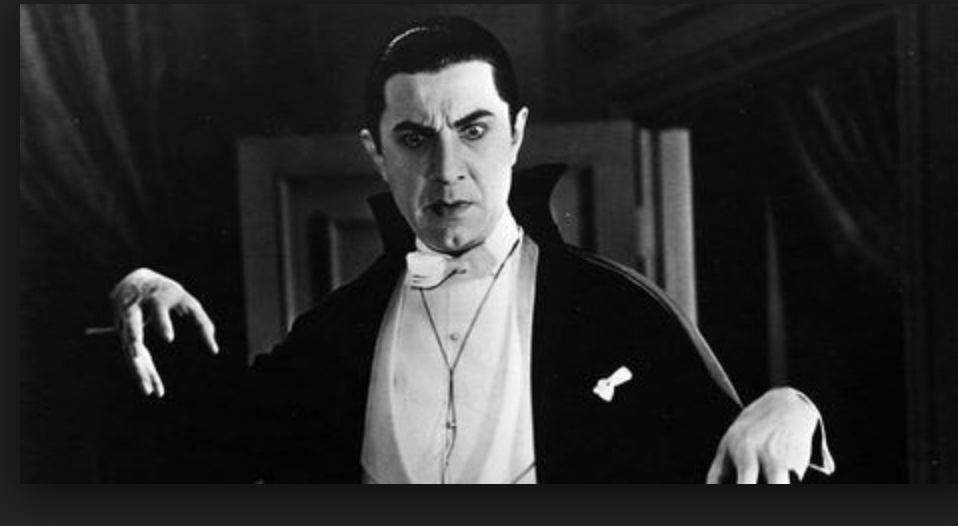
Mark Zuckerberg is the man in the hot seat, forced to defend the tech platforms’ vampire business model to Congress. People are just beginning to wake up to the problems generated by these data-sucking companies. Facebook now has 2 billion members around the world, whose private preferences are the “product” Facebook has given to any “advertiser” that comes along. Because they know so much about us, Facebook’s clients–malicious Russian robots and conspiracy theorists included–can figure out exactly how to win our trust. Analysts who know Facebook intimately, including Kara Swisher of RECODE and Farhad Manooj of the New York Times, confirm that Zuckerberg and his peers have no idea how to deal with, or even measure, the profound social and political impacts they have unleashed.
Google, which has the most data of all, has done a marginally better job of weaning its search engine off robotic conspiracy theories. But it has failed to care much about the fake news and hate speech its subsidiary, YouTube, turns up as preferred content.
Belatedly, as the techlash gains force, some folks in Silicon Valley are thinking about software solutions. Below is one look at whether the algorithms that got us into so much trouble can reverse course, and nurture our better natures. This depends entirely on the values and priorities of the people writing the code for it. Given the track record so far, this is not reassuring. We need laws that companies must follow. This requires government policies, demanded by media literate citizens using their real intelligence.
I don’t think that ceding more power to algorithms is the best solution. It may be part of the response, but it can’t be the whole story. I like the idea floated by Markos Kounalakis: create a Mayor of Facebook. Create accountability through human, democratic systems, so that people can help other people when they are doxxed, their identities are stolen, and their safety is compromised by viral hate videos. Here is Markos’s brilliant idea:
We’ve had an amazing three months in San Francisco and Berkeley, but now that the snows are melting back East, and the boys are swinging their bats, it’s time to head home. Easy Rider is tanned, rested and ready. We the drivers, not so much, thanks to a wonderful round of farewells that continue for several more days. We depart April 15 and will find our way through many national parks and heartland cities. On the horizon: Lake Tahoe, Death Valley, Zion, Bryce, Denver, St. Louis, Louisville, Gettysburg and other iconic spots. Stay tuned for reports and photos! Wish us smooth roads, generous truck drivers, and colorful encounters. As we say goodbye, here are a few snapshots to remember our adventure out West.
We surprised ourselves by skipping our beloved Monterey aquarium, and setting off instead to see something new: the John Steinbeck center in Salinas. Here on display was Rocinante–his Travels With Charley camper–and other mementos of the America he brought to life.
Steinbeck chose to represent the underdog, as a great journalist must do. He worked in the lettuce fields, instead of taking his place in Salinas’s middle class. His father was a California businessman, a middle manager at a flour company that went bust, and then, at Spreckels, the largest sugar company in the world. John Steinbeck was a contemporary of Hemingway, but he was more interested in social justice than proving his manhood. Steinbeck’s novels told the world about the invisible victims of the Great Depression, like the Dustbowl Okies, who fled from their forfeited farms to California, only to starve or be exploited there.
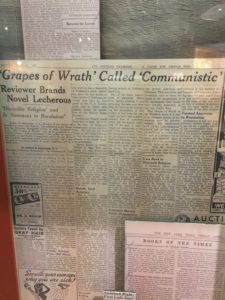
Banned and Burned
The city fathers in Salinas were not comfortable with the ugly truths he exposed, calling his work “Communist propaganda.” In Kern County, they banned his books and burned Grapes of Wrath in a town square! But Steinbeck prevailed, winning the Pulitzer Prize, the National Book Award, the Nobel Prize for Literature, and the Presidential Medal of Freedom in 1964. Today there is fancy building in the middle of town, called the National Steinbeck Center. It is one of Salinas’ main touristic claims to fame.
As we headed up to San Francisco at last, John decided that we should also name our car, in honor of our own journey across America. It would be Easy Rider, after the iconic 1969 hippie road trip movie featuring Peter Fonda. Peter’s father Henry Fonda starred in the 1940 film of Steinbeck’s Grapes of Wrath, which launched his film career.
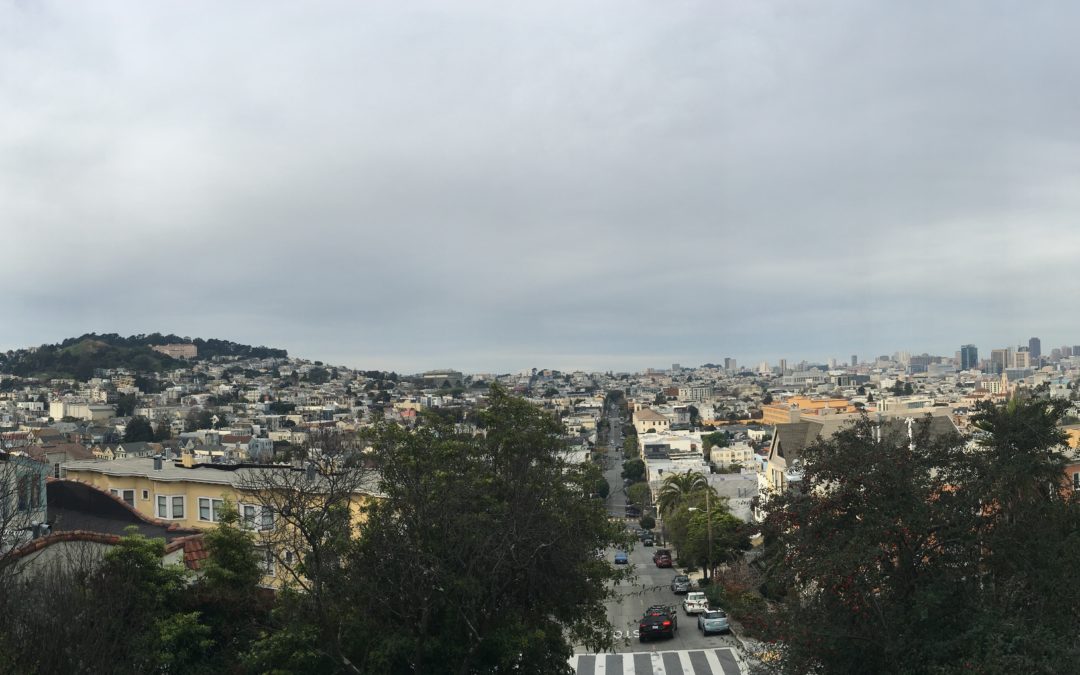
When we finally arrived at Sanchez St., we were ready for this journey to end. Now we could settle in to the Wild West of San Francisco’s Castro neighborhood, with its rainbow flags, composting rules and counterculture history. Here, every fetish was a noble rebellion. The punky skunky smell was artisanal marijuana, sold legally at the nearby Apothecarium. When two young, white homeless men in a bedraggled tent set up on the sidewalk across from the laundromat, the police came to move them along. But instead of snarling and arresting them, the way they do in Budapest or New York, the officer asked, “Do you need services?”
Ah, we’ve come a long way, from Boston, and even Salinas. It’s time to cultivate our garden–and think about all that we’ve seen.
Jan. 13-14: Pioneertown and Hearst’s Enchanted Castle
As we left the desert, we couldn’t resist a side trip to Pioneertown, a Wild West film set still popular with tourists. All sorts of Hollywood B movies were made here. Pappy and Harriet’s, the funky café at the edge of town, has hosted famous country and rock performers on stage for 35 years.
After patting a few goats, taking snapshots and fortifying ourselves with iced tea at Pappy and Harriet’s, our desert idyll was over. We headed north, skirting the LA basin past Barstow and Bakersfield, toward Paso Robles.
Unstable Ground
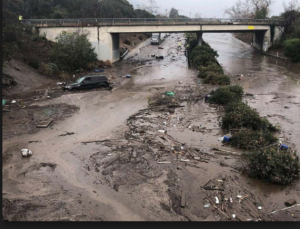
We could have veered west into the dense labyrinth of LA, enjoying some of its Hollywood splendor before heading up the coastal Highway 1. I lived here twice, when I was in my early 20s– first on a Carpinteria mesa where I was a housemother at a boys’ prep school, and then in Malibu, when I had my favorite job as a general assignment reporter for the Los Angeles Times. John and I had planned to stay in Santa Barbara on Jan. 12 to visit my old friend Roxie, who lives on her grandparents’ avocado ranch. But she had to flee in the middle of the night on Jan. 9, as flash floods and mudslides roared by her house. The river of mud killed 21 people in Santa Barbara County, injuring 120 more, and destroying 100 homes.
As we detoured north on Jan. 13, a victim was still missing in the mud, which was blocking all north-south traffic on Santa Barbara’s main highway 101.
California is notoriously unstable, which is both its downfall and its genius. The abrupt tectonic movement of the earth, the wild fires and floods, also permeate its culture. In California, the expectation of the new allows people to migrate here and start again, defining themselves as they wish, without the historic constraints of ancestry or neighbors who know who you really are. Change is normal. It’s a place where you have to be young, no matter how old you are.
We drove inland, up the spine of the state, past solar and wind farms, and irrigated fields of citrus and grapes. This was, and always will be, Steinbeck country. A few figures huddled in the fields, picking winter crops. Darkness had already fallen when we finally turned toward the coast at Cambria. We could hear and smell the ocean, but we would have to wait until sunrise, to actually see it.
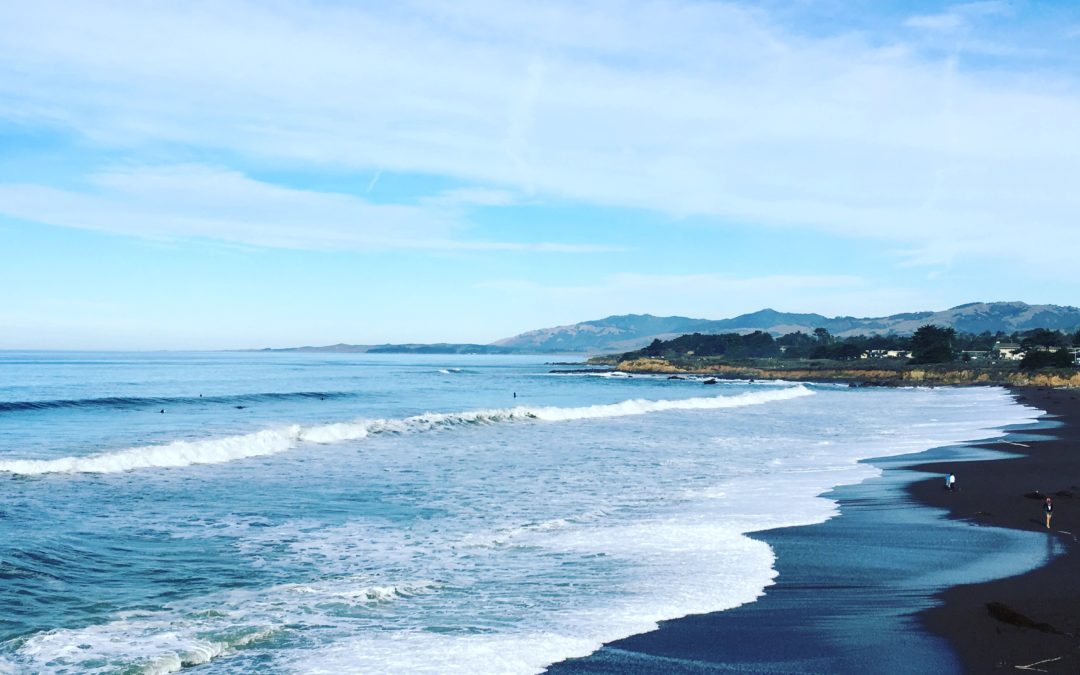
The next morning we headed down to the musky-smelling sea, walking on wet sand littered with driftwood and long ropes of kelp. We were surprised to see so many old surfers, still mounting the waves in their winter wetsuits.
Hearst’s Hilltop Folly
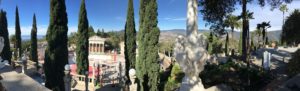
At Hearst Castle, we boarded a bus for the 5-mile, cliff-clinging ride up Hearst’s mountain. From here, William Randoph Hearst ran one of America’s greatest 20th century media empires, which he used without apology, to his own personal advantage. He took his father’s mining fortune, bought newspapers, and from 1919 to 1947, built this extraordinary set of buildings and gardens in the middle of nowhere. It ultimately encompassed 250,000 acres of prime coastal and grazing land. Aside from a term in Congress, Hearst never had the political career he lusted after. His extraordinary lifestyle on this mountaintop, complete with wild animals and frolicking Hollywood stars, was unsustainable. Now, as a California state park, his castle remains an unparalleled masterpiece, attracting 750,000 paying visitors each year.
Even in today’s era of obscene billionaire mega-mansions, Hearst’s project is the most ambitious private residence ever built in America. Donald Trump couldn’t begin to compete with its excess. The White House is a shack in comparison; Elvis’s Graceland is a broom closet. According to Wikipedia, Hearst’s great mountain top estate “featured 56 bedrooms, 61 bathrooms, 19 sitting rooms, 127 acres of gardens, indoor and outdoor swimming pools, tennis courts, a movie theater, an airfield, and the world’s largest private zoo.” Although he had to sell off his exotic animals after the 1929 stock market crash, a few zebras still mingle today with the cattle herd grazing on the grounds.
Today Hearst Castle is like an aging but still glamorous movie star, dependent on expensive reconstructions, illusions, and memories. For all its hubris, this place is magical. The credit goes to architect Julia Morgan, but apparently Hearst also had a hand in its design. He kept buying bigger tapestries and art works, forcing the exasperated Morgan to redo her carefully proportioned stone walls and ceilings. The estate combines genuine 3,000 year old treasures, including Egyptian, Roman, Greek and Renaissance artworks, mixed with homey touches, like the bottles of ketchup Hearst insisted on serving at his baronial table. Hollywood royalty were his ultimate decorative flourish; they flew in for house parties throughout the 1930s and 40s.
When we had picked this town out on the map, it was mostly because I knew we didn’t want to be in Palm Springs or its neighboring fancy resort towns. This would be an entirely different kind of place, a counterculture oasis. It was where Gram Parsons’ friends tried to fulfill his cremation request when he died of a drug overdose in 1973. A decade later, Joshua Tree National Monument (now Park) inspired the title of U2’s best and most famous album. Bono said, as he was creating the music, “I started to see two Americas, the mythic America and the real America.” [From Wikipedia: King, Philip, and Nuala O’Connor (directors) (1999). Classic Albums: U2 – The Joshua Tree (Television documentary). Isis Productions.]
We also saw more than one America, as we were driving across the continent to get here. There were rich Americans living in porticoed estates, next to poor Americans, in unpainted wooden shacks. There were Black American slave descendants, still waiting table for the white heirs to antebellum privilege, in unsustainable plantation houses that rented out rooms for the night. The original Native Americans were both everywhere and nowhere, thanks to relentless efforts by European, Hispanic and other interlopers to take over their territory. We met white Christians and black Christians, intimately close on the radio airwaves, but far apart in the physical world. There were East Asian immigrants working at gas stations, and fourth-generation Appalachian truckers who paid them for a cup of coffee. Underneath it all was the hot magma of politics, ready to spew forth at the slightest provocation: volcanic Trump fans and anti-Trump fanatics, who couldn’t stand to think about each other’s worthy existence. They were all Americans, engaging somehow in the same national destiny, without the common bonds of blood, history, or plans for tomorrow.
John booked us a romantic retreat at Campbell House in Twentynine Palms, which, appropriately, was deserted. We loved the story of the stone house’s construction in the mid- 1920s, by disreputable newlyweds. Elizabeth Crozer, a Philadelphia debutante, was disinherited when she ran off to marry Bill Campbell, an orphan who’d been injured by mustard gas in WW1. They were advised by Dr. James Luckie of Pasadena that the desert might heal his damaged lungs. The advice was brilliant. Bill survived another 20 years, long enough to live through the next world war, from their desert redoubt.
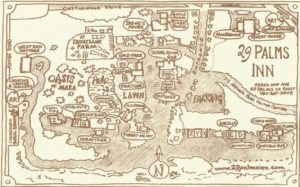
The healing qualities of the desert air were especially good news for us, since John and I were still coughing like crazy from the colds we picked up in the South. We got a little lost on our first night, driving under faint stars in the desert’s famously dark sky, to the Twentynine Palms Inn for dinner. It was great to finally be in Southern California, at the edge of the legendary Joshua Tree National Park! We felt better already. Was it the desert air, the live bluegrass music, or the margaritas? We waited for two seats at the bar, crowding in among the locals. This place had a special vibe, a kind of desert version of Rick’s legendary Casablanca café.
When the young Campbells camped out in the winter of 1924-5, in an isolated tent near the Mara Oasis, having a named Twentynine Palms was still a mirage, There were just seven or eight other shacks. The Campbells mingled with the Native American nomads who watered seasonally at the oasis, and became avid archeologists, documenting the earliest human life in the area. http://campbellhouse29palms.com/history.php
Elizabeth’s father relented and she received her inheritance, so they built their 1929 estate on 25 acres of high desert. After Elizabeth died in 1971, the children sold the property to the composer who wrote “Zip-a-de-Doo-Dah.” He turned it into a Hollywood party house. An English aristocrat then bought the place, installing her china teapot collection and renaming it Roughly Manor. Today it is the quirky Campbell House B&B, honoring the young couple who started their runaway marriage here.
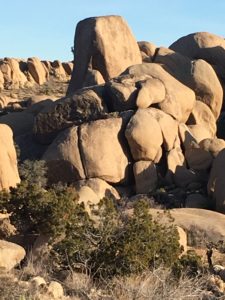
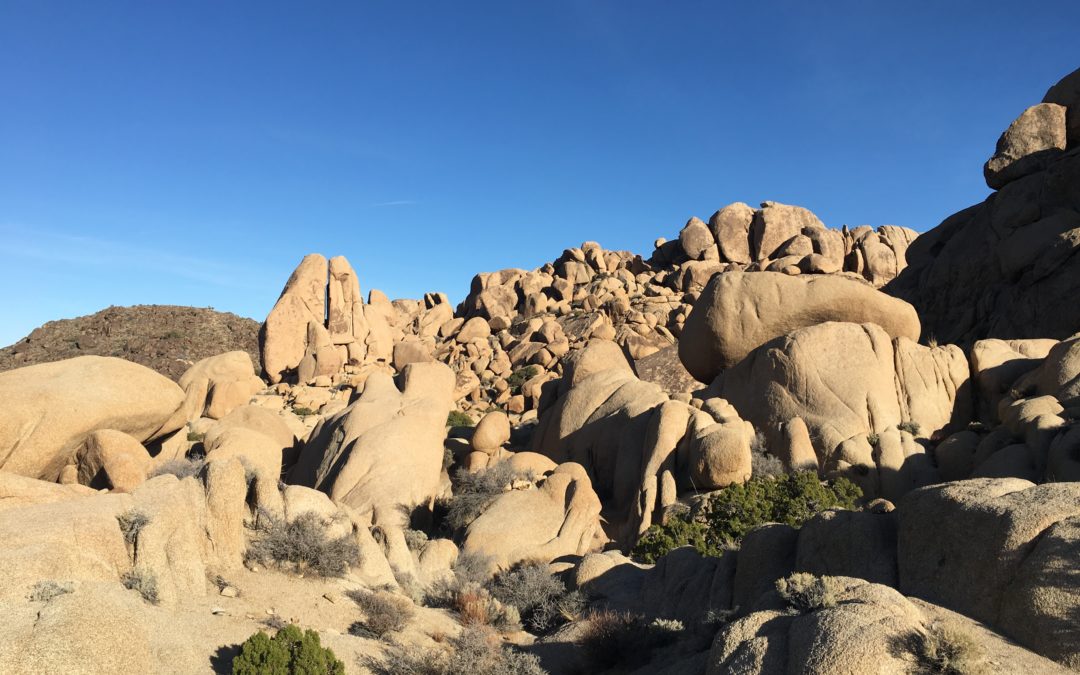
We stopped at the Joshua Tree National Park headquarters the next day, full of rookie questions. What are Joshua trees, anyway? They looked like frenzied cactuses, arms all akimbo. They are actually short-spiked agave plants, the ranger explained. The smaller chocotillo cactuses, other denizens of this desert, grew huddled together like a tribe of chattering monkeys. And then there were the enormous sand-colored rocks, balancing against each other in random formations. What mighty force could have pushed them into such improbable dependancies?
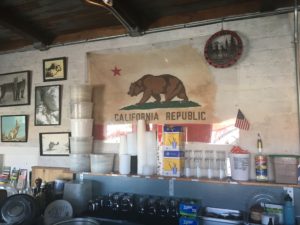
We drove half and hour to lunch in the nearby hippie town of Joshua Tree, but took a wrong turn. We found ourselves dead-ending into a very large, official sign that said “Live Combat Zone. 100% I.D. required.” U.S. Marines came out of a formidable guard post to confront us. We turned the car around very, very quickly. It was a relief to find the right road, and stumble into the Crossroads Café. Its dreadlocked and tattooed waiters were escapees from places like East Harlem and Boston, and they occupied a completely different world from the Marine base close by.
The Crossroads Cafe
We learned that like everywhere else, the Native Americans had a terrible time in this area, as the newer Americans took over in the 20th century. There was the tragic death of a gifted Indian runner named Willie Boy, who fell in love with a non-Indian girl and committed suicide in 1909, after being framed for her murder. Folks are sorry about it now. What was done, is done, but that doesn’t mean it’s over with.
On our second night, as we took up our favorite perch at the Twentynine Palms Inn bar, we struck up a conversation with the folks sitting next to us. Some were from the local community college, and some from the Marine base. They were all friends. After hearing them talk about military things, I asked “What do you think about North Korea?” Their reaction was swift and unanimous: if Trump hit the nuclear button, General Mattis, the Secretary of Defense, would save us. He was sane, even if the Presidents of the United States and North Korea were not. One speaker said he grew up on various military bases, with a father who served in Vietnam. “I’m grateful for being exposed to the wider world,” he said, “so I know what Trump is.” How can we talk to Trump voters now? I asked innocently, holding my breath. “You don’t,” he said firmly. “You talk to them with your votes.”
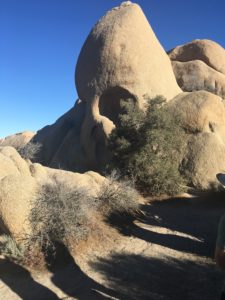
Skull Rock
The next day was our last at Joshua Tree, so we took an especially long hike, on a path through the giant desert rocks. We watched for rattlesnakes that never appeared, stopping at Skull Rock, the Keys View lookout, and Barker Dam. I imagined the Campbells, carefully labeling Indian artifacts there, and the cattle rustlers and gold prospectors who died seeking their fortunes. To John, some rocks looked like sleeping elephant seals, and I saw others that were petrified whales or ghosts.
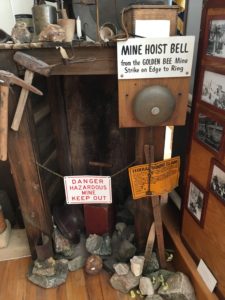
In the afternoon we stopped by the former one-room Twentynine Palms schoolhouse, now a museum. Normal glassware, left in the sun, would turn purple in the old days. The tiny museum was crowded with gray-haired visitors, one carrying an oxygen tank, another leaning on her walker. They were listening intently to an aged volunteer, who was glorifying the pioneers.They were oohing and ahing at a gold mine shaft.
The past: mining gold
Old people are building the past, I realized, looking around me. Young people are building the future.
We were going to be back on the road the next morning, driving north through Barstow, toward our San Francisco goal. In two days, we would be living in yet another America, the unstable epicenter of its high tech industries, where twentysomethings are mining artificial intelligence and virtual realities to invent another brave new world.
On our last night in Twentynine Palms, we watched a wobbly old videotape of John Huston’s “Grapes of Wrath,” which even in its original black and white, is a magnificent movie. It prepared us for the final push of our journey, through Monterey to Salinas, where John Steinbeck worked the lettuce fields and learned everything he needed to know, in order to write one of America’s greatest, and most devastating sagas.


 When we had picked this town out on the map, it was mostly because I knew we didn’t want to be in Palm Springs or its neighboring fancy resort towns. This would be an entirely different kind of place, a counterculture oasis. It was where Gram Parsons’ friends tried to fulfill his cremation request when he died of a drug overdose in 1973. A decade later, Joshua Tree National Monument (now Park) inspired the title of U2’s best and most famous album. Bono said, as he was creating the music, “I started to see two Americas, the mythic America and the real America.”