Central European University is a unique place, a gem. It is fragile. What happens here is extremely difficult to do. CEU takes people from damaged countries and helps them work for a better world. It encourages critical thinking, and seeks an honest engagement with history. It has no dominant nationality; students and faculty are drawn from over 100 countries. They embrace change, but work to channel it in positive directions…
It is to the great credit of George Soros that he invests and cares about this, rather than just going for the high-octane, easier tasks of lining up stars from Princeton, Cambridge, LSE, Oxford, Shanghai and Singapore. People from these places came this week to help launch CEU’s new School of Public Policy and International Affairs, whose motto is “purpose beyond power.” These luminaries are doing something great in their own settings, but it is frankly less ambitious than what we are taking on at CEU. And no matter how brilliant they may be, the things they know are a shadow of what the CEU community knows and does.
I am seeing a Dalit woman and a Roma woman, both of whom came from utterly outcast families, growing up barefoot with no prospects, come to CEU and flourish, with inspiring contributions to make to the larger world as well as their own embattled communities. In order to build a university that takes advantage of their experiences and ideas, and equips them to contribute to society, there are people who are working around the clock, and on weekends, with every bit of genius and energy they can muster. These are people who could have had easier lives at other universities. I am talking about John Shattuck and Wolfgang Reinecke, Liviu Matei, Noemi Kakucs, Kinga Pal, Kati Horvath, Ildiko Moran, Janos the driver, Sybil Wyatt, Peter Almond, Stephen Fee. High and low, they give it absolutely everything, to the detriment sometimes of their own health and personal lives.
A film that captures some of these stories is in its final editing phase. It is complex, subtle, and wonderful. I look forward to sharing it soon with all of you.
So how far should real journalists go in saying that someone is “misstating” the facts, i.e. lying? This was raised recently by the NYTimes ombudsman.
http://t.co/rn2GLZrx …Everyone came down on the poor fellow to say DUH, of course, that’s what real journalists are supposed to do! But it’s not so simple. Most politics is entirely faith-based. Why else would someone listen to those blow-hards on radio and tv, who lie day after day to paint a scary world full of conspiracies? Look for example at all the “documentaries” that claim the US government actually created the terrorist
http://freedocumentaries.org/int.php?filmID=94 attacks on the World Trade Center.
Or on any day of the week, look at how Glenn Beck or Bill O’Reilly or Ann Coulter or Laura Ingram push their mythical versions of Obama and US history out to the public. Are they lying? Yes! Do they know they are lying? I’m not sure. Reality and fantasy have merged into a coherent political vision that has real traction out there. Just look at the Tea Party guy who didn’t realize the “government” that he hates provides the Medicare that he loves.
So maybe its time to organize some more effective journalistic fact-checking. We need to take the great fact-checking websites: http://www.snopes.com/ for urban legends, and http://www.politifact.com/ and http://www.factcheck.org/ for USA political assertions, and connect them with red and green hyperlinks from the news texts to their findings.
So if a story about Obama or Romney making assertions is filled with green words, that means the links will show those statements to be factually pretty good. But if they are filled with red words, that means the links will show how the statement is distorted or untrue. By clicking on each green or red word, you could read each reference (like a footnote) that would tell you why it’s demonstrably true or false.
If the journalism is presented in paper, rather than digital form, you could place the story in the middle of white space, and then have cartoon balloons going off on all sides framing the story, each telling whether the phrase is true, and on what basis we determined that.
I have long fantasized about having a tag on information that floats around the internet—kind of a “Good Housekeeping Seal of Approval” that would indicate transparently the story’s original source and verification. The food chain of a factoid would then be visible—we could see whether it started out as malware, or whether it really appeared in that official budget document.
The sad part is I don’t think proving something is false will automatically take away its power to appeal. I’m remembering the “Swift Boat veterans” lying about John Kerry’s role during the Vietnam War, in a tremendously effective attack that he failed to counter. A woman interviewed by the NYTimes was asked if she knew the allegations were false, and what she thought when she was shown conclusively that they were. “It doesn’t make any difference,” she said; she still hated John Kerry.
Fairy tales would be fine if they weren’t the basis for going to war, and electing those who might choose do that again on the basis of other fairy tales. So we have to keep looking for ways to persuade people not only to figure out what is true and false…but to care and act on those facts.
It was a bit dizzying to have both Larry Lessig, who loves the Internet and social networks, and Evgeny Mrozov, who doesn’t, in town the same week. Larry held forth Monday on how money drives the legislative process in Congress, and Evgeny gave us some dark thoughts on Friday from his Net Delusion book about how slacktivism can divert us from genuine civic activity, even as dictators effectively nail folks down with heat-seeking propaganda tools and tracking technologies.
@Alaa Abd ElFattah was extended today for another 15 days.
Ahmad said that a turning point in the revolution came when the Mubarak’s regime actually shut down the entire Internet in the country. This required the activists for a time to resort to medieval catapults to lob their news bulletins out of the encampment on the square, to the periphery where theoretically people in the shadows would retrieve them.
Meanwhile, a rumored Occupy Budapest movement this weekend failed to materialize in nearby Szabadsag (Freedom) square. The police seemed to know in advance that something was up; a band of them were waiting just around the corner. A delegation of European press freedom advocates arrived Sunday night for three days, including meetings with government officials, to challenge the new Hungarian media laws. A study, to be issued this week by the Center for Media and Communication Studies where I am a fellow, will show that the Hungarian media laws are indeed out of line with European Union norms, despite the Hungarian government’s claims to the contrary.
So democracy is an ongoing struggle, with or without liberated media and communication tools. On the good news front, all of us—the Egyptian army, the embattled bloggers, the money bags in Congress and their critics, the Hungarian government and its critics–all of us apparently dodged an earth-crushing asteroid last week. To celebrate, I’m heading to the USA on Tuesday to see for myself how the home fires may be burning there as the winter begins.–Nov. 13, 2011
The quote of the day comes from, of all people, a GOP President of long ago:
“Now it is true that I believe this country is following a dangerous trend when it permits too great a degree of centralization of governmental functions. I oppose this–in some instances the fight is a rather desperate one. But to attain any success it is quite clear that the Federal government cannot avoid or escape responsibilities which the mass of the people firmly believe should be undertaken by it. The political processes of our country are such that if a rule of reason is not applied in this effort, we will lose everything–even to a possible and drastic change in the Constitution. This is what I mean by my constant insistence upon “moderation” in government. Should any political party attempt to abolish social security, unemployment insurance, and eliminate labor laws and farm programs, you would not hear of that party again in our political history. There is a tiny splinter group, of course, that believes you can do these things. Among them are H. L. Hunt (you possibly know his background), a few other Texas oil millionaires, and an occasional politician or business man from other areas. Their number is negligible and they are stupid. –Dwight D. Eisenhower http://bit.ly/aGUbaP
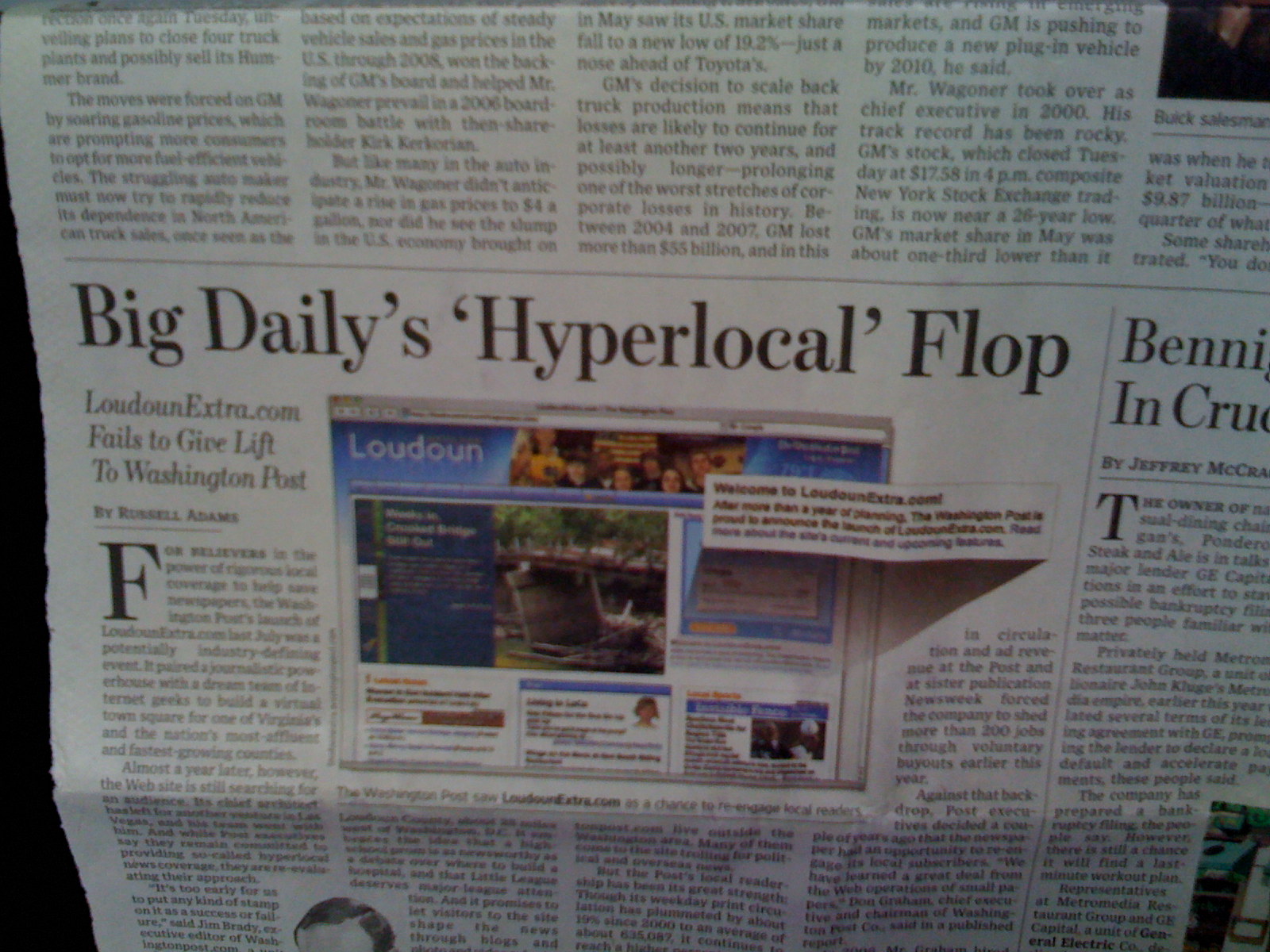
Why should we worry about the death of newspapers?
Reading any newspaper is pretty much a two-dimensional, impersonal, top-down, one-way, and often stupefying experience. News reports are infuriatingly self-referential and incomplete. If they stir us up they don’t give us any place to go. Is this civic engagement? The endless stream of revelations and problems, celebrities and disasters, seems disconnected from our own personal choices and public solutions. Too often, newspaper readers feel like “passengers in the back seat of the car, howling at the driver,” as MIT Prof. William Uricchio once put it.
Now we, the public, can be the drivers in a three-D world, with enticing participatory media that are upending power relationships, changing the links between user emotion and action, creating and engaging communities, providing platforms for people to do things for each other, and allowing a new sense of public space. We get more information than we can use, including original documents and expert opinions. We can all be prod-users: publishing our news to the world through Twitter, Facebook, YouTube and a wealth of cellphone tools that allow us to collect, geotrack, prioritize, keep and spread stories, pictures, videos and images.
These tools enable people not just to have more fun, but to contribute to political campaigns, bear witness to official misconduct, arrange meet-ups to deal with local problems, crunch and visualize data, and write rough drafts of history for public resources like Wikipedia. If watching television disengaged people from community, as Harvard political scientist Robert Putnam asserted in his famous “Bowling Alone” study, new media technologies are drawing us together with extraordinary results.
So why don’t we wash all that ink off our hands for good?
We certainly can give up the ink and paper format. But we are suicidal idiots if we give up the professional service that newspapers provide. Newspaper journalism is the foundation of the watchdog news chain. The best newspaper journalists have our back and work on our behalf to sort out what’s true and publicly relevant, whether they or their advertisers like it or not. That is what they mean by “objectivity.”
Good independent journalism is hard to do. It costs money. It also requires a popular culture that supports unpopular questions and answers. It asks citizens to live in the real world and care about what is factually true. It requires a support structure based on something other than the voyeur pornography of violence, sex and celebrity.
At their best, newspapers provide what Alex Jones calls the “iron core” of news, the honest, time-consuming effort by paid professionals to hold the powerful accountable. Television and radio newscasts, Google news, Jon Stewart, Rush Limbaugh, and the people who run the world still depend to a large extent on the flow of facts and assertions vetted, organized and prioritized by newspaper journalists. Internet advertising without subscription fees cannot finance “iron core” journalism. So newspapers, even as they adapt to the web and cell phone platforms, are going bankrupt and journalists are losing their jobs.
Technology is not the sole culprit. Neither journalists nor the public have adequately differentiated good journalism from bad, nor defended newspapers when they have been under attack from self-interested ideologues. It has been increasingly hard for news organizations to resist offering simply whatever the public wants, instead of fighting for what the attentive citizen needs to know. Journalists too often have abandoned the qualities that made them both controversial and essential.
For new business models to work, journalists need to provide news services of unique value and promote their credo as effectively as the critics have attacked it. Media literacy training should be part of basic education for everyone, as power and responsibility for evaluating the news moves from the elite to the street. Technology alone didn’t destroy journalism, but a thoughtful use of digital and participatory media can help save it. We need to build and organize fan groups for real journalism and turn that support into sustenance.
The smartest digital entrepreneurs understand the continued importance of good journalism. Despite our information overload, vital news and information is deliberately hidden—as prize-winning newspaper and magazine exposes of corruption, torture, spying on citizens, and other issues, continue to teach us. We need someone with clout to hold propaganda creators accountable, while being accountable themselves. We know where to find these journalists if they mess up. In contrast, we can’t expect the evanescent and sometimes anonymous virtual digital folks who volunteer their pieces of information, to provide the consistent, influential flow of relevant, verified news that people require every day in a democracy.
We need a common picture of the real world that we cohabit today, if we are going to work together to build the future. Without professional journalists in the mix, we are tempted to travel only the streets we already know, mirroring ourselves with our media choices, rather than facing unwelcome facts. That is why we need to save newspapers—or at least the journalism they can provide. They help us demand the best from the powerful, and from ourselves.
Originally published in Newsday, December 2009.