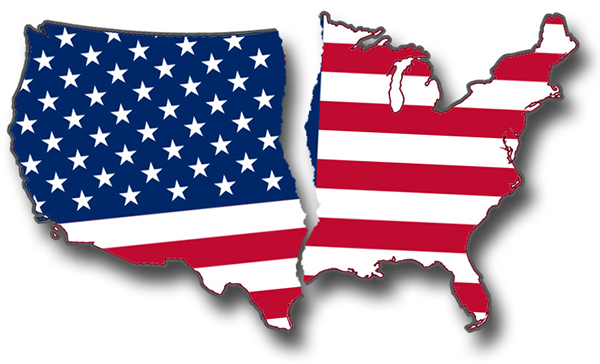
I write to you in a spirit of respect and cooperation. We are all Americans, and I think it is better for our country if we can try to work together. Abraham Lincoln was quoting the Bible when he said a house divided against itself cannot stand. The letter below reflects my recent trip across the country–see the “road trip” section of this website— included meeting different Americans of all kinds, and listening carefully to them.
I listen to Hannity on Fox and the other pro-Trump pundits on Fox, Medium, etc. and am alarmed at how off the mark they are. Their descriptions of Democrats, Hillary voters, the media, and “libtards” are simply bizarre. Do they care that they are getting this so wrong?
Why is it that Hannity finds Trump perfect in every way, and changes the subject to Hillary Clinton if any question about Trump is raised? This seems fishy to me. On the other hand, on MSNBC and CNN, there seems nothing that Trump can do right, offending my conservative friends who want Trump to succeed.
Before the 2016 election, the mainstream media and the Democrats failed to understand how angry and conservative many Americans were. Polls show that most Trump voters don’t love everything about him (despite Hannity), but they want to stand by him as a warrior for their economic and cultural issues. By excusing every sin he commits, the people showing up at Trump rallies are acting more like a cult than a smart group of citizens. No politician deserves this fervent level of uncritical support.
It’s time to get past the labels to something more authentic. Here is my try at respectfully understanding Trump’s supporters:
I don’t think you are “stupid” for supporting Donald Trump. I respect that there are issues you want him to push.
The Democrats haven’t offered you the solutions you want or the candidates you trust.
Trump is a warrior who seems to care about the “little guy,” who has been pushed around.
If he is shaking up the Establishment, it’s okay with you. You don’t think the Establishment powers (political parties, the media, Wall Street, government, etc.) have been on your side.
Trump seems fearless, rather than beholden to money interests or traditional political allies. You like that he is rich and think that he can therefore be more “independent” from special interests.
Some of you believe that Hillary Clinton was dishonest, and endangered American security with her email server. You think that this is worse, or equal to, anything Trump is accused of doing.
Some of you feel that immigrants are getting a better break than you are. That goes for minorities, too. You think they are getting unfair advantages, provided by “liberals.”
Some of you are unhappy with the way Hollywood, the mainstream media, and global culture have overwhelmed old-fashioned values of marriage and gender.
You see global trade deals as hurting American jobs and sovereignty. It’s time to cancel those alliances and build a wall at the border. Same thing for military alliances—other countries should bear more of the burden of defense and not sponge off the USA.
You believe liberals want you to feel guilty. You want to feel proud.
You believe liberals want to take away your freedoms, and give the government way too much power.
You believe government should get out of the way, and let business do its business. This is how you get jobs and make America great again.
You love it when Trump berates the media and the Establishment. You think the media are out to make money and promote a liberal agenda. The Establishment doesn’t do anything for you.
Do I have it about right?
Now let me describe my side. Please try to keep an open mind. It is an honest effort.
Some of us are as frustrated as you are, about some of the same issues. We think there are different causes and solutions.
We think there is way too much money in politics. The Supreme Court decision that money is “free speech” was nuts.
We know that while American business is the heart of creating jobs, it’s main focus is making a profit for its investors, not the welfare of its employees or our nation.
Unlike business, government is set up to represent and serve the American people, not make money. It’s not perfect, but it’s better than the alternatives. That is why we all have to contribute by paying taxes and keeping a close watch on the government.
We understand that the mainstream media are not perfect either, but good reporters are actually trying to check the facts for us and hold the powerful accountable. (Did you know that the New York Times’ Jeff Gerth actually started the Whitewater investigations, that led ultimately to the impeachment of Democratic President Bill Clinton? Ask yourself: why would the New York Times do that if they are just a “liberal bias” news organization?)
Liberals are not about feeling “guilty.” They are about being generous. They draw on a powerful religious tradition of caring for the weak, the poor, and the stranger at the door.
Liberals care about fairness. They recognize that all people, including minorities and majority white people, together make America great, with their blood, sweat and tears. If you think minorities are getting unfair advantages, try walking in their shoes for a day. You’ll see the reality of what is unfair!
We do not see being gay as a “lifestyle choice” that threatens anyone or any religion. It is a physical fact. We do not see gender orientation, religion, poverty or ethnic background as sins. We see hatred and discrimination as sins.
We are not afraid of immigrants. We find compelling evidence that today’s immigrants are contributing more to our country than they are taking away. How do we know this? We look at the actual economic data. We respect that immigrant ancestors helped build America. However, we do believe America’s borders should be secure and immigrants should go through a process.
We want everyone to have a job. We are on the side of anyone who is doing the best they can to survive economically and make America great, including every American worker struggling to make a decent living.
We want America to be the land of opportunity. We don’t want regulations to strangle the economy. But we want safe air, food, water and streets. To pay for this, we support reasonable taxes and fair government regulations.
We don’t like “welfare queens” but see that this is largely a myth created by politicians. We see many poor people working at jobs that don’t pay enough to support their families.
We would like a fairer tax system, rather than one that simply allows the rich to get richer while starving our public treasury.
We do not believe in “political correctness.” We believe in being “polite” and “respectful.” We are dismayed that some think it’s okay to call people slurs and ugly names, charging that people with better manners are “politically correct.”
We don’t think Obamacare has worked perfectly, but we believe that the private health marketplace was worse. We want everyone to be able to afford health care. We want to have our pre-existing conditions and adult children covered by health insurance. We don’t see this happening under the Trump-backed GOP proposals.
We know that those who work for the American government are essential to our nation’s safety and prosperity. We honor their service, whether they are in the military or a civilian job.
Our public spaces—including our national parks—are sacred and should not be plundered for the profit of a few. Trump is privatizing some of our public lands and offering them for sale to big business.
We are determined that our political leaders should follow the law, no matter what office they hold or what party they represent.
We are appalled by Donald Trump. It is not because we disrespect you, or think your concerns should be ignored. It is because:
We think Trump is a corrupt politician who wants to useyou to build up his ego and his bank account. How do we know this? Check out his past bankruptcies, his failure to pay his bills, the way his family businesses are now using government to make more money. Don’t just take the media’s word for it, look at where they got it: in public court records.
We think Trump is way over his head, and has no idea what he is doing. This is why he changes his mind and flip-flops what he says from one minute to the next. Ask Tony Schwartz, the man who co-wrote Trump’s book, “The Art of the Deal.” He thinks Trump is dangerously unstable.
We think Trump’s deal-maker personality is fake, a character made up for his TV show. How do we know this? We see him being outplayed by Vladimir Putin, Xi Jinping, Kim Jung Un, and Benjamin Netanyahu on the world stage.
We do not believe Trump has your back or is working in an effective way to help “the little guy.” For every American business that may have benefitted in the short run from his trade war, he has hurt as many or more American workers in another industry. How do we know this? Check out the actual economic data, including for example, the losses to American soybean farmers, Harley Davidson motorcycles, and metal nail manufacturers.
We see Trump creating the swamp of corrupt people in his administration who want to use our tax dollars to make themselves feel good and get richer. The many examples of his Cabinet’s first-class vacation travel, business contracts and other sleazy practices on the taxpayer’s dollar are unprecedented in the modern era.
We see our freedoms disappearing fast under Trump. Except for the military, he has attacked literally all the checks and balances on his power: law enforcement, intelligence experts, the courts, the media, independent agencies, independent political officials, international allies and respected experts.
He claims to be against big government but he supports the GOP platform directing the government to regulate how women deal with their bodies, ending their basic freedom to decide whether or not to have children.
Trump is about the past, not the future. Trump is promising you that American will return to a world that is long gone, or never existed, instead of helping us all take advantage of new opportunities. Example: solar energy instead of coal mines. If America goes backward, instead of forward, someone else—China?—will dominate the new global economy.
Hillary Clinton’s private email server, and questionable Clinton Foundation donations, are disappointing. But they are minor in comparison to the security breaches and corruption we see in Donald Trump’s administration. So far, the highest US legal authorities agree that Clinton’s so-called “crimes” were not crimes. Yet Trump and Fox pundits always change the subject to Hillary Clinton. She has been off the stage for two years! Are they still trying to discredit her because they are insecure about the 2016 election results?
For criminal activity, let’s take a look at how Trump and his friends are making money off the presidency! Example: The Saudi government’s use of Trump hotels since he became president. China giving Trump business patents that they previously denied before he became President.
The Russia problem is real. The probe is not a witch hunt, but a matter of the utmost US national security. If the President is not willing to protect us against Vladimir Putin’s cyber attacks, for whatever reason, this is dangerous weakness that puts our country at risk, and may even be treason.
Thank you for listening. We need to find ways to hear each other, and compromise, because a united country is a strong country. That is the only way we will ever make America great again.
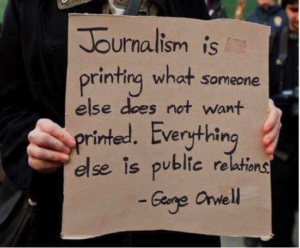
Journalism has never been as easy as it looks. One day in 1940s, Los Angeles newspaper reporters were riveted by a report that came crackling over the police radio. A headless torso had just been found outside the city, in a gravel pit! Competing reporters from the Los Angeles Times and Los Angeles Herald Express both raced to the scene of the crime, each trying to overtake the other’s car on the back roads. Once each had gotten a photo and grabbed a few details from the police, they jumped back in their cars and raced the nearest farmhouse—the only place for miles that might have a telephone. The Herald got there first. He persuaded the farmer to let him use the phone, and called in all the lurid details to his city desk—while the Times man furiously waited his turn. The Herald man finally wrapped up the call and handed his rival the telephone receiver—after grabbing a pair of kitchen scissors and deftly cutting the cord.
Thus the Herald would have its special edition on the streets well before the Times, grabbing that day’s audience and therefore, more money from street sales. Advertisers would be happy to have more eyeballs for their wares.
The story may be apocryphal—it was told to me when I was working the night shift at the Los Angeles Times in the 1970s. But it certainly illustrates how competitive journalists have always been with each other. Dedicated to that tradition myself, I confess that I carried a special lock in my purse to lock up the rotary dial on the pay phone outside the Sheriff’s office, so I could scoop my colleagues during the sensational Chowchilla kidnapping case in 1976.
Those days are long gone, not just because there are cell phones now. The business model for journalism is famously broken because everyone can be a journalist, using the Internet and mobile apps to broadcast their stories. How many people notice who publishes the story first? What matters now is who gets to attach advertising to it, and how popular it is with viewers who might be halfway across the world.
FIRST: THE BAD NEWS New models are emerging. Huffington Post was built by taking other people’s content, repackaging it as a news feed, and selling ads for itself on that package of freeloaded content. (Facebook and Google do this better than any news organization; tailoring ads to each user with automated data gathering and pairing software.) It’s a miracle now if anyone is ever held accountable for whether a story’s content is true or not. A story that is passed around on social media is unmoored from its origins, its time and place. You can’t go down to the Internet’s headquarters and demand a correction. Have we reached the point yet, with the Comet Ping Pong Pizza shooting, that we are finally ready to instill media literacy at all levels of our educational curriculum?
The problem is that fake news is almost always more interesting than real news. Jim Rutenberg of the NYT calls for “some sort of hyperfactual counterinsurgency that treats every false meme as a baby Hitler to be killed in its crib with irrefutable facts.”
Facebook is working with fact checking organizations like PolitiFact to make it easy to mark articles as “suspect” before they are reposted, after a study showed that more fake news than real news was shared among Facebook users. Google says it is going to cut off known purveyors of fake news (like The Angry Patriot) from using their advertising network tools.
This could help, since Google and Facebook are the biggest publishing platforms today. They get 85% of every online advertising dollar, and most of the fake new producers are spreading it as clickbait for money.
To be absolutely clear: Fake news is not the same as biased or sloppy journalism, it is something entirely different. It is propaganda that wants to sell you something, without regard to whether it is true. Journalism is something quite different.
Media analyst Tom Rosenstiel asserts that we have reached a new level with the elevation of Breitbart’s Bannon and the Russian propaganda of the 2016 election. Rosenstiel says: “The goal of fake news is not to make people believe the lie. It is to make them doubt all news.”
How can we get back to having facts matter? We all know journalists in a democracy actually have a serious job to do– in between the body-in-gravel-pit stories.
Someone needs to hold the powerful accountable, and while citizen journalism has become very important, our news flow needs to be less random than the videos people take with their cellphones when something happens nearby.
When the digital revolution hit, journalists were already losing their mojo. The Kennedy School’s Tom Patterson has mapped for years how the negativity of journalism norms has turned off voters. What journalists have done to destroy their own credibility is a whole separate blog for another day. I have been writing for the past 25 years about this.
ATTACKS ON “THE MEDIA” The enabling environment for journalism– to speak truth to power–has been disappearing. The elite media have been weakened by their own arrogance, insularity and imperfections. But do not underestimate the power of anti-media campaigns by Nixon’s clever media consigliore Roger Ailes, who reinvented propaganda as “news” on Fox, along with Reagan’s Mike Deaver and Pat Buchanan, and George W. Bush’s Karl Rove. And now President Trump and his minions declare that the news media are the “enemies of the American people.”
Alas, too many Americans believe them. Part of this is a lack of understanding of who the “media” are—from the New York Times to the gutter lies of Breitbart. There is almost universal public cynicism now about the motives of journalists, without an understanding of how real journalists work, and why. For every “Spotlight” there has been an “Absence of Malice” portraying journalists as immoral hacks.
It hasn’t just been the Republicans who have found it convenient to undermine the critical press. There were also constant attacks from the left by Noam Chomsky and others, who made careers out of denigrating journalism as capitalist propaganda. Chomsky has no idea of how journalists actually do their work—I doubt he has ever spent any time watching what happens in an American newsroom. But he has a global following for his critique, fitting into preconceived prejudices just like the Alt-Right.
Traditional journalism culture dictated that journalists weren’t supposed to be the story. So there has been no journalism p.r. campaign to counteract these negative narratives, as they gained traction from Nixon to Chomsky and Trump. Ever since the 1980s, it has been fashionable to blame “the media” for virtually everything.
What should journalists do now? How can they present serious news about climate change, and other contentious issues, when they’re competing with comedians and Macedonian fake news bloggers and a combative, tweeting President who holds them captive with every single news cycle?
The Internet may have ruined journalism’s business model and empowered fake news, but is also making possible some exciting new watchdog capacities. I am not arguing that this will solve all of the media’s problems–but I do think there is hope.
Let’s talk about the most important, expensive, controversial and difficult form of journalism. investigative journalism. Real investigative journalism isn’t about listening to police radios and racing to the gravel pit. If you saw Spotlight, about the Boston Globe’s investigation of the Catholic Church’s hidden sex scandal, you know how time consuming, expensive and difficult it can be.
Investigative journalists are the special forces of journalism. They are detectives, doing systematic, in-depth, original research and reporting, relying largely on primary sources, including public records and eyewitnesses. They are focused on social justice, corruption and accountability. Usually what they are unearthing has been kept secret.
To be clear: Julian Assange, Chelsea Manning and Edward Snowden are not journalists. But leaks from people like them are the raw material, one of the things an investigative journalist might start with. Everything has to be checked out, especially if it’s coming from Assange.
AND FINALLY: THE GOOD NEWS Today’s investigative journalists are using sophisticated data analysis tools and drones to document things like the destruction and capture of public lands in the rain forests of South America. Increasingly, these journalists must be skilled in data crunching and forensic Internet exploration. Not only do we have these massive leaks–made possible by digital technologies–but we now have crowd-sourcing, which invites the public to join the hunt.
David Fahrenthold of the Washington Post provides a great example of how this works. His investigative journalism coup was possible only because of the new collaborative journalism in place today.
Farenthold got a tip at 10 a.m. one morning that there was a portrait of then GOP candidate Donald Trump, paid for by the Trump Foundation, hanging in one of Trump’s luxury resorts. He used Google to figure out what the portrait looked like, and then asked his Twitter followers if they knew where the picture might be. By 8 p.m., one of Fahrenthold’s Miami followers found the portrait among 385 guest photos posted on the TripAdvisor page for Trump’s Doral Country Club in Miami.
But Fahrentold needed to confirm the portrait, which the Trump Foundation had bought for $10,000, was still there. He asked his Twitter followers to help. Enrique Acevedo, a Univision anchor in Miami, booked into a room at the Doral club after finishing work at midnight. He wandered the grounds, asking housekeeping and maintenance crews if they had seen it. They led him into the club’s Champions Bar and Grill, where Acevedo found the portrait, took a picture and tweeted it to Fahrenthold.
Farenthold told Terry Gross on NPR’s “Fresh Air,” “Unless the Champions Bar and Grill was used as a soup kitchen in its off hours” the Trump Foundation and Trump’s Doral Club had violated the law.
While President Trump hasn’t paid a political price yet for Fahrenthold’s expose, The Washington Post reporter’s work is only a small part of what is happening out there with investigative journalism.
Until recently, there were essentially three models of investigative journalism:
investigative reporters at established news organizations, like Fahrentold at the Post, and the Globe’s Spotlight team.
independently-funded strike teams who partner with mainstream media to get their investigations published, like ProPublica’s relationship with the New York Times.
an increasing number of independent nonprofit organizations that publish entirely on their own, like Direkt36 in Hungary.
This brings us to the fourth and newest model of investigative journalism—which is the centerpiece of my research. Over 145 nonprofit investigative journalism groups from every region in the world have banded together as a uniquely powerful, worldwide network of investigative journalists. What is amazing is when journalists like this work together on the same story as part of the same story.
Here is how the network model works:
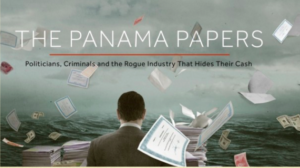
The Panama Papers was the biggest leak in history, far larger than the top-secret Edward Snowden files or the Wikileaks State Department cables. This was a leak of 11.5 million documents, 2.6 terabytes of information. The offer was sent by email in April 2015 to a single Munich newspaper reporter named Bastian Obermayer. The anonymous source wanted to expose criminal wrongdoing. Obermayer and the source set up an encrypted transfer system. The data sent to Suddeutsche Zeitung included confidential materials, covering 40 years of work by one Panama law firm, Mossack Fonseca.
Obermayer realized he couldn’t even begin go through all these documents himself. It included the records of 214,000 offshore companies, the names of real owners, and passport scans. There were bank statements and email chains.
The illegal activities hidden in these documents seemed to involve powerful people in many countries. So Obermayer contacted the International Center for Investigative Journalism in Washington. They assembled a global team that eventually swelled to 400 investigative journalists from 70 countries, all working secretly on the Panama Papers data, with an agreed simultaneous publication date a year later–in April 2016.
In addition to being a team of sometime rivals, this journalism network was remarkable because it was decentralized, rather than controlled in a single place by a single news organization. (Alas, ISIS also seems to work this way.) With Panama Papers, everyone published their own stories in their own publications, using their own resources and editing practices, but with the same Panama Papers logo, and at the same time.
A NEW COLLABORATIVE CULTURE What this kind of networked undertaking requires was a new journalism culture, a collaborative model. It is the opposite of that 1940s race to the farmhouse, where a rival cut the phone cord to weaken his colleague. Collaboration—not competition– might be the key to the future of journalism in the Trump era.
To do the Panama Papers project, the International Center for Investigative Journalism developed new digital tools. They created their own private Facebook-like social network platform called iHub where participating journalists could all look at the data, discuss it and share new information in a protected, encrypted, members-only space. They adapted the dating app Tinder…to help journalists select which reporting partners they were willing to work with.
Third, they used library software, so the reporters could easily search for names, countries, etc. To access the material, they had security measures like phone authenticators that generated a new code every 30 seconds.
The human social factors in this project were as important—maybe more important—than the technical tools. ICIJ was able to find reporters from far-flung places, who decided to trust each other, because they met at annual face-to-face training conferences in places like Rio de Janeiro, Kathmandu and Lillehammer.
IMPACT During Watergate, The Washington Post languished alone its reporting for weeks before other media picked it up and amplified it at the national level. And that was during the golden age of media power in the US:
Today’s collaborative, network model is more powerful in several ways:
—It creates more security for the reporters, since everyone is reporting the same thing. As one veteran journalist said, with the new networked model, “If you kill one of us, 40 will take our place. If you kill 40 of us, 400 will take our place.” And it also creates local impact! By being published simultaneously all over the world under one big umbrella title, the local Panama Papers exposes couldn’t be ignored as easily at home.
—The Panama Papers project exposed the offshore holdings involving people in 200 countries, including 12 current and former world leaders.
—It revealed how associates of Russian President Vladimir Putin secretly shuffled as much as $2 billion through banks and shadow companies. He called the expose “a western spy plot.”
—U.K. leader David Cameron had urged his country’s overseas territories — including the British Virgin Islands — to work with him in 2013 to fight against tax evasion and offshore secrecy. It turned out his late father Ian Cameron, a wealthy stockbroker, was a Mossack Fonseca client who used the law firm to shield his investment fund, from U.K. taxes.
Icelandic Prime Minister Sigmundur Davíð Gunnlaugsson had to resign when documents were presented showing he had lied about his offshore business.
The files revealed offshore companies linked to the family of China’s top leader, Xi Jinping, who had vowed to fight “armies of corruption,”
And there were offshore companies linked to Ukraine’s current president, Petro Poroshenko, who positioned himself as a reformer in a country shaken by previous corruption scandals
There were massive demonstrations in Argentina about revelations there.
In Azerbaijan a small war was initiated which some believed was designed to distract from revelations featuring the president and his daughters.
Spain’s minister of industry resigned.
As a result of the Panama Papers scandal five European nations have now agreed to share tax and law enforcement data. The agreement includes the United Kingdom, Germany, France, Italy and Spain.
The Panama Papers documents continue to be used for new stories all the time, and new data dumps are engaging some parts of the team. Perhaps Trump will show up in some of these new documents.
WHAT IT TAKES
The new model is powerful, but it does cost money. So far, these nonprofit investigative journalism ventures are funded by local philanthropies and global foundations like Soros, Ford, Omidyar, Gates and others, along with wealthy individuals like the Sandlers in the USA, who established ProPublica.
Prof. Hamilton estimates that every $1 spent on investigative journalism in the US nets about $100 in public goods. Some of us are working on the idea of an international trust fund, run by journalists and scholars, which would use some of the funds recovered– thanks to the journalists’ corruption investigations–to finance new journalism projects. Such a qui tam fund exists to reward lawyers who recover money for the US government under the Federal Foreign Tort Claims Act. They get a percentage of the proceeds. I won’t dwell on the complications of setting this up to ensure it doesn’t skew and bias the journalism. But it is one of the things we are looking at.
LESSONS LEARNED
So what lessons can we take from this Panama Papers network model to help the journalists covering the Trump Administration?
First, Journalists should double down on doing their core job. Continue to offer verified facts, transparently presented.
But be wary about what battles to pick. Keep things in proportion, in context. The watchdog that barks at everything loses his bite.
Journalists need to keep their cool. It feels good to liberals when the New York Times says Trump is “lying” but this has to meet a difficult standard of intentionality, as NPR Vice President Mike Oreskes points out. Otherwise it is a falsehood or misstatement. If the media match the hysteria of Trump they will lose their impact, because he can make things up and they can’t.
How investigative journalism fares in the US in the next few years may depend on people like us to support it financially and take the time to insist, through whatever means we have, that the facts do matter. This enabling environment for journalism will determine whether or not the facts matter on the ground.
And it would help if journalists apply the Panama Papers’ collaborative culture to their work in the United States.
Bastian Obermayer, the German reporter who first got the Panama Papers leak, has this advice for American journalists:
—“A new level of solidarity and cooperation is needed among the fourth estate. American journalists should stop Trump from dividing their ranks, ” he says.
The next time Trump or his surrogates single out any reporter, or don’t answer a question, “the next reporter who’s allowed to speak should simply repeat the question of the journalist that Trump has snubbed,” Obermayer says. If Trump snubs this second reporter, the next one called on should continue to repeat the original question that the Trump Administration has refused to answer.
Obermayer even suggests that a news organization with a scoop should join forces with rival publications to find missing pieces of the puzzle. “It has always been the noblest job of the journalist to check the power of the government, the center of power. This seems even more important as the president acts like one of the oligarchs that journalists, like us, investigate,” he says. Obermayer concludes that since Trump has decided to go down this hostile path, “it is time for us (journalists) to change our path too. That’s no only fair—it is absolutely necessary.”
*This post is adapted from my February 2017 presentation to the American Academy of Arts and Sciences, and my recent evaluation of the Global Investigative Journalism Network (GIJN) for the Adessium Foundation. I would like to thank especially David Kaplan, Anya Schiffrin, Ethan Zuckerman, James Hamilton, Tom Rosenstiel, Brant Houston and Bruce Shapiro for educating me about the new world of networked investigative journalism.


 We are appalled by Donald Trump. It is not because we disrespect you, or think your concerns should be ignored. It is because:
 Journalism has never been as easy as it looks. One day in 1940s, Los Angeles newspaper reporters were riveted by a report that came crackling over the police radio. A headless torso had just been found outside the city, in a gravel pit! Competing reporters from the Los Angeles Times and Los Angeles Herald Express both raced to the scene of the crime, each trying to overtake the other’s car on the back roads. Once each had gotten a photo and grabbed a few details from the police, they jumped back in their cars and raced the nearest farmhouse—the only place for miles that might have a telephone. The Herald got there first. He persuaded the farmer to let him use the phone, and called in all the lurid details to his city desk—while the Times man furiously waited his turn. The Herald man finally wrapped up the call and handed his rival the telephone receiver—after grabbing a pair of kitchen scissors and deftly cutting the cord.
 Investigative journalists are the special forces of journalism. They are detectives, doing systematic, in-depth, original research and reporting, relying largely on primary sources, including public records and eyewitnesses. They are focused on social justice, corruption and accountability. Usually what they are unearthing has been kept secret.
 The
The